Fusion Length Requiring Spinopelvic Fixation in Lumbosacral Fusion with Anterior Column Support at L5-S1: Assessment of Fusion Status Using Computed Tomography.
Sung Cheol Park, Sangjun Park, Do-Hyung Lee, Jinew Seo, Jae Hyuk Yang, Min-Seok Kang, Yunjin Nam, Seung Woo Suh
{"title":"Fusion Length Requiring Spinopelvic Fixation in Lumbosacral Fusion with Anterior Column Support at L5-S1: Assessment of Fusion Status Using Computed Tomography.","authors":"Sung Cheol Park, Sangjun Park, Do-Hyung Lee, Jinew Seo, Jae Hyuk Yang, Min-Seok Kang, Yunjin Nam, Seung Woo Suh","doi":"10.4055/cios23183","DOIUrl":null,"url":null,"abstract":"<p><strong>Background: </strong>The lumbosacral (LS) junction has a higher nonunion rate than other lumbar segments, especially in long-level fusion. Nonunion at L5-S1 would result in low back pain, spinal imbalance, and poor surgical outcomes. Although anterior column support at L5-S1 has been recommended to prevent nonunion in long-level LS fusion, fusion length requiring additional spinopelvic fixation (SPF) in LS fusion with anterior column support at L5-S1 has not been evaluated thoroughly. This study aimed to determine the number of fused levels requiring SPF in LS fusion with anterior column support at L5-S1 by assessing the interbody fusion status using computed tomography (CT) depending on the fusion length.</p><p><strong>Methods: </strong>Patients who underwent instrumented LS fusion with L5-S1 interbody fusion without additional augmentation and CT > 1 year postoperatively were included. The fusion rates were assessed based on the number of fused segments. Patients were divided into two groups depending on the L5-S1 interbody fusion status: those with union vs. those with nonunion. Binary logistic regression analyses were performed to identify risk factors for LS junctional nonunion.</p><p><strong>Results: </strong>Fusion rates of L5-S1 interbody fusion were 94.9%, 90.3%, 80.0%, 50.0%, 52.6%, and 43.5% for fusion of 1, 2, 3, 4, 5, and ≥ 6 levels, respectively. The number of spinal levels fused ≥ 4 (<i>p</i> < 0.001), low preoperative bone mineral density (BMD; adjusted odds ratio [aOR], 0.667; <i>p</i> = 0.035), and postoperative pelvic incidence (PI) - lumbar lordosis (LL) mismatch (aOR, 1.034; <i>p</i> = 0.040) were identified as significant risk factors for nonunion of L5-S1 interbody fusion according to the multivariate logistic regression analysis.</p><p><strong>Conclusions: </strong>Exhibiting ≥ 4 fused spinal levels, low preoperative BMD, and large postoperative PI-LL mismatch were identified as independent risk factors for nonunion of anterior column support at L5-S1 in LS fusion without additional fixation. Therefore, SPF should be considered in LS fusion extending to or above L2 to prevent LS junctional nonunion.</p>","PeriodicalId":47648,"journal":{"name":"Clinics in Orthopedic Surgery","volume":"16 1","pages":"86-94"},"PeriodicalIF":2.0000,"publicationDate":"2024-02-01","publicationTypes":"Journal Article","fieldsOfStudy":null,"isOpenAccess":false,"openAccessPdf":"https://www.ncbi.nlm.nih.gov/pmc/articles/PMC10825249/pdf/","citationCount":"0","resultStr":null,"platform":"Semanticscholar","paperid":null,"PeriodicalName":"Clinics in Orthopedic Surgery","FirstCategoryId":"3","ListUrlMain":"https://doi.org/10.4055/cios23183","RegionNum":2,"RegionCategory":"医学","ArticlePicture":[],"TitleCN":null,"AbstractTextCN":null,"PMCID":null,"EPubDate":"2024/1/15 0:00:00","PubModel":"Epub","JCR":"Q2","JCRName":"ORTHOPEDICS","Score":null,"Total":0}
引用次数: 0
Abstract
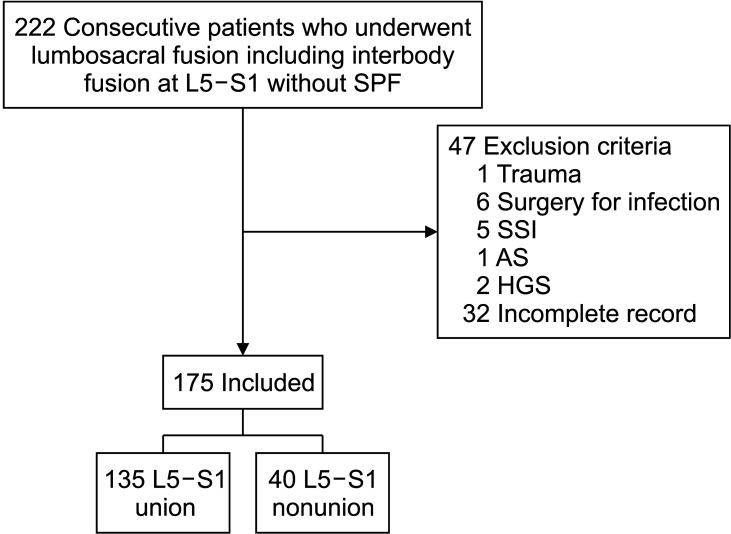
Background: The lumbosacral (LS) junction has a higher nonunion rate than other lumbar segments, especially in long-level fusion. Nonunion at L5-S1 would result in low back pain, spinal imbalance, and poor surgical outcomes. Although anterior column support at L5-S1 has been recommended to prevent nonunion in long-level LS fusion, fusion length requiring additional spinopelvic fixation (SPF) in LS fusion with anterior column support at L5-S1 has not been evaluated thoroughly. This study aimed to determine the number of fused levels requiring SPF in LS fusion with anterior column support at L5-S1 by assessing the interbody fusion status using computed tomography (CT) depending on the fusion length.
Methods: Patients who underwent instrumented LS fusion with L5-S1 interbody fusion without additional augmentation and CT > 1 year postoperatively were included. The fusion rates were assessed based on the number of fused segments. Patients were divided into two groups depending on the L5-S1 interbody fusion status: those with union vs. those with nonunion. Binary logistic regression analyses were performed to identify risk factors for LS junctional nonunion.
Results: Fusion rates of L5-S1 interbody fusion were 94.9%, 90.3%, 80.0%, 50.0%, 52.6%, and 43.5% for fusion of 1, 2, 3, 4, 5, and ≥ 6 levels, respectively. The number of spinal levels fused ≥ 4 (p < 0.001), low preoperative bone mineral density (BMD; adjusted odds ratio [aOR], 0.667; p = 0.035), and postoperative pelvic incidence (PI) - lumbar lordosis (LL) mismatch (aOR, 1.034; p = 0.040) were identified as significant risk factors for nonunion of L5-S1 interbody fusion according to the multivariate logistic regression analysis.
Conclusions: Exhibiting ≥ 4 fused spinal levels, low preoperative BMD, and large postoperative PI-LL mismatch were identified as independent risk factors for nonunion of anterior column support at L5-S1 in LS fusion without additional fixation. Therefore, SPF should be considered in LS fusion extending to or above L2 to prevent LS junctional nonunion.




 京公网安备 11010802042870号
京ICP备2023020795号-1
京公网安备 11010802042870号
京ICP备2023020795号-1

 分享
分享
 求助内容:
求助内容: 应助结果提醒方式:
 扫码关注我们
