Limited Effects of Ultra-low Oxygen Concentration during Extended Embryo Culture on In vitro Fertilisation Outcomes in Indian Women: A Retrospective Cross-sectional Study.
Deven Patel, R G Patel, Trupti Patel, Nikunj Patel, Naroda Maheshwari
{"title":"Limited Effects of Ultra-low Oxygen Concentration during Extended Embryo Culture on <i>In vitro</i> Fertilisation Outcomes in Indian Women: A Retrospective Cross-sectional Study.","authors":"Deven Patel, R G Patel, Trupti Patel, Nikunj Patel, Naroda Maheshwari","doi":"10.4103/jhrs.jhrs_143_23","DOIUrl":null,"url":null,"abstract":"<p><strong>Background: </strong>Amongst various other factors, oxygen (O2) concentration in embryo culture plays an important role in determining pregnancy outcomes in women undergoing in vitro fertilisation. Some studies have reported that lowering O2 levels in embryo culture provides better results.</p><p><strong>Aims: </strong>To explore the effects of low- and ultra-low- O2 concentrations (5% and 2%, respectively) in extended embryo culture on various outcome parameters of pregnancy.</p><p><strong>Settings and design: </strong>This was a retrospective cross-sectional study.</p><p><strong>Materials and methods: </strong>In this study 382 participants had their embryos cultured in varying O2 concentrations (5% or 2%), followed by either a fresh embryo transfer (ET) or frozen embryo transfer (FET). Outcomes such as pregnancy rate, implantation rate, abortion rate, twinning rate, and live birth rate were compared between the groups.</p><p><strong>Statistical analysis used: </strong>Chi square test was applied to compare the primary and secondary outcomes between different groups.</p><p><strong>Results: </strong>No significant differences were observed in pregnancy rate and implantation rate between 5% and 2% O2 groups, irrespective of their mode of ET. The abortion rate was significantly higher in 5% O2 group than in 2% group during FET (24.71% vs. 11.49%, <i>P</i> = 0.02). While the proportion of good-quality embryos was higher in 5% O2 group, these did not translate to better pregnancy outcomes. Additionally, embryos cultured in 2% O2 concentration had a significantly better implantation rate when they were transferred fresh rather than frozen (71.34% vs. 61.46%, <i>P</i> = 0.04). There were no other differences observed.</p><p><strong>Conclusion: </strong>Only marginal benefits were observed in switching human embryos to ultra-low O2 concentration after the initial days of culture.</p>","PeriodicalId":15975,"journal":{"name":"Journal of Human Reproductive Sciences","volume":"16 4","pages":"324-332"},"PeriodicalIF":1.1000,"publicationDate":"2023-10-01","publicationTypes":"Journal Article","fieldsOfStudy":null,"isOpenAccess":false,"openAccessPdf":"https://www.ncbi.nlm.nih.gov/pmc/articles/PMC10841928/pdf/","citationCount":"0","resultStr":null,"platform":"Semanticscholar","paperid":null,"PeriodicalName":"Journal of Human Reproductive Sciences","FirstCategoryId":"1085","ListUrlMain":"https://doi.org/10.4103/jhrs.jhrs_143_23","RegionNum":0,"RegionCategory":null,"ArticlePicture":[],"TitleCN":null,"AbstractTextCN":null,"PMCID":null,"EPubDate":"2023/12/29 0:00:00","PubModel":"Epub","JCR":"Q2","JCRName":"Medicine","Score":null,"Total":0}
引用次数: 0
Abstract
Background: Amongst various other factors, oxygen (O2) concentration in embryo culture plays an important role in determining pregnancy outcomes in women undergoing in vitro fertilisation. Some studies have reported that lowering O2 levels in embryo culture provides better results.
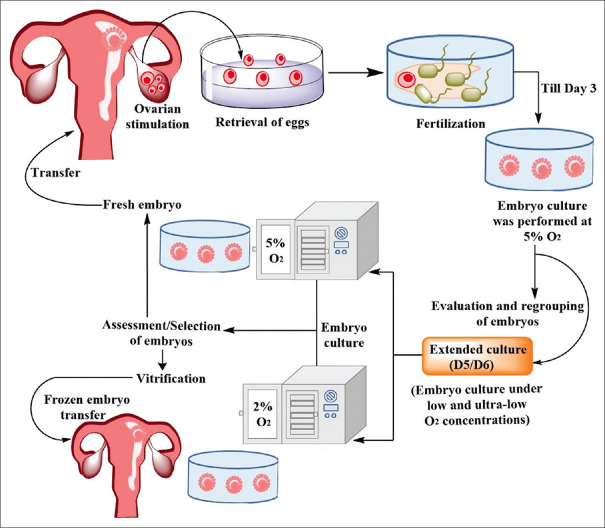
Aims: To explore the effects of low- and ultra-low- O2 concentrations (5% and 2%, respectively) in extended embryo culture on various outcome parameters of pregnancy.
Settings and design: This was a retrospective cross-sectional study.
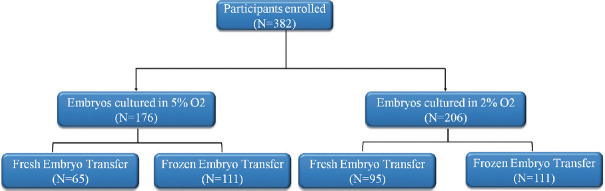
Materials and methods: In this study 382 participants had their embryos cultured in varying O2 concentrations (5% or 2%), followed by either a fresh embryo transfer (ET) or frozen embryo transfer (FET). Outcomes such as pregnancy rate, implantation rate, abortion rate, twinning rate, and live birth rate were compared between the groups.
Statistical analysis used: Chi square test was applied to compare the primary and secondary outcomes between different groups.
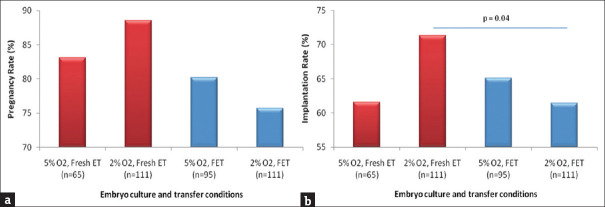
Results: No significant differences were observed in pregnancy rate and implantation rate between 5% and 2% O2 groups, irrespective of their mode of ET. The abortion rate was significantly higher in 5% O2 group than in 2% group during FET (24.71% vs. 11.49%, P = 0.02). While the proportion of good-quality embryos was higher in 5% O2 group, these did not translate to better pregnancy outcomes. Additionally, embryos cultured in 2% O2 concentration had a significantly better implantation rate when they were transferred fresh rather than frozen (71.34% vs. 61.46%, P = 0.04). There were no other differences observed.
Conclusion: Only marginal benefits were observed in switching human embryos to ultra-low O2 concentration after the initial days of culture.
期刊介绍:
The Journal of Human Reproductive Sciences (JHRS) (ISSN:0974-1208) a Quarterly peer-reviewed international journal is being launched in January 2008 under the auspices of Indian Society of Assisted Reproduction. The journal will cover all aspects human reproduction including Andrology, Assisted conception, Endocrinology, Physiology and Pathology, Implantation, Preimplantation Diagnosis, Preimplantation Genetic Diagnosis, Embryology as well as Ethical, Legal and Social issues. The journal will publish peer-reviewed original research papers, case reports, systematic reviews, meta-analysis, and debates.




 京公网安备 11010802042870号
京ICP备2023020795号-1
京公网安备 11010802042870号
京ICP备2023020795号-1

 分享
分享
 求助内容:
求助内容: 应助结果提醒方式:
 扫码关注我们
