Accuracy of artificial intelligence-assisted growth prediction in skeletal Class I preadolescent patients using serial lateral cephalograms for a 2-year growth interval

IF 1.7 3区 医学 Q2 DENTISTRY, ORAL SURGERY & MEDICINE Orthodontics & Craniofacial Research Pub Date : 2024-02-06 DOI:10.1111/ocr.12764
A. Larkin, J.-S. Kim, N. Kim, S.-H. Baek, S. Yamada, K. Park, K. Tai, Y. Yanagi, J. H. Park
{"title":"Accuracy of artificial intelligence-assisted growth prediction in skeletal Class I preadolescent patients using serial lateral cephalograms for a 2-year growth interval","authors":"A. Larkin,&nbsp;J.-S. Kim,&nbsp;N. Kim,&nbsp;S.-H. Baek,&nbsp;S. Yamada,&nbsp;K. Park,&nbsp;K. Tai,&nbsp;Y. Yanagi,&nbsp;J. H. Park","doi":"10.1111/ocr.12764","DOIUrl":null,"url":null,"abstract":"<div>\n \n \n <section>\n \n <h3> Objective</h3>\n \n <p>To investigate the accuracy of artificial intelligence-assisted growth prediction using a convolutional neural network (CNN) algorithm and longitudinal lateral cephalograms (Lat-cephs).</p>\n </section>\n \n <section>\n \n <h3> Materials and Methods</h3>\n \n <p>A total of 198 Japanese preadolescent children, who had skeletal Class I malocclusion and whose Lat-cephs were available at age 8 years (T0) and 10 years (T1), were allocated into the training, validation, and test phases (n = 161, n = 17, n = 20). Orthodontists and the CNN model identified 28 hard-tissue landmarks (HTL) and 19 soft-tissue landmarks (STL). The mean prediction error values were defined as ‘excellent,’ ‘very good,’ ‘good,’ ‘acceptable,’ and ‘unsatisfactory’ (criteria: 0.5 mm, 1.0 mm, 1.5 mm, and 2.0 mm, respectively). The degree of accurate prediction percentage (APP) was defined as ‘very high,’ ‘high,’ ‘medium,’ and ‘low’ (criteria: 90%, 70%, and 50%, respectively) according to the percentage of subjects that showed the error range within 1.5 mm.</p>\n </section>\n \n <section>\n \n <h3> Results</h3>\n \n <p>All HTLs showed acceptable-to-excellent mean PE values, while the STLs Pog’, Gn’, and Me’ showed unsatisfactory values, and the rest showed good-to-acceptable values. Regarding the degree of APP, HTLs Ba, ramus posterior, Pm, Pog, B-point, Me, and mandibular first molar root apex exhibited low APPs. The STLs labrale superius, lower embrasure, lower lip, point of lower profile, B′, Pog,’ Gn’ and Me’ also exhibited low APPs. The remainder of HTLs and STLs showed medium-to-very high APPs.</p>\n </section>\n \n <section>\n \n <h3> Conclusion</h3>\n \n <p>Despite the possibility of using the CNN model to predict growth, further studies are needed to improve the prediction accuracy in HTLs and STLs of the chin area.</p>\n </section>\n </div>","PeriodicalId":19652,"journal":{"name":"Orthodontics & Craniofacial Research","volume":"27 4","pages":"535-543"},"PeriodicalIF":1.7000,"publicationDate":"2024-02-06","publicationTypes":"Journal Article","fieldsOfStudy":null,"isOpenAccess":false,"openAccessPdf":"https://onlinelibrary.wiley.com/doi/epdf/10.1111/ocr.12764","citationCount":"0","resultStr":null,"platform":"Semanticscholar","paperid":null,"PeriodicalName":"Orthodontics & Craniofacial Research","FirstCategoryId":"3","ListUrlMain":"https://onlinelibrary.wiley.com/doi/10.1111/ocr.12764","RegionNum":3,"RegionCategory":"医学","ArticlePicture":[],"TitleCN":null,"AbstractTextCN":null,"PMCID":null,"EPubDate":"","PubModel":"","JCR":"Q2","JCRName":"DENTISTRY, ORAL SURGERY & MEDICINE","Score":null,"Total":0}
引用次数: 0

Abstract

Objective

To investigate the accuracy of artificial intelligence-assisted growth prediction using a convolutional neural network (CNN) algorithm and longitudinal lateral cephalograms (Lat-cephs).

Materials and Methods

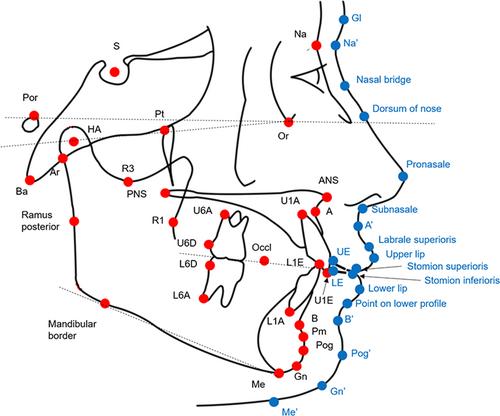
A total of 198 Japanese preadolescent children, who had skeletal Class I malocclusion and whose Lat-cephs were available at age 8 years (T0) and 10 years (T1), were allocated into the training, validation, and test phases (n = 161, n = 17, n = 20). Orthodontists and the CNN model identified 28 hard-tissue landmarks (HTL) and 19 soft-tissue landmarks (STL). The mean prediction error values were defined as ‘excellent,’ ‘very good,’ ‘good,’ ‘acceptable,’ and ‘unsatisfactory’ (criteria: 0.5 mm, 1.0 mm, 1.5 mm, and 2.0 mm, respectively). The degree of accurate prediction percentage (APP) was defined as ‘very high,’ ‘high,’ ‘medium,’ and ‘low’ (criteria: 90%, 70%, and 50%, respectively) according to the percentage of subjects that showed the error range within 1.5 mm.

Results

All HTLs showed acceptable-to-excellent mean PE values, while the STLs Pog’, Gn’, and Me’ showed unsatisfactory values, and the rest showed good-to-acceptable values. Regarding the degree of APP, HTLs Ba, ramus posterior, Pm, Pog, B-point, Me, and mandibular first molar root apex exhibited low APPs. The STLs labrale superius, lower embrasure, lower lip, point of lower profile, B′, Pog,’ Gn’ and Me’ also exhibited low APPs. The remainder of HTLs and STLs showed medium-to-very high APPs.

Conclusion

Despite the possibility of using the CNN model to predict growth, further studies are needed to improve the prediction accuracy in HTLs and STLs of the chin area.
Abstract Image

查看原文
分享 分享
微信好友 朋友圈 QQ好友 复制链接
本刊更多论文
使用连续侧位头影对骨骼 I 级青春期前患者两年生长间隔进行人工智能辅助生长预测的准确性。
目的研究使用卷积神经网络(CNN)算法和纵向侧头影(Lat-cephs)进行人工智能辅助生长预测的准确性:共有 198 名日本青春期前儿童被分配到训练、验证和测试阶段(n = 161、n = 17、n = 20),这些儿童患有骨骼 I 类(C-I)错颌畸形,且在 8 岁(T0)和 10 岁(T1)时可获得 Lat-cephs 照片。正畸医生和 CNN 模型识别了 28 个硬组织地标(HTL)和 19 个软组织地标(STL)。平均预测误差 (PE) 值被定义为 "优秀"、"很好"、"良好"、"可接受 "和 "不满意"(标准分别为 0.5 毫米、1.0 毫米、1.5 毫米和 2.0 毫米)。根据误差范围在 1.5 毫米以内的受试者比例,准确预测百分比(APP)被定义为 "非常高"、"高"、"中 "和 "低"(标准分别为 90%、70% 和 50%):所有 HTL 的平均 PE 值均为可接受到优秀,而 STL 的 Pog'、Gn'和 Me' 的平均 PE 值均为不满意,其余均为良好到可接受。在 APP 程度方面,下颌第一磨牙根尖的 HTLs Ba、ramus posterior、Pm、Pog、B-point、Me 表现出较低的 APP 值。STL的唇上、下龈、下唇、下轮廓点、B'、Pog、Gn'和Me'的APP值也较低。其余的 HTL 和 STL 显示出中等到非常高的 APP:尽管可以使用 CNN 模型预测生长,但仍需进一步研究,以提高下巴部位 HTL 和 STL 的预测准确性。
本文章由计算机程序翻译,如有差异,请以英文原文为准。
求助全文
约1分钟内获得全文 去求助
来源期刊
Orthodontics & Craniofacial Research
Orthodontics & Craniofacial Research 医学-牙科与口腔外科
CiteScore
5.30
自引率
3.20%
发文量
65
审稿时长
>12 weeks
期刊介绍: Orthodontics & Craniofacial Research - Genes, Growth and Development is published to serve its readers as an international forum for the presentation and critical discussion of issues pertinent to the advancement of the specialty of orthodontics and the evidence-based knowledge of craniofacial growth and development. This forum is based on scientifically supported information, but also includes minority and conflicting opinions. The objective of the journal is to facilitate effective communication between the research community and practicing clinicians. Original papers of high scientific quality that report the findings of clinical trials, clinical epidemiology, and novel therapeutic or diagnostic approaches are appropriate submissions. Similarly, we welcome papers in genetics, developmental biology, syndromology, surgery, speech and hearing, and other biomedical disciplines related to clinical orthodontics and normal and abnormal craniofacial growth and development. In addition to original and basic research, the journal publishes concise reviews, case reports of substantial value, invited essays, letters, and announcements. The journal is published quarterly. The review of submitted papers will be coordinated by the editor and members of the editorial board. It is policy to review manuscripts within 3 to 4 weeks of receipt and to publish within 3 to 6 months of acceptance.
期刊最新文献
Changes in the Pterygopalatine and Midpalatal Sutures After Rapid Palatal Expansion With Tooth-Bone-Borne (MARPE) and Tooth-Borne (Hyrax) Appliances. Comparison of the Effectiveness of Fluoride Varnish and Fluoride-Releasing Adhesives in Preventing and Managing White Spot Lesions During Fixed Orthodontic Treatment, and Evaluation of Patient-Reported Outcomes: A Randomised Controlled Trial 1 Year After Debonding. Human Periodontal Ligament Transcriptomes Under Orthodontic Extrusion and Intrusion: An Exploratory Pilot RNA-Seq Study With an Interactive Public Web Tool. Concordance Between the Occlusal Contacts Record Obtained Using an Intraoral Scanner and Carbon Paper. Effect of Thickness and Trim Lines on the Magnitude and Distribution of Transverse Forces Exerted by Thermoformed Plastic Aligners During Maxillary Arch Expansion.
×
引用
GB/T 7714-2015
复制
MLA
复制
APA
复制
导出至
BibTeX EndNote RefMan NoteFirst NoteExpress
×
×
提示
您的信息不完整,为了账户安全,请先补充。
现在去补充
×
提示
您因"违规操作"
具体请查看互助需知
我知道了
×
提示
现在去查看 取消
×
提示
确定
0
微信
客服QQ
Book学术公众号 扫码关注我们
反馈
×
意见反馈
请填写您的意见或建议
请填写您的手机或邮箱
已复制链接
已复制链接
快去分享给好友吧!
我知道了
×
扫码分享
扫码分享
Book学术官方微信
Book学术文献互助
Book学术文献互助群
群 号:604180095
Book学术
文献互助 智能选刊 最新文献 互助须知 联系我们:info@booksci.cn
Book学术提供免费学术资源搜索服务,方便国内外学者检索中英文文献。致力于提供最便捷和优质的服务体验。
Copyright © 2023 Book学术 All rights reserved.
ghs 京公网安备 11010802042870号 京ICP备2023020795号-1





