Neuromuscular monitoring of a patient with Charcot-Marie-Tooth disease; which monitoring technique is adequate? - A case report and literature review.
{"title":"Neuromuscular monitoring of a patient with Charcot-Marie-Tooth disease; which monitoring technique is adequate? - A case report and literature review.","authors":"Seung Un Kim, Seora Kim, Ki Tae Jung","doi":"10.17085/apm.23111","DOIUrl":null,"url":null,"abstract":"<p><strong>Background: </strong>Charcot-Marie-Tooth disease (CMTD) is a hereditary polyneuropathy associated with a life-threatening risk of pulmonary complications.</p><p><strong>Case: </strong>A 61-year-old male with CMTD for 40 years was admitted for the drainage of an abscess in his left ankle. Total intravenous anesthesia was administered, and an electromyography device was attached to the hand for neuromuscular monitoring; however, the response was not measured. Kinemyography and acceleromyography devices were attached to both hands, and responses were obtained. After neuromuscular blockade (NMB) with rocuronium 0.6 mg/kg, the train-of-four (TOF) response on kinemyography was normally measured, but the post-tetanic count on acceleromyography consistently showed 0 during anesthesia. Sugammadex 200 mg was injected to reverse the NMB. After 5 min, the TOF ratios for kinemyography and acceleromyography exceeded 90%. The patient recovered without any complications.</p><p><strong>Conclusions: </strong>For CMTD patients, acceleromyography or kinemyography is superior to electromyography, and sugammadex can be used to reverse NMB successfully.</p>","PeriodicalId":101360,"journal":{"name":"Anesthesia and pain medicine","volume":"19 1","pages":"54-61"},"PeriodicalIF":3.2000,"publicationDate":"2024-01-01","publicationTypes":"Journal Article","fieldsOfStudy":null,"isOpenAccess":false,"openAccessPdf":"https://www.ncbi.nlm.nih.gov/pmc/articles/PMC10846999/pdf/","citationCount":"0","resultStr":null,"platform":"Semanticscholar","paperid":null,"PeriodicalName":"Anesthesia and pain medicine","FirstCategoryId":"1085","ListUrlMain":"https://doi.org/10.17085/apm.23111","RegionNum":0,"RegionCategory":null,"ArticlePicture":[],"TitleCN":null,"AbstractTextCN":null,"PMCID":null,"EPubDate":"2024/1/30 0:00:00","PubModel":"Epub","JCR":"","JCRName":"","Score":null,"Total":0}
引用次数: 0
Abstract
Background: Charcot-Marie-Tooth disease (CMTD) is a hereditary polyneuropathy associated with a life-threatening risk of pulmonary complications.
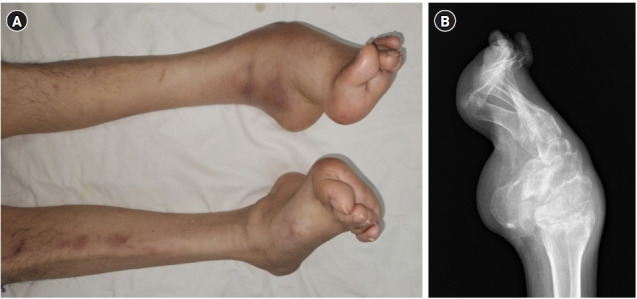
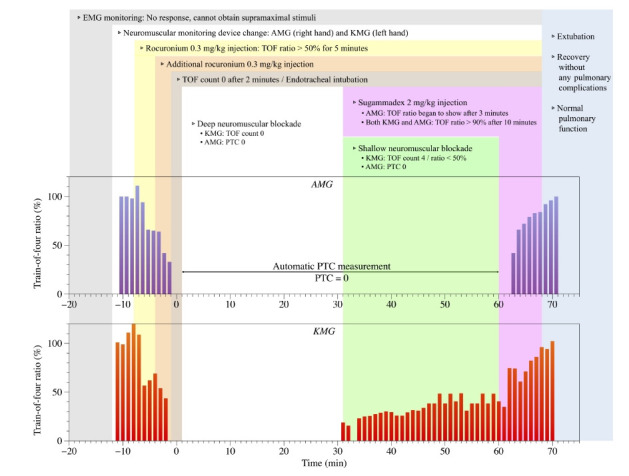
Case: A 61-year-old male with CMTD for 40 years was admitted for the drainage of an abscess in his left ankle. Total intravenous anesthesia was administered, and an electromyography device was attached to the hand for neuromuscular monitoring; however, the response was not measured. Kinemyography and acceleromyography devices were attached to both hands, and responses were obtained. After neuromuscular blockade (NMB) with rocuronium 0.6 mg/kg, the train-of-four (TOF) response on kinemyography was normally measured, but the post-tetanic count on acceleromyography consistently showed 0 during anesthesia. Sugammadex 200 mg was injected to reverse the NMB. After 5 min, the TOF ratios for kinemyography and acceleromyography exceeded 90%. The patient recovered without any complications.
Conclusions: For CMTD patients, acceleromyography or kinemyography is superior to electromyography, and sugammadex can be used to reverse NMB successfully.



 京公网安备 11010802042870号
京ICP备2023020795号-1
京公网安备 11010802042870号
京ICP备2023020795号-1

 分享
分享

 求助内容:
求助内容: 应助结果提醒方式:
 扫码关注我们
