{"title":"INTEGRAL-ILCCO cohort data analysis revealed the association of clonal haematopoiesis with an increased risk of lung cancer","authors":"Chao Cheng, Wei Hong, Christopher I Amos","doi":"10.1002/ctd2.258","DOIUrl":null,"url":null,"abstract":"<p>To investigate the association between clonal haematopoiesis (CH) and lung cancer risk, we identified CH mutations in 1 059 lung cancer cases and 899 controls using the blood whole-exome sequencing data generated from the Integrative Analysis of Lung Cancer Etiology and Risk project of the International Lung Cancer Consortium (INTEGRAL-ILCCO). Based on the variant allele frequency (VAF) of these mutations, we stratified CH carriers into two groups, low VAF (1%–10%) and high VAF (≥10%), respectively. We observed a significant association between the presence of CH mutations and the risk of lung cancer after adjusting for known risk factors (odd ratio, OR = 1.37, 95% confidence interval, CI = 1.02–1.85). Such an association was largely driven by CH mutations with high-VAF, the OR for high-VAF CH and low-VAF CH were 2.54 (1.38–4.93) and 1.14 (0.82–1.6), respectively. Trend analysis indicated a significant dose–response relationship (<i>P</i> trend = 0.004). This association between high-VAF CH and lung cancer risk remained consistent when subjects were stratified by risk factors or lung cancer histological subtypes. A combination of results from INTEGRAL-ILCCO, UKBB, and MGBB cohorts resulted in a meta-analysed OR of 1.36 (95% CI = 1.14–1.62) for all CH carriers and of 1.76 (95% CI = 1.34–2.31) for high-VAF CH carriers, respectively. In conclusion, our analysis revealed a significant association between CH and increased risk of lung cancer as supported by three independent cohorts.</p>","PeriodicalId":72605,"journal":{"name":"Clinical and translational discovery","volume":"4 1","pages":""},"PeriodicalIF":1.9000,"publicationDate":"2024-02-13","publicationTypes":"Journal Article","fieldsOfStudy":null,"isOpenAccess":false,"openAccessPdf":"https://onlinelibrary.wiley.com/doi/epdf/10.1002/ctd2.258","citationCount":"0","resultStr":null,"platform":"Semanticscholar","paperid":null,"PeriodicalName":"Clinical and translational discovery","FirstCategoryId":"1085","ListUrlMain":"https://onlinelibrary.wiley.com/doi/10.1002/ctd2.258","RegionNum":0,"RegionCategory":null,"ArticlePicture":[],"TitleCN":null,"AbstractTextCN":null,"PMCID":null,"EPubDate":"","PubModel":"","JCR":"","JCRName":"","Score":null,"Total":0}
引用次数: 0
Abstract
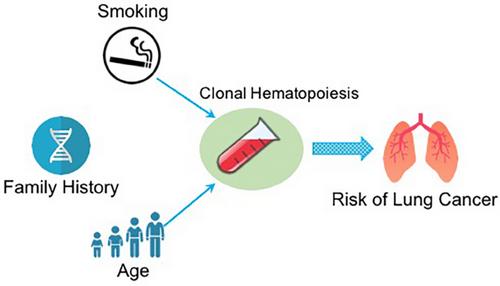
To investigate the association between clonal haematopoiesis (CH) and lung cancer risk, we identified CH mutations in 1 059 lung cancer cases and 899 controls using the blood whole-exome sequencing data generated from the Integrative Analysis of Lung Cancer Etiology and Risk project of the International Lung Cancer Consortium (INTEGRAL-ILCCO). Based on the variant allele frequency (VAF) of these mutations, we stratified CH carriers into two groups, low VAF (1%–10%) and high VAF (≥10%), respectively. We observed a significant association between the presence of CH mutations and the risk of lung cancer after adjusting for known risk factors (odd ratio, OR = 1.37, 95% confidence interval, CI = 1.02–1.85). Such an association was largely driven by CH mutations with high-VAF, the OR for high-VAF CH and low-VAF CH were 2.54 (1.38–4.93) and 1.14 (0.82–1.6), respectively. Trend analysis indicated a significant dose–response relationship (P trend = 0.004). This association between high-VAF CH and lung cancer risk remained consistent when subjects were stratified by risk factors or lung cancer histological subtypes. A combination of results from INTEGRAL-ILCCO, UKBB, and MGBB cohorts resulted in a meta-analysed OR of 1.36 (95% CI = 1.14–1.62) for all CH carriers and of 1.76 (95% CI = 1.34–2.31) for high-VAF CH carriers, respectively. In conclusion, our analysis revealed a significant association between CH and increased risk of lung cancer as supported by three independent cohorts.



 京公网安备 11010802042870号
京ICP备2023020795号-1
京公网安备 11010802042870号
京ICP备2023020795号-1

 分享
分享

 求助内容:
求助内容: 应助结果提醒方式:
 扫码关注我们
