Huiling Yi, Shuo Wu, Xiaohan Wang, Lanxiang Liu, Wenzhu Wang, Yan Yu, Zihan Li, Yinglan Jin, Jian Liu, Tao Zheng, Dan Du
{"title":"Multimodal evaluation of the effects of low-intensity ultrasound on cerebral blood flow after traumatic brain injury in mice.","authors":"Huiling Yi, Shuo Wu, Xiaohan Wang, Lanxiang Liu, Wenzhu Wang, Yan Yu, Zihan Li, Yinglan Jin, Jian Liu, Tao Zheng, Dan Du","doi":"10.1186/s12868-024-00849-0","DOIUrl":null,"url":null,"abstract":"<p><p>Traumatic brain injury (TBI) is one of the leading causes of death and disability worldwide, and destruction of the cerebrovascular system is a major factor in the cascade of secondary injuries caused by TBI. Laser speckle imaging (LSCI)has high sensitivity in detecting cerebral blood flow. LSCI can visually show that transcranial focused ultrasound stimulation (tFUS) treatment stimulates angiogenesis and increases blood flow. To study the effect of tFUS on promoting angiogenesis in Controlled Cortical impact (CCI) model. tFUS was administered daily for 10 min and for 14 consecutive days after TBI. Cerebral blood flow was measured by LSCI at 1, 3, 7 and 14 days after trauma. Functional outcomes were assessed using LSCI and neurological severity score (NSS). After the last test, Nissl staining and vascular endothelial growth factor (VEGF) were used to assess neuropathology. TBI can cause the destruction of cerebrovascular system. Blood flow was significantly increased in TBI treated with tFUS. LSCI, behavioral and histological findings suggest that tFUS treatment can promote angiogenesis after TBI.</p>","PeriodicalId":9031,"journal":{"name":"BMC Neuroscience","volume":"25 1","pages":"8"},"PeriodicalIF":2.3000,"publicationDate":"2024-02-13","publicationTypes":"Journal Article","fieldsOfStudy":null,"isOpenAccess":false,"openAccessPdf":"https://www.ncbi.nlm.nih.gov/pmc/articles/PMC10865643/pdf/","citationCount":"0","resultStr":null,"platform":"Semanticscholar","paperid":null,"PeriodicalName":"BMC Neuroscience","FirstCategoryId":"3","ListUrlMain":"https://doi.org/10.1186/s12868-024-00849-0","RegionNum":4,"RegionCategory":"医学","ArticlePicture":[],"TitleCN":null,"AbstractTextCN":null,"PMCID":null,"EPubDate":"","PubModel":"","JCR":"Q3","JCRName":"NEUROSCIENCES","Score":null,"Total":0}
引用次数: 0
Abstract
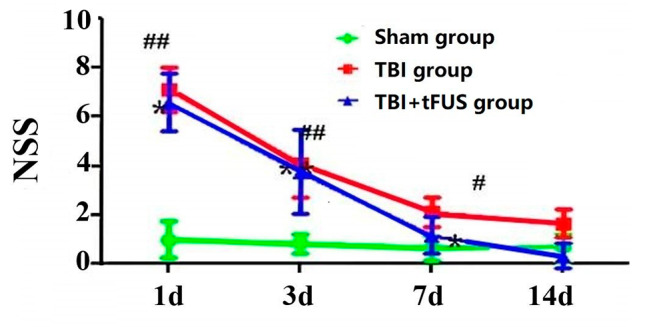
Traumatic brain injury (TBI) is one of the leading causes of death and disability worldwide, and destruction of the cerebrovascular system is a major factor in the cascade of secondary injuries caused by TBI. Laser speckle imaging (LSCI)has high sensitivity in detecting cerebral blood flow. LSCI can visually show that transcranial focused ultrasound stimulation (tFUS) treatment stimulates angiogenesis and increases blood flow. To study the effect of tFUS on promoting angiogenesis in Controlled Cortical impact (CCI) model. tFUS was administered daily for 10 min and for 14 consecutive days after TBI. Cerebral blood flow was measured by LSCI at 1, 3, 7 and 14 days after trauma. Functional outcomes were assessed using LSCI and neurological severity score (NSS). After the last test, Nissl staining and vascular endothelial growth factor (VEGF) were used to assess neuropathology. TBI can cause the destruction of cerebrovascular system. Blood flow was significantly increased in TBI treated with tFUS. LSCI, behavioral and histological findings suggest that tFUS treatment can promote angiogenesis after TBI.
期刊介绍:
BMC Neuroscience is an open access, peer-reviewed journal that considers articles on all aspects of neuroscience, welcoming studies that provide insight into the molecular, cellular, developmental, genetic and genomic, systems, network, cognitive and behavioral aspects of nervous system function in both health and disease. Both experimental and theoretical studies are within scope, as are studies that describe methodological approaches to monitoring or manipulating nervous system function.





 京公网安备 11010802042870号
京ICP备2023020795号-1
京公网安备 11010802042870号
京ICP备2023020795号-1

 分享
分享
 求助内容:
求助内容: 应助结果提醒方式:
 扫码关注我们
