{"title":"Temporal Muscle Swelling after Clipping Surgery with Frontotemporal Craniotomy Is Associated with Immediate Postcraniotomy Headache.","authors":"Yoshiro Ito, Hisayuki Hosoo, Aiki Marushima, Yuji Matsumaru, Eiichi Ishikawa","doi":"10.2176/jns-nmc.2023-0228","DOIUrl":null,"url":null,"abstract":"<p><p>Immediate postcraniotomy headache frequently occurs within the first 48 h after surgery. The mechanisms underlying immediate postcraniotomy headache are not yet fully understood, and effective treatments are not yet established. This study aimed to identify the factors associated with immediate postcraniotomy headache in patients who underwent clipping surgery with frontotemporal craniotomy and to examine the effects of these factors on postcraniotomy headache. A total of 51 patients were included in this study. Immediate postcraniotomy headache was defined as pain with numerical rating scale score ≥4 on postoperative day 7. Sixteen patients (31.4%) had immediate postcraniotomy headache. The headache-positive group had a higher incidence of preoperative analgesic use (50.0% vs. 5.7%, respectively, p < 0.001), increased temporal muscle swelling ratio (137.0%±30.2% vs. 112.5%±30.5%, respectively, p = 0.01), and higher postoperative analgesic use (12.9±5.8 vs. 6.7±5.2, respectively, p < 0.001) than the headache-negative group. The risk factors independently associated with immediate postcraniotomy headache were preoperative analgesic use and temporal muscle swelling by >115.15% compared with the contralateral side in the receiver operating characteristic analysis. Postcraniotomy headache was significantly more common in patients with preoperative analgesic use and temporal muscle swelling than in those without (p < 0.001 and p = 0.002, respectively). Altogether, patients with immediate postcraniotomy headache had greater preoperative analgesic use, greater temporal muscle swelling ratio, and higher postoperative analgesic use than those without. Thus, temporal muscle swelling is a key response to immediate postcraniotomy headache.</p>","PeriodicalId":19225,"journal":{"name":"Neurologia medico-chirurgica","volume":" ","pages":"168-174"},"PeriodicalIF":2.3000,"publicationDate":"2024-04-15","publicationTypes":"Journal Article","fieldsOfStudy":null,"isOpenAccess":false,"openAccessPdf":"https://www.ncbi.nlm.nih.gov/pmc/articles/PMC11099162/pdf/","citationCount":"0","resultStr":null,"platform":"Semanticscholar","paperid":null,"PeriodicalName":"Neurologia medico-chirurgica","FirstCategoryId":"3","ListUrlMain":"https://doi.org/10.2176/jns-nmc.2023-0228","RegionNum":4,"RegionCategory":"医学","ArticlePicture":[],"TitleCN":null,"AbstractTextCN":null,"PMCID":null,"EPubDate":"2024/2/15 0:00:00","PubModel":"Epub","JCR":"Q2","JCRName":"CLINICAL NEUROLOGY","Score":null,"Total":0}
引用次数: 0
Abstract
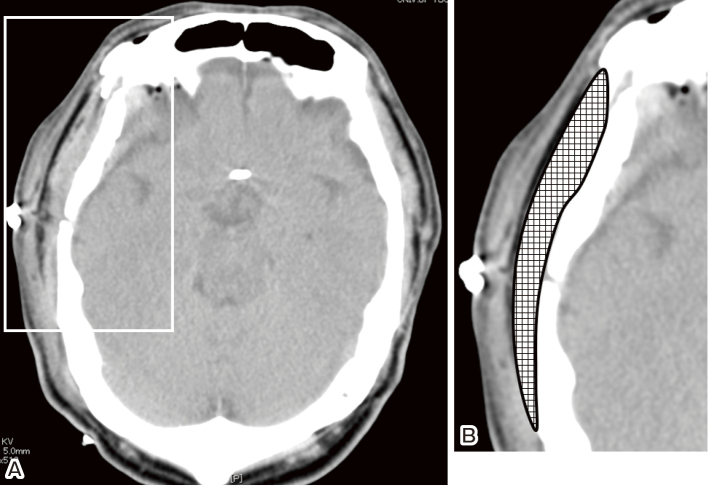
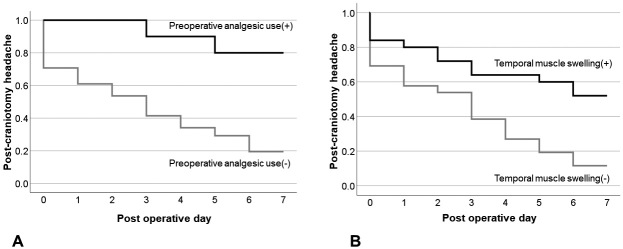
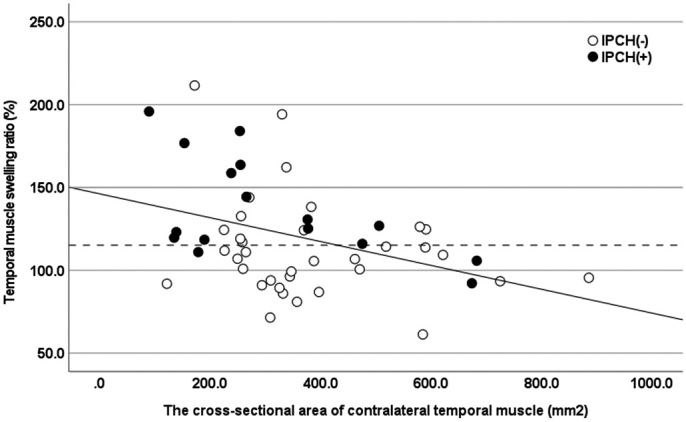
Immediate postcraniotomy headache frequently occurs within the first 48 h after surgery. The mechanisms underlying immediate postcraniotomy headache are not yet fully understood, and effective treatments are not yet established. This study aimed to identify the factors associated with immediate postcraniotomy headache in patients who underwent clipping surgery with frontotemporal craniotomy and to examine the effects of these factors on postcraniotomy headache. A total of 51 patients were included in this study. Immediate postcraniotomy headache was defined as pain with numerical rating scale score ≥4 on postoperative day 7. Sixteen patients (31.4%) had immediate postcraniotomy headache. The headache-positive group had a higher incidence of preoperative analgesic use (50.0% vs. 5.7%, respectively, p < 0.001), increased temporal muscle swelling ratio (137.0%±30.2% vs. 112.5%±30.5%, respectively, p = 0.01), and higher postoperative analgesic use (12.9±5.8 vs. 6.7±5.2, respectively, p < 0.001) than the headache-negative group. The risk factors independently associated with immediate postcraniotomy headache were preoperative analgesic use and temporal muscle swelling by >115.15% compared with the contralateral side in the receiver operating characteristic analysis. Postcraniotomy headache was significantly more common in patients with preoperative analgesic use and temporal muscle swelling than in those without (p < 0.001 and p = 0.002, respectively). Altogether, patients with immediate postcraniotomy headache had greater preoperative analgesic use, greater temporal muscle swelling ratio, and higher postoperative analgesic use than those without. Thus, temporal muscle swelling is a key response to immediate postcraniotomy headache.



 京公网安备 11010802042870号
京ICP备2023020795号-1
京公网安备 11010802042870号
京ICP备2023020795号-1

 分享
分享
 求助内容:
求助内容: 应助结果提醒方式:
 扫码关注我们
