Increased burden of rare protein-truncating variants in constrained, brain-specific and synaptic genes in extremely impulsively violent males with antisocial personality disorder
Dita Mušálková, Anna Přistoupilová, Ivana Jedličková, Hana Hartmannová, Helena Trešlová, Lenka Nosková, Kateřina Hodaňová, Petra Bittmanová, Viktor Stránecký, Václav Jiřička, Michaela Langmajerová, Marc Woodbury-Smith, Mehdi Zarrei, Brett Trost, Stephen W. Scherer, Anthony J. Bleyer, Jan Vevera, Stanislav Kmoch
{"title":"Increased burden of rare protein-truncating variants in constrained, brain-specific and synaptic genes in extremely impulsively violent males with antisocial personality disorder","authors":"Dita Mušálková, Anna Přistoupilová, Ivana Jedličková, Hana Hartmannová, Helena Trešlová, Lenka Nosková, Kateřina Hodaňová, Petra Bittmanová, Viktor Stránecký, Václav Jiřička, Michaela Langmajerová, Marc Woodbury-Smith, Mehdi Zarrei, Brett Trost, Stephen W. Scherer, Anthony J. Bleyer, Jan Vevera, Stanislav Kmoch","doi":"10.1111/gbb.12882","DOIUrl":null,"url":null,"abstract":"<p>The genetic correlates of extreme impulsive violence are poorly understood, and there have been few studies that have characterized a large group of affected individuals both clinically and genetically. We performed whole exome sequencing (WES) in 290 males with the life-course-persistent, extremely impulsively violent form of antisocial personality disorder (APD) and analyzed the spectrum of rare protein-truncating variants (rPTVs). Comparisons were made with 314 male controls and publicly available genotype data. Functional annotation tools were used for biological interpretation. Participants were significantly more likely to harbor rPTVs in genes that are intolerant to loss-of-function variants (odds ratio [OR] 2.06; <i>p</i> < 0.001), specifically expressed in brain (OR 2.80; <i>p</i> = 0.036) and enriched for those involved in neurotransmitter transport and synaptic processes. In 60 individuals (20%), we identified rPTVs that we classified as clinically relevant based on their clinical associations, biological function and gene expression patterns. Of these, 37 individuals harbored rPTVs in 23 genes that are associated with a monogenic neurological disorder, and 23 individuals harbored rPTVs in 20 genes reportedly intolerant to loss-of-function variants. The analysis presents evidence in support of a model where presence of either one or several private, functionally relevant mutations contribute significantly to individual risk of life-course-persistent APD and reveals multiple individuals who could be affected by clinically unrecognized neuropsychiatric Mendelian disease. Thus, Mendelian diseases and increased rPTV burden may represent important factors for the development of extremely impulsive violent life-course-persistent forms of APD irrespective of their clinical presentation.</p>","PeriodicalId":50426,"journal":{"name":"Genes Brain and Behavior","volume":"23 1","pages":""},"PeriodicalIF":2.3000,"publicationDate":"2024-02-15","publicationTypes":"Journal Article","fieldsOfStudy":null,"isOpenAccess":false,"openAccessPdf":"https://onlinelibrary.wiley.com/doi/epdf/10.1111/gbb.12882","citationCount":"0","resultStr":null,"platform":"Semanticscholar","paperid":null,"PeriodicalName":"Genes Brain and Behavior","FirstCategoryId":"102","ListUrlMain":"https://onlinelibrary.wiley.com/doi/10.1111/gbb.12882","RegionNum":4,"RegionCategory":"心理学","ArticlePicture":[],"TitleCN":null,"AbstractTextCN":null,"PMCID":null,"EPubDate":"","PubModel":"","JCR":"Q2","JCRName":"BEHAVIORAL SCIENCES","Score":null,"Total":0}
引用次数: 0
Abstract
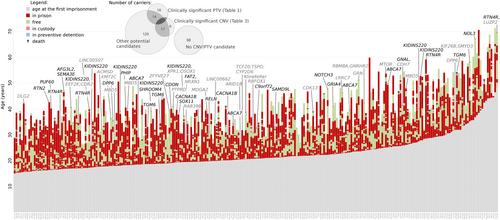
The genetic correlates of extreme impulsive violence are poorly understood, and there have been few studies that have characterized a large group of affected individuals both clinically and genetically. We performed whole exome sequencing (WES) in 290 males with the life-course-persistent, extremely impulsively violent form of antisocial personality disorder (APD) and analyzed the spectrum of rare protein-truncating variants (rPTVs). Comparisons were made with 314 male controls and publicly available genotype data. Functional annotation tools were used for biological interpretation. Participants were significantly more likely to harbor rPTVs in genes that are intolerant to loss-of-function variants (odds ratio [OR] 2.06; p < 0.001), specifically expressed in brain (OR 2.80; p = 0.036) and enriched for those involved in neurotransmitter transport and synaptic processes. In 60 individuals (20%), we identified rPTVs that we classified as clinically relevant based on their clinical associations, biological function and gene expression patterns. Of these, 37 individuals harbored rPTVs in 23 genes that are associated with a monogenic neurological disorder, and 23 individuals harbored rPTVs in 20 genes reportedly intolerant to loss-of-function variants. The analysis presents evidence in support of a model where presence of either one or several private, functionally relevant mutations contribute significantly to individual risk of life-course-persistent APD and reveals multiple individuals who could be affected by clinically unrecognized neuropsychiatric Mendelian disease. Thus, Mendelian diseases and increased rPTV burden may represent important factors for the development of extremely impulsive violent life-course-persistent forms of APD irrespective of their clinical presentation.
期刊介绍:
Genes, Brain and Behavior was launched in 2002 with the aim of publishing top quality research in behavioral and neural genetics in their broadest sense. The emphasis is on the analysis of the behavioral and neural phenotypes under consideration, the unifying theme being the genetic approach as a tool to increase our understanding of these phenotypes.
Genes Brain and Behavior is pleased to offer the following features:
8 issues per year
online submissions with first editorial decisions within 3-4 weeks and fast publication at Wiley-Blackwells
High visibility through its coverage by PubMed/Medline, Current Contents and other major abstracting and indexing services
Inclusion in the Wiley-Blackwell consortial license, extending readership to thousands of international libraries and institutions
A large and varied editorial board comprising of international specialists.



 京公网安备 11010802042870号
京ICP备2023020795号-1
京公网安备 11010802042870号
京ICP备2023020795号-1

 分享
分享
 求助内容:
求助内容: 应助结果提醒方式:
 扫码关注我们
