Nabil Majd Alawi, Hoang M. Nguyen, Hassan H. Al-Mohammedawi, Firas Khaleel AL-Zuhairi, Chi M. Phan, Thamer Adnan Abdullah, Haydar A. S. Aljaafari, Zaidoon M. Shakor, Khalid A. Sukkar, Jamal M. Ali
{"title":"Steam combined dry reforming of methane over CoMo/Al2O3 nanoflake catalyst at low microwave power irradiation","authors":"Nabil Majd Alawi, Hoang M. Nguyen, Hassan H. Al-Mohammedawi, Firas Khaleel AL-Zuhairi, Chi M. Phan, Thamer Adnan Abdullah, Haydar A. S. Aljaafari, Zaidoon M. Shakor, Khalid A. Sukkar, Jamal M. Ali","doi":"10.1007/s43153-024-00436-0","DOIUrl":null,"url":null,"abstract":"<p>This research involved the implementation of steam-assisted dry reforming (SDR) on methane utilizing a CoMo/Al<sub>2</sub>O<sub>3</sub> nanoflake catalyst under microwave irradiation. The CoMo/Al<sub>2</sub>O<sub>3</sub> nanoflakes demonstrated superior catalytic activity for reforming reactions, attributed to their enhanced surface exposure to incident microwaves and heightened microwave absorption capability. Fischer–Tropsch (F–T) synthesis was employed for the production of liquid fuels, with the predicted syngas ratio (H<sub>2</sub>/CO) easily adjustable by varying the steam-to-carbon ratio (S/C) supplied to the reactor. Achieving an H<sub>2</sub>/CO ratio greater than one was feasible with an intake S/C ratio below 0.1 and 200 W of microwave power. In comparison to carbon-based catalysts, the CoMo nanoflakes exhibited significantly higher catalytic stability after 16 h of time-on-stream (TOS) during the SDR process under microwave irradiation. The utilization of microwaves in this process opens novel routes for methane reforming to fuel, offering distinct advantages.</p>","PeriodicalId":9194,"journal":{"name":"Brazilian Journal of Chemical Engineering","volume":"184 1","pages":""},"PeriodicalIF":1.5000,"publicationDate":"2024-02-17","publicationTypes":"Journal Article","fieldsOfStudy":null,"isOpenAccess":false,"openAccessPdf":"","citationCount":"0","resultStr":null,"platform":"Semanticscholar","paperid":null,"PeriodicalName":"Brazilian Journal of Chemical Engineering","FirstCategoryId":"5","ListUrlMain":"https://doi.org/10.1007/s43153-024-00436-0","RegionNum":4,"RegionCategory":"工程技术","ArticlePicture":[],"TitleCN":null,"AbstractTextCN":null,"PMCID":null,"EPubDate":"","PubModel":"","JCR":"Q3","JCRName":"ENGINEERING, CHEMICAL","Score":null,"Total":0}
引用次数: 0
Abstract
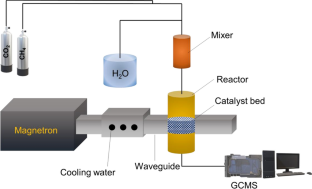
This research involved the implementation of steam-assisted dry reforming (SDR) on methane utilizing a CoMo/Al2O3 nanoflake catalyst under microwave irradiation. The CoMo/Al2O3 nanoflakes demonstrated superior catalytic activity for reforming reactions, attributed to their enhanced surface exposure to incident microwaves and heightened microwave absorption capability. Fischer–Tropsch (F–T) synthesis was employed for the production of liquid fuels, with the predicted syngas ratio (H2/CO) easily adjustable by varying the steam-to-carbon ratio (S/C) supplied to the reactor. Achieving an H2/CO ratio greater than one was feasible with an intake S/C ratio below 0.1 and 200 W of microwave power. In comparison to carbon-based catalysts, the CoMo nanoflakes exhibited significantly higher catalytic stability after 16 h of time-on-stream (TOS) during the SDR process under microwave irradiation. The utilization of microwaves in this process opens novel routes for methane reforming to fuel, offering distinct advantages.
期刊介绍:
The Brazilian Journal of Chemical Engineering is a quarterly publication of the Associação Brasileira de Engenharia Química (Brazilian Society of Chemical Engineering - ABEQ) aiming at publishing papers reporting on basic and applied research and innovation in the field of chemical engineering and related areas.



 京公网安备 11010802042870号
京ICP备2023020795号-1
京公网安备 11010802042870号
京ICP备2023020795号-1

 分享
分享
 求助内容:
求助内容: 应助结果提醒方式:
 扫码关注我们
