{"title":"Temperature dependent stereodynamics in surface scattering measured through subtle changes in the molecular wave function†","authors":"Helen Chadwick and Gil Alexandrowicz","doi":"10.1039/D4FD00007B","DOIUrl":null,"url":null,"abstract":"<p >A magnetically manipulated molecular beam technique is used to change the rotational orientation of H<small><sub>2</sub></small> molecules which collide with a stepped Cu(511) surface and explore how the polarisation dependence of molecules scattering into the specular channel changes as a function of surface temperature. At all temperatures, H<small><sub>2</sub></small> molecules that are rotating like cartwheels are more likely to be scattered into the specular channel than those that are rotating like helicopters. Furthermore, the scattered molecules are more likely to be rotating like cartwheels, regardless of their state before the collision. Increasing the temperature of the Cu(511) surface causes the polarisation effects to become stronger, with the scattering becoming more selective for H<small><sub>2</sub></small> with cartwheel like rotation. Therefore, scattering a molecular beam of H<small><sub>2</sub></small> from a Cu(511) surface and taking the molecules scattered into the specular channel provides a method to create a rotationally polarised beam of H<small><sub>2</sub></small>, where the polarisation can be tuned by changing the surface temperature. In contrast, the rotational orientation dependence observed for specular scattering from a flat Cu(111) surface is independent of surface temperature within the same temperature range.</p>","PeriodicalId":49075,"journal":{"name":"Faraday Discussions","volume":"251 ","pages":" 76-91"},"PeriodicalIF":3.1000,"publicationDate":"2024-02-14","publicationTypes":"Journal Article","fieldsOfStudy":null,"isOpenAccess":false,"openAccessPdf":"https://pubs.rsc.org/en/content/articlepdf/2024/fd/d4fd00007b?page=search","citationCount":"0","resultStr":null,"platform":"Semanticscholar","paperid":null,"PeriodicalName":"Faraday Discussions","FirstCategoryId":"92","ListUrlMain":"https://pubs.rsc.org/en/content/articlelanding/2024/fd/d4fd00007b","RegionNum":3,"RegionCategory":"化学","ArticlePicture":[],"TitleCN":null,"AbstractTextCN":null,"PMCID":null,"EPubDate":"","PubModel":"","JCR":"Q2","JCRName":"Chemistry","Score":null,"Total":0}
引用次数: 0
Abstract
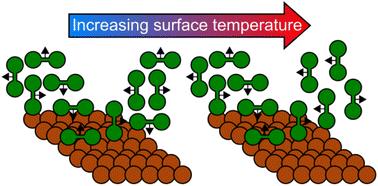
A magnetically manipulated molecular beam technique is used to change the rotational orientation of H2 molecules which collide with a stepped Cu(511) surface and explore how the polarisation dependence of molecules scattering into the specular channel changes as a function of surface temperature. At all temperatures, H2 molecules that are rotating like cartwheels are more likely to be scattered into the specular channel than those that are rotating like helicopters. Furthermore, the scattered molecules are more likely to be rotating like cartwheels, regardless of their state before the collision. Increasing the temperature of the Cu(511) surface causes the polarisation effects to become stronger, with the scattering becoming more selective for H2 with cartwheel like rotation. Therefore, scattering a molecular beam of H2 from a Cu(511) surface and taking the molecules scattered into the specular channel provides a method to create a rotationally polarised beam of H2, where the polarisation can be tuned by changing the surface temperature. In contrast, the rotational orientation dependence observed for specular scattering from a flat Cu(111) surface is independent of surface temperature within the same temperature range.





 京公网安备 11010802042870号
京ICP备2023020795号-1
京公网安备 11010802042870号
京ICP备2023020795号-1

 分享
分享
 求助内容:
求助内容: 应助结果提醒方式:
 扫码关注我们
