Thomas Gstir, David Sundelin, Tim Michaelsen, Atilay Ayasli, Dasarath Swaraj, Jerin Judy, Fabio Zappa, Wolf Geppert and Roland Wester
{"title":"Reaction dynamics of the methoxy anion CH3O− with methyl iodide CH3I","authors":"Thomas Gstir, David Sundelin, Tim Michaelsen, Atilay Ayasli, Dasarath Swaraj, Jerin Judy, Fabio Zappa, Wolf Geppert and Roland Wester","doi":"10.1039/D3FD00164D","DOIUrl":null,"url":null,"abstract":"<p >Studying larger nucleophiles in bimolecular nucleophilic substitution (S<small><sub>N</sub></small>2) reactions bridges the gap from simple model systems to those relevant to organic chemistry. Therefore, we investigated the reaction dynamics between the methoxy anion (CH<small><sub>3</sub></small>O<small><sup>−</sup></small>) and iodomethane (CH<small><sub>3</sub></small>I) in our crossed-beam setup combined with velocity map imaging at the four collision energies 0.4, 0.7, 1.2, and 1.6 eV. We find the two ionic products I<small><sup>−</sup></small> and CH<small><sub>2</sub></small>I<small><sup>−</sup></small>, which can be attributed to the S<small><sub>N</sub></small>2 and proton transfer channels, respectively. The proton transfer channel progresses in a previously observed fashion from indirect to direct scattering with increasing collision energy. Interestingly, the S<small><sub>N</sub></small>2 channel exhibits direct dynamics already at low collision energies. Both the direct stripping, leading to forward scattering, and the direct rebound mechanism, leading to backward scattering into high angles, are observed.</p>","PeriodicalId":49075,"journal":{"name":"Faraday Discussions","volume":"251 ","pages":" 573-586"},"PeriodicalIF":3.1000,"publicationDate":"2024-02-16","publicationTypes":"Journal Article","fieldsOfStudy":null,"isOpenAccess":false,"openAccessPdf":"https://pubs.rsc.org/en/content/articlepdf/2024/fd/d3fd00164d?page=search","citationCount":"0","resultStr":null,"platform":"Semanticscholar","paperid":null,"PeriodicalName":"Faraday Discussions","FirstCategoryId":"92","ListUrlMain":"https://pubs.rsc.org/en/content/articlelanding/2024/fd/d3fd00164d","RegionNum":3,"RegionCategory":"化学","ArticlePicture":[],"TitleCN":null,"AbstractTextCN":null,"PMCID":null,"EPubDate":"","PubModel":"","JCR":"Q2","JCRName":"Chemistry","Score":null,"Total":0}
引用次数: 0
Abstract
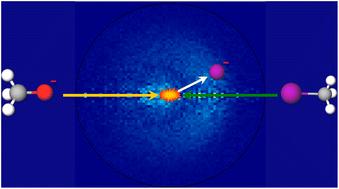
Studying larger nucleophiles in bimolecular nucleophilic substitution (SN2) reactions bridges the gap from simple model systems to those relevant to organic chemistry. Therefore, we investigated the reaction dynamics between the methoxy anion (CH3O−) and iodomethane (CH3I) in our crossed-beam setup combined with velocity map imaging at the four collision energies 0.4, 0.7, 1.2, and 1.6 eV. We find the two ionic products I− and CH2I−, which can be attributed to the SN2 and proton transfer channels, respectively. The proton transfer channel progresses in a previously observed fashion from indirect to direct scattering with increasing collision energy. Interestingly, the SN2 channel exhibits direct dynamics already at low collision energies. Both the direct stripping, leading to forward scattering, and the direct rebound mechanism, leading to backward scattering into high angles, are observed.



 京公网安备 11010802042870号
京ICP备2023020795号-1
京公网安备 11010802042870号
京ICP备2023020795号-1

 分享
分享
 求助内容:
求助内容: 应助结果提醒方式:
 扫码关注我们
