Shuyan Wang, Guangjun Kuang, Baoli Shao, Xi Chen, Lei Xie, Yimei Ma
{"title":"Numerical simulation on adsorption of CO2 using K2CO3 particles in the bubbling fluidized bed","authors":"Shuyan Wang, Guangjun Kuang, Baoli Shao, Xi Chen, Lei Xie, Yimei Ma","doi":"10.1002/apj.3041","DOIUrl":null,"url":null,"abstract":"<p>With the increase of greenhouse gas emissions, global warming has become an urgent problem, and the use of solid adsorbents to capture CO<sub>2</sub> gas in flue gas has attracted more and more attention. In this study, the process of CO<sub>2</sub> capture by K<sub>2</sub>CO<sub>3</sub> particles in the bubbling fluidized bed (BFB) is numerically simulated with Eulerian–Eulerian(E–E) two fluid model incorporating with the kinetic theory of granular flows (KTGF). The results are verified through a detailed comparison with experimental data from Ayobi et al. Furthermore, Regarding the fundamental factors influencing CO<sub>2</sub> adsorption rate is revealed, diminishing the inlet gas superficial velocity and augmenting the particle size of the solid adsorbent both contribute to improve adsorption performance. Specifically, the adsorption rate increases from 76.7% to 81.7% at the gas superficial velocity reducing from 1.10 to 0.71 m/s, while the adsorption rate from 77.6% to 79.7% with the particle size ranging from 400 to 600 μm. Additionally, the study delves into an exploration of fluid dynamic characteristics pertaining to gas particles within the bubbling fluidized bed while systematically considering varied inlet gas superficial velocities and particle sizes.</p>","PeriodicalId":49237,"journal":{"name":"Asia-Pacific Journal of Chemical Engineering","volume":"19 3","pages":""},"PeriodicalIF":1.6000,"publicationDate":"2024-02-05","publicationTypes":"Journal Article","fieldsOfStudy":null,"isOpenAccess":false,"openAccessPdf":"","citationCount":"0","resultStr":null,"platform":"Semanticscholar","paperid":null,"PeriodicalName":"Asia-Pacific Journal of Chemical Engineering","FirstCategoryId":"5","ListUrlMain":"https://onlinelibrary.wiley.com/doi/10.1002/apj.3041","RegionNum":4,"RegionCategory":"工程技术","ArticlePicture":[],"TitleCN":null,"AbstractTextCN":null,"PMCID":null,"EPubDate":"","PubModel":"","JCR":"Q3","JCRName":"ENGINEERING, CHEMICAL","Score":null,"Total":0}
引用次数: 0
Abstract
With the increase of greenhouse gas emissions, global warming has become an urgent problem, and the use of solid adsorbents to capture CO2 gas in flue gas has attracted more and more attention. In this study, the process of CO2 capture by K2CO3 particles in the bubbling fluidized bed (BFB) is numerically simulated with Eulerian–Eulerian(E–E) two fluid model incorporating with the kinetic theory of granular flows (KTGF). The results are verified through a detailed comparison with experimental data from Ayobi et al. Furthermore, Regarding the fundamental factors influencing CO2 adsorption rate is revealed, diminishing the inlet gas superficial velocity and augmenting the particle size of the solid adsorbent both contribute to improve adsorption performance. Specifically, the adsorption rate increases from 76.7% to 81.7% at the gas superficial velocity reducing from 1.10 to 0.71 m/s, while the adsorption rate from 77.6% to 79.7% with the particle size ranging from 400 to 600 μm. Additionally, the study delves into an exploration of fluid dynamic characteristics pertaining to gas particles within the bubbling fluidized bed while systematically considering varied inlet gas superficial velocities and particle sizes.
期刊介绍:
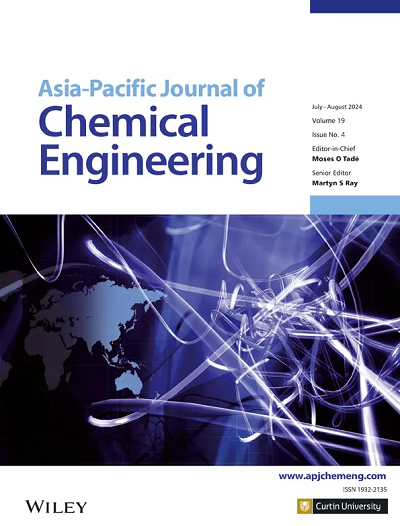
Asia-Pacific Journal of Chemical Engineering is aimed at capturing current developments and initiatives in chemical engineering related and specialised areas. Publishing six issues each year, the journal showcases innovative technological developments, providing an opportunity for technology transfer and collaboration.
Asia-Pacific Journal of Chemical Engineering will focus particular attention on the key areas of: Process Application (separation, polymer, catalysis, nanotechnology, electrochemistry, nuclear technology); Energy and Environmental Technology (materials for energy storage and conversion, coal gasification, gas liquefaction, air pollution control, water treatment, waste utilization and management, nuclear waste remediation); and Biochemical Engineering (including targeted drug delivery applications).




 京公网安备 11010802042870号
京ICP备2023020795号-1
京公网安备 11010802042870号
京ICP备2023020795号-1

 分享
分享
 求助内容:
求助内容: 应助结果提醒方式:
 扫码关注我们
