Daniel Shan En Lim, Sean Eng Howe Pang, Tze Min Koay, Zestin Wen Wen Soh, John S. Ascher, Eunice Jingmei Tan
{"title":"Community science enhances modelled bee distributions in a tropical Asian city","authors":"Daniel Shan En Lim, Sean Eng Howe Pang, Tze Min Koay, Zestin Wen Wen Soh, John S. Ascher, Eunice Jingmei Tan","doi":"10.1111/btp.13298","DOIUrl":null,"url":null,"abstract":"<p>Bees and the ecosystem services they provide are vital to urban ecosystems, but little is understood about their distributions, particularly in the Asian tropics. This is largely due to taxonomic impediments and limited inventorying, monitoring, and digitization of occurrence records. While expert collections (EC) are demonstrably insufficient by themselves as a data source to model and understand bee distributions, the boom of community science (CS) in urban areas provides an untapped opportunity to learn about bee distributions within our cities. We used CS observations in combination with EC observations to model the distribution of bees in Singapore, a small tropical city-state in Southeast Asia. To address the restricted spatial context, we performed multiple bias corrections and show that species distribution models performed well when estimating the distribution of habitat specialists with distinct range limits detectable within Singapore. We successfully modelled 37 bee species, where model statistics improved for 23 species upon the incorporation of CS observations. Nine species had insufficient EC observations to obtain acceptable models, but could be modelled with the incorporation of CS observations. This is the first study to combine both EC and CS observations to map and model the occurrences of tropical Asian bee species for a highly urbanized region at such fine resolution. Our results suggest that urban landscapes with impervious surfaces and higher temperatures are less suitable for bee species, and such findings can be used to advise the management of urban landscapes to optimize the diversity of bee pollinators and other organisms.</p>","PeriodicalId":8982,"journal":{"name":"Biotropica","volume":"56 2","pages":""},"PeriodicalIF":1.7000,"publicationDate":"2024-02-11","publicationTypes":"Journal Article","fieldsOfStudy":null,"isOpenAccess":false,"openAccessPdf":"","citationCount":"0","resultStr":null,"platform":"Semanticscholar","paperid":null,"PeriodicalName":"Biotropica","FirstCategoryId":"93","ListUrlMain":"https://onlinelibrary.wiley.com/doi/10.1111/btp.13298","RegionNum":3,"RegionCategory":"环境科学与生态学","ArticlePicture":[],"TitleCN":null,"AbstractTextCN":null,"PMCID":null,"EPubDate":"","PubModel":"","JCR":"Q3","JCRName":"ECOLOGY","Score":null,"Total":0}
引用次数: 0
Abstract
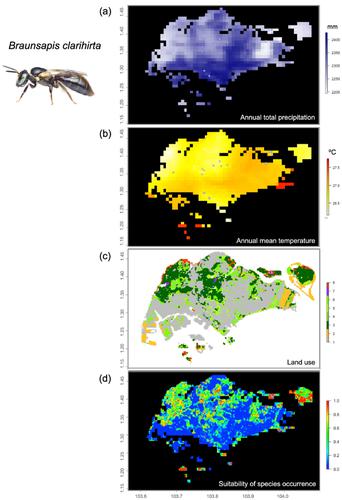
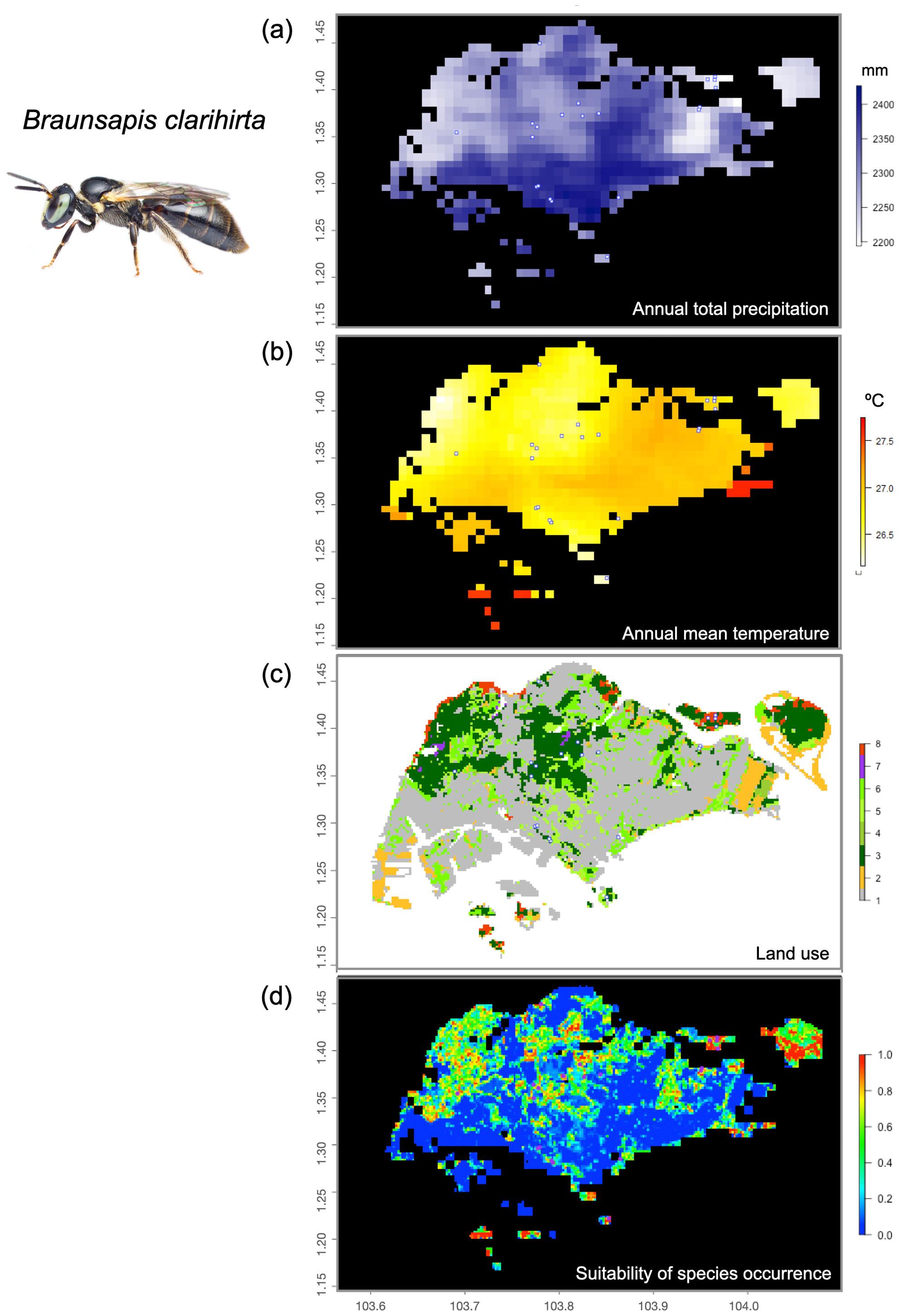
Bees and the ecosystem services they provide are vital to urban ecosystems, but little is understood about their distributions, particularly in the Asian tropics. This is largely due to taxonomic impediments and limited inventorying, monitoring, and digitization of occurrence records. While expert collections (EC) are demonstrably insufficient by themselves as a data source to model and understand bee distributions, the boom of community science (CS) in urban areas provides an untapped opportunity to learn about bee distributions within our cities. We used CS observations in combination with EC observations to model the distribution of bees in Singapore, a small tropical city-state in Southeast Asia. To address the restricted spatial context, we performed multiple bias corrections and show that species distribution models performed well when estimating the distribution of habitat specialists with distinct range limits detectable within Singapore. We successfully modelled 37 bee species, where model statistics improved for 23 species upon the incorporation of CS observations. Nine species had insufficient EC observations to obtain acceptable models, but could be modelled with the incorporation of CS observations. This is the first study to combine both EC and CS observations to map and model the occurrences of tropical Asian bee species for a highly urbanized region at such fine resolution. Our results suggest that urban landscapes with impervious surfaces and higher temperatures are less suitable for bee species, and such findings can be used to advise the management of urban landscapes to optimize the diversity of bee pollinators and other organisms.
期刊介绍:
Ranked by the ISI index, Biotropica is a highly regarded source of original research on the ecology, conservation and management of all tropical ecosystems, and on the evolution, behavior, and population biology of tropical organisms. Published on behalf of the Association of Tropical Biology and Conservation, the journal''s Special Issues and Special Sections quickly become indispensable references for researchers in the field. Biotropica publishes timely Papers, Reviews, Commentaries, and Insights. Commentaries generate thought-provoking ideas that frequently initiate fruitful debate and discussion, while Reviews provide authoritative and analytical overviews of topics of current conservation or ecological importance. The newly instituted category Insights replaces Short Communications.




 京公网安备 11010802042870号
京ICP备2023020795号-1
京公网安备 11010802042870号
京ICP备2023020795号-1

 分享
分享
 求助内容:
求助内容: 应助结果提醒方式:
 扫码关注我们
