{"title":"EXPRESS: Diversity and Inclusion under Pressure: Building Relational Resilience into Humanitarian Operations","authors":"Brooke A. Gazdag, Niels Van Quaquebeke, M. Besiou","doi":"10.1177/10591478241234993","DOIUrl":null,"url":null,"abstract":"In this essay, our analysis takes important insights on diversity and inclusion from the behavioral literature but critically contextualizes them against the reality of humanitarian operations. Humanitarian operations are characterized by system immanent diversity, particularly between local and expatriate aid workers, who not only bring valuable different perspectives to the table but also differ along multiple dimensions of diversity into a so-called diversity faultline. Such a faultline, however, provides fertile ground for continued conflict resulting in relational fractures and, ultimately, inefficient collaboration. While, in theory, inclusion could help overcome the negative effects of faultlines, in practice, the time pressure for humanitarian organizations to quickly respond to disasters makes it effectively impossible to engage in it. Against this background, we argue, humanitarian organizations should take preemptive action before disaster strikes. Specifically, we posit that the pre-disaster phase presents an opportunity to engage in inclusion in order to cultivate relational resilience between local and expatriate aid workers. Such resilience would enable them to not only better weather the inevitable relational fractures during a disaster response (and thus stay more functional throughout), but also quickly realign with each other in the post-disaster phase. We conclude with a set of concrete recommendations for practicing inclusion in the pre-disaster phase.","PeriodicalId":4,"journal":{"name":"ACS Applied Energy Materials","volume":"45 19","pages":""},"PeriodicalIF":5.5000,"publicationDate":"2024-02-14","publicationTypes":"Journal Article","fieldsOfStudy":null,"isOpenAccess":false,"openAccessPdf":"","citationCount":"0","resultStr":null,"platform":"Semanticscholar","paperid":null,"PeriodicalName":"ACS Applied Energy Materials","FirstCategoryId":"91","ListUrlMain":"https://doi.org/10.1177/10591478241234993","RegionNum":3,"RegionCategory":"材料科学","ArticlePicture":[],"TitleCN":null,"AbstractTextCN":null,"PMCID":null,"EPubDate":"","PubModel":"","JCR":"Q2","JCRName":"CHEMISTRY, PHYSICAL","Score":null,"Total":0}
引用次数: 0
Abstract
In this essay, our analysis takes important insights on diversity and inclusion from the behavioral literature but critically contextualizes them against the reality of humanitarian operations. Humanitarian operations are characterized by system immanent diversity, particularly between local and expatriate aid workers, who not only bring valuable different perspectives to the table but also differ along multiple dimensions of diversity into a so-called diversity faultline. Such a faultline, however, provides fertile ground for continued conflict resulting in relational fractures and, ultimately, inefficient collaboration. While, in theory, inclusion could help overcome the negative effects of faultlines, in practice, the time pressure for humanitarian organizations to quickly respond to disasters makes it effectively impossible to engage in it. Against this background, we argue, humanitarian organizations should take preemptive action before disaster strikes. Specifically, we posit that the pre-disaster phase presents an opportunity to engage in inclusion in order to cultivate relational resilience between local and expatriate aid workers. Such resilience would enable them to not only better weather the inevitable relational fractures during a disaster response (and thus stay more functional throughout), but also quickly realign with each other in the post-disaster phase. We conclude with a set of concrete recommendations for practicing inclusion in the pre-disaster phase.
期刊介绍:
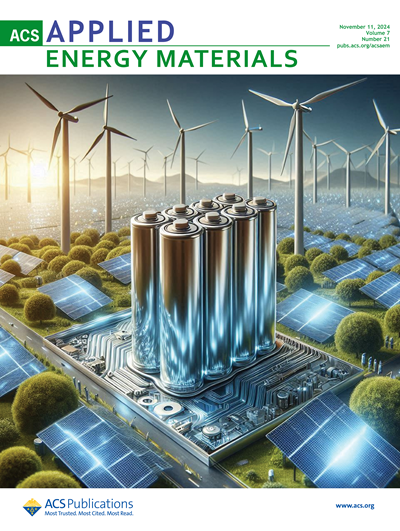
ACS Applied Energy Materials is an interdisciplinary journal publishing original research covering all aspects of materials, engineering, chemistry, physics and biology relevant to energy conversion and storage. The journal is devoted to reports of new and original experimental and theoretical research of an applied nature that integrate knowledge in the areas of materials, engineering, physics, bioscience, and chemistry into important energy applications.



 京公网安备 11010802042870号
京ICP备2023020795号-1
京公网安备 11010802042870号
京ICP备2023020795号-1

 分享
分享
 求助内容:
求助内容: 应助结果提醒方式:
 扫码关注我们
