{"title":"A novel stabilized nodal integration formulation using particle finite element method for incompressible flow analysis","authors":"Lu‐Jia Yu, Yin‐Fu Jin, Zhen-Yu Yin, Jian‐Fei Chen","doi":"10.1002/fld.5271","DOIUrl":null,"url":null,"abstract":"In simulations using the particle finite element method (PFEM) with node‐based strain smoothing technique (NS‐PFEM) to simulate the incompressible flow, spatial and temporal instabilities have been identified as crucial problems. Accordingly, this study presents a stabilized NS‐PFEM‐FIC formulation to simulate an incompressible fluid with free‐surface flow. In the proposed approach, (1) stabilization is achieved by implementing the gradient strain field in place of the constant strain field over the smoothing domains, handling spatial and temporal instabilities in direct nodal integration; (2) the finite increment calculus (FIC) stabilization terms are added using nodal integration, and a three‐step fractional step method is adopted to update pressures and velocities; and (3) a novel slip boundary with the predictor–corrector algorithm is developed to deal with the interaction between the free‐surface flow with rigid walls, avoiding the pressure concentration induced by standard no‐slip condition. The proposed stabilized NS‐PFEM‐FIC is validated via several classical numerical cases (hydrostatic test, water jet impinging, water dam break, and water dam break on a rigid obstacle). Comparisons of all simulations to the experimental results and other numerical solutions reveal good agreement, demonstrating the strong ability of the proposed stabilized NS‐PFEM‐FIC to solve incompressible free‐surface flow with high accuracy and promising application prospects.","PeriodicalId":1,"journal":{"name":"Accounts of Chemical Research","volume":"16 5","pages":""},"PeriodicalIF":17.7000,"publicationDate":"2024-02-12","publicationTypes":"Journal Article","fieldsOfStudy":null,"isOpenAccess":false,"openAccessPdf":"","citationCount":"0","resultStr":null,"platform":"Semanticscholar","paperid":null,"PeriodicalName":"Accounts of Chemical Research","FirstCategoryId":"5","ListUrlMain":"https://doi.org/10.1002/fld.5271","RegionNum":1,"RegionCategory":"化学","ArticlePicture":[],"TitleCN":null,"AbstractTextCN":null,"PMCID":null,"EPubDate":"","PubModel":"","JCR":"Q1","JCRName":"CHEMISTRY, MULTIDISCIPLINARY","Score":null,"Total":0}
引用次数: 0
Abstract
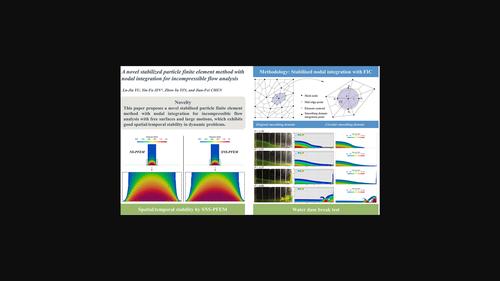
In simulations using the particle finite element method (PFEM) with node‐based strain smoothing technique (NS‐PFEM) to simulate the incompressible flow, spatial and temporal instabilities have been identified as crucial problems. Accordingly, this study presents a stabilized NS‐PFEM‐FIC formulation to simulate an incompressible fluid with free‐surface flow. In the proposed approach, (1) stabilization is achieved by implementing the gradient strain field in place of the constant strain field over the smoothing domains, handling spatial and temporal instabilities in direct nodal integration; (2) the finite increment calculus (FIC) stabilization terms are added using nodal integration, and a three‐step fractional step method is adopted to update pressures and velocities; and (3) a novel slip boundary with the predictor–corrector algorithm is developed to deal with the interaction between the free‐surface flow with rigid walls, avoiding the pressure concentration induced by standard no‐slip condition. The proposed stabilized NS‐PFEM‐FIC is validated via several classical numerical cases (hydrostatic test, water jet impinging, water dam break, and water dam break on a rigid obstacle). Comparisons of all simulations to the experimental results and other numerical solutions reveal good agreement, demonstrating the strong ability of the proposed stabilized NS‐PFEM‐FIC to solve incompressible free‐surface flow with high accuracy and promising application prospects.
期刊介绍:
Accounts of Chemical Research presents short, concise and critical articles offering easy-to-read overviews of basic research and applications in all areas of chemistry and biochemistry. These short reviews focus on research from the author’s own laboratory and are designed to teach the reader about a research project. In addition, Accounts of Chemical Research publishes commentaries that give an informed opinion on a current research problem. Special Issues online are devoted to a single topic of unusual activity and significance.
Accounts of Chemical Research replaces the traditional article abstract with an article "Conspectus." These entries synopsize the research affording the reader a closer look at the content and significance of an article. Through this provision of a more detailed description of the article contents, the Conspectus enhances the article's discoverability by search engines and the exposure for the research.





 京公网安备 11010802042870号
京ICP备2023020795号-1
京公网安备 11010802042870号
京ICP备2023020795号-1

 分享
分享
 求助内容:
求助内容: 应助结果提醒方式:
 扫码关注我们
