{"title":"Moving least‐squares aided finite element method: A powerful means to predict flow fields in the presence of a solid part","authors":"M. Mostafaiyan, S. Wiessner, G. Heinrich","doi":"10.1002/fld.5261","DOIUrl":null,"url":null,"abstract":"With the assistance of the moving least‐squares (MLS) interpolation functions, a two‐dimensional finite element code is developed to consider the effects of a stationary or moving solid body in a flow domain. At the same time, the mesh or grid is independent of the shape of the solid body. We achieve this goal in two steps. In the first step, we use MLS interpolants to enhance the pressure (P) and velocity (V) shape functions. By this means, we capture different discontinuities in a flow domain. In our previous publications, we have named this technique the PVMLS method (pressure and velocity shape functions enhanced by the MLS interpolants) and described it thoroughly. In the second step, we modify the PVMLS method (the M‐PVMLS method) to consider the effect of a solid part(s) in a flow domain. To evaluate the new method's performance, we compare the results of the M‐PVMLS method with a finite element code that uses boundary‐fitted meshes.","PeriodicalId":1,"journal":{"name":"Accounts of Chemical Research","volume":"110 35","pages":""},"PeriodicalIF":18.0000,"publicationDate":"2024-02-11","publicationTypes":"Journal Article","fieldsOfStudy":null,"isOpenAccess":false,"openAccessPdf":"","citationCount":"0","resultStr":null,"platform":"Semanticscholar","paperid":null,"PeriodicalName":"Accounts of Chemical Research","FirstCategoryId":"5","ListUrlMain":"https://doi.org/10.1002/fld.5261","RegionNum":1,"RegionCategory":"化学","ArticlePicture":[],"TitleCN":null,"AbstractTextCN":null,"PMCID":null,"EPubDate":"","PubModel":"","JCR":"Q1","JCRName":"CHEMISTRY, MULTIDISCIPLINARY","Score":null,"Total":0}
引用次数: 0
Abstract
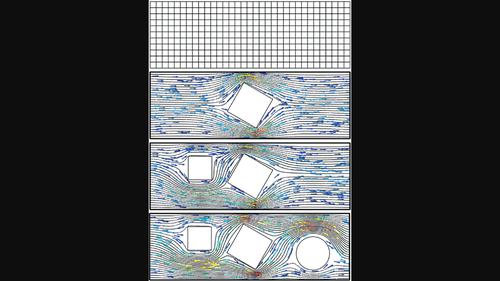
With the assistance of the moving least‐squares (MLS) interpolation functions, a two‐dimensional finite element code is developed to consider the effects of a stationary or moving solid body in a flow domain. At the same time, the mesh or grid is independent of the shape of the solid body. We achieve this goal in two steps. In the first step, we use MLS interpolants to enhance the pressure (P) and velocity (V) shape functions. By this means, we capture different discontinuities in a flow domain. In our previous publications, we have named this technique the PVMLS method (pressure and velocity shape functions enhanced by the MLS interpolants) and described it thoroughly. In the second step, we modify the PVMLS method (the M‐PVMLS method) to consider the effect of a solid part(s) in a flow domain. To evaluate the new method's performance, we compare the results of the M‐PVMLS method with a finite element code that uses boundary‐fitted meshes.
期刊介绍:
Accounts of Chemical Research presents short, concise and critical articles offering easy-to-read overviews of basic research and applications in all areas of chemistry and biochemistry. These short reviews focus on research from the author’s own laboratory and are designed to teach the reader about a research project. In addition, Accounts of Chemical Research publishes commentaries that give an informed opinion on a current research problem. Special Issues online are devoted to a single topic of unusual activity and significance.
Accounts of Chemical Research replaces the traditional article abstract with an article "Conspectus." These entries synopsize the research affording the reader a closer look at the content and significance of an article. Through this provision of a more detailed description of the article contents, the Conspectus enhances the article's discoverability by search engines and the exposure for the research.





 京公网安备 11010802042870号
京ICP备2023020795号-1
京公网安备 11010802042870号
京ICP备2023020795号-1

 分享
分享
 求助内容:
求助内容: 应助结果提醒方式:
 扫码关注我们
