{"title":"High‐order gas kinetic flux solver for viscous compressible flow simulations","authors":"Lan Jiang, Jie Wu, Liming Yang, Hao Dong","doi":"10.1002/fld.5272","DOIUrl":null,"url":null,"abstract":"Although the gas kinetic schemes (GKS) have emerged as one of the powerful tools for simulating compressible flows, they exhibit several shortcomings. Since the local solution of continuous Boltzmann equation with the Maxwellian distribution function is used to calculate the numerical fluxes at the cell interface, the flux expression in GKS is usually more complicated. In this paper, a high‐order simplified gas kinetic flux solver (GKFS) is presented for simulating two‐dimensional compressible flows. Circular function‐based GKFS (C‐GKFS), which simplifies the Maxwellian distribution function into the circular function, combined with an improved weighted essentially non‐oscillatory (WENO‐Z) scheme is applied to capture more details of the flow fields with fewer grids. As a result, a simple high‐order accurate C‐GKFS is obtained, which improves the computing efficiency and reduce its complexity to facilitate the practical application of engineering. A series of benchmark‐test problems are simulated and good agreement can be obtained compared with the references, which demonstrate that the high‐order C‐GKFS can achieve the desired accuracy.","PeriodicalId":1,"journal":{"name":"Accounts of Chemical Research","volume":" 5","pages":""},"PeriodicalIF":17.7000,"publicationDate":"2024-02-08","publicationTypes":"Journal Article","fieldsOfStudy":null,"isOpenAccess":false,"openAccessPdf":"","citationCount":"0","resultStr":null,"platform":"Semanticscholar","paperid":null,"PeriodicalName":"Accounts of Chemical Research","FirstCategoryId":"5","ListUrlMain":"https://doi.org/10.1002/fld.5272","RegionNum":1,"RegionCategory":"化学","ArticlePicture":[],"TitleCN":null,"AbstractTextCN":null,"PMCID":null,"EPubDate":"","PubModel":"","JCR":"Q1","JCRName":"CHEMISTRY, MULTIDISCIPLINARY","Score":null,"Total":0}
引用次数: 0
Abstract
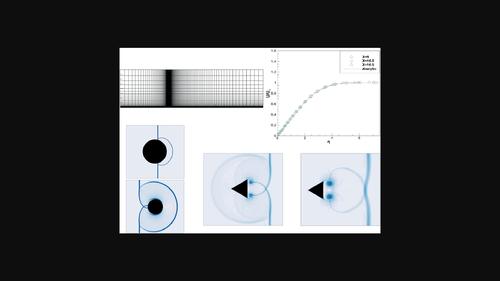
Although the gas kinetic schemes (GKS) have emerged as one of the powerful tools for simulating compressible flows, they exhibit several shortcomings. Since the local solution of continuous Boltzmann equation with the Maxwellian distribution function is used to calculate the numerical fluxes at the cell interface, the flux expression in GKS is usually more complicated. In this paper, a high‐order simplified gas kinetic flux solver (GKFS) is presented for simulating two‐dimensional compressible flows. Circular function‐based GKFS (C‐GKFS), which simplifies the Maxwellian distribution function into the circular function, combined with an improved weighted essentially non‐oscillatory (WENO‐Z) scheme is applied to capture more details of the flow fields with fewer grids. As a result, a simple high‐order accurate C‐GKFS is obtained, which improves the computing efficiency and reduce its complexity to facilitate the practical application of engineering. A series of benchmark‐test problems are simulated and good agreement can be obtained compared with the references, which demonstrate that the high‐order C‐GKFS can achieve the desired accuracy.
期刊介绍:
Accounts of Chemical Research presents short, concise and critical articles offering easy-to-read overviews of basic research and applications in all areas of chemistry and biochemistry. These short reviews focus on research from the author’s own laboratory and are designed to teach the reader about a research project. In addition, Accounts of Chemical Research publishes commentaries that give an informed opinion on a current research problem. Special Issues online are devoted to a single topic of unusual activity and significance.
Accounts of Chemical Research replaces the traditional article abstract with an article "Conspectus." These entries synopsize the research affording the reader a closer look at the content and significance of an article. Through this provision of a more detailed description of the article contents, the Conspectus enhances the article's discoverability by search engines and the exposure for the research.




 京公网安备 11010802042870号
京ICP备2023020795号-1
京公网安备 11010802042870号
京ICP备2023020795号-1

 分享
分享
 求助内容:
求助内容: 应助结果提醒方式:
 扫码关注我们
