{"title":"Correlation between variant call accuracy and quality parameters in comprehensive cancer genomic profiling tests","authors":"Hideaki Isago, Kousuke Watanabe, Yumiko Satoh, Makoto Kurano","doi":"10.1016/j.plabm.2024.e00369","DOIUrl":null,"url":null,"abstract":"<div><h3>Background</h3><p>Comprehensive genomic profiling (CGP) tests have been widely utilized in clinical practice. In this test, the variant list automatically output from the data analysis pipeline often contains false-positive variants, although the correlation between the quality parameters and prevalence of false-positive variants remains unclear.</p></div><div><h3>Methods</h3><p>We analyzed 125 CGP tests performed in our laboratory. False-positive variants were manually detected via visual inspection. The quality parameters of both wet and dry processes were also analyzed.</p></div><div><h3>Results</h3><p>Among the 125 tests, 52 (41.6%) required more than one correction of the called variants, and 21 (16.8%) required multiple corrections. A significant correlation was detected between somatic false-positive variants and quality parameters in the wet (ΔΔCq, pre-capture library peak size, pre-capture library DNA amount, capture library peak size, and capture library concentration) and dry processes (total reads, mapping rates, duplication rates, mean depth, and depth coverage). Capture library concentration and mean depth were strong independent predictors of somatic false-positive variants.</p></div><div><h3>Conclusions</h3><p>We demonstrated a correlation between somatic false-positive variants and quality parameters in the CGP test. This study facilitates gaining a better understanding of CGP test quality management.</p></div>","PeriodicalId":20421,"journal":{"name":"Practical Laboratory Medicine","volume":"39 ","pages":"Article e00369"},"PeriodicalIF":1.3000,"publicationDate":"2024-03-01","publicationTypes":"Journal Article","fieldsOfStudy":null,"isOpenAccess":false,"openAccessPdf":"https://www.sciencedirect.com/science/article/pii/S2352551724000155/pdfft?md5=482fb8d2769a4b2634936ad7334284a5&pid=1-s2.0-S2352551724000155-main.pdf","citationCount":"0","resultStr":null,"platform":"Semanticscholar","paperid":null,"PeriodicalName":"Practical Laboratory Medicine","FirstCategoryId":"1085","ListUrlMain":"https://www.sciencedirect.com/science/article/pii/S2352551724000155","RegionNum":0,"RegionCategory":null,"ArticlePicture":[],"TitleCN":null,"AbstractTextCN":null,"PMCID":null,"EPubDate":"2024/2/15 0:00:00","PubModel":"Epub","JCR":"Q3","JCRName":"MEDICAL LABORATORY TECHNOLOGY","Score":null,"Total":0}
引用次数: 0
Abstract
Background
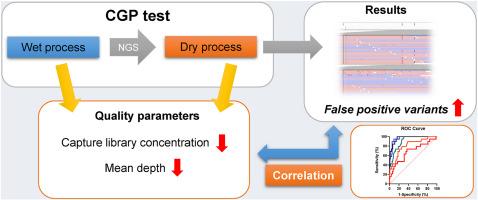
Comprehensive genomic profiling (CGP) tests have been widely utilized in clinical practice. In this test, the variant list automatically output from the data analysis pipeline often contains false-positive variants, although the correlation between the quality parameters and prevalence of false-positive variants remains unclear.
Methods
We analyzed 125 CGP tests performed in our laboratory. False-positive variants were manually detected via visual inspection. The quality parameters of both wet and dry processes were also analyzed.
Results
Among the 125 tests, 52 (41.6%) required more than one correction of the called variants, and 21 (16.8%) required multiple corrections. A significant correlation was detected between somatic false-positive variants and quality parameters in the wet (ΔΔCq, pre-capture library peak size, pre-capture library DNA amount, capture library peak size, and capture library concentration) and dry processes (total reads, mapping rates, duplication rates, mean depth, and depth coverage). Capture library concentration and mean depth were strong independent predictors of somatic false-positive variants.
Conclusions
We demonstrated a correlation between somatic false-positive variants and quality parameters in the CGP test. This study facilitates gaining a better understanding of CGP test quality management.
期刊介绍:
Practical Laboratory Medicine is a high-quality, peer-reviewed, international open-access journal publishing original research, new methods and critical evaluations, case reports and short papers in the fields of clinical chemistry and laboratory medicine. The objective of the journal is to provide practical information of immediate relevance to workers in clinical laboratories. The primary scope of the journal covers clinical chemistry, hematology, molecular biology and genetics relevant to laboratory medicine, microbiology, immunology, therapeutic drug monitoring and toxicology, laboratory management and informatics. We welcome papers which describe critical evaluations of biomarkers and their role in the diagnosis and treatment of clinically significant disease, validation of commercial and in-house IVD methods, method comparisons, interference reports, the development of new reagents and reference materials, reference range studies and regulatory compliance reports. Manuscripts describing the development of new methods applicable to laboratory medicine (including point-of-care testing) are particularly encouraged, even if preliminary or small scale.



 京公网安备 11010802042870号
京ICP备2023020795号-1
京公网安备 11010802042870号
京ICP备2023020795号-1

 分享
分享
 求助内容:
求助内容: 应助结果提醒方式:
 扫码关注我们
