Ehsan Jafari Nodoushan, M. Tajnesaie, Ahmad Shakibaeinia
{"title":"Two‐ and three‐dimensional multiphase mesh‐free particle modeling of transitional landslide with μ(I) rheology","authors":"Ehsan Jafari Nodoushan, M. Tajnesaie, Ahmad Shakibaeinia","doi":"10.1002/fld.5274","DOIUrl":null,"url":null,"abstract":"Landslides, which are the sources of most catastrophic natural disasters, can be subaerial (dry), submerged (underwater), or semi‐submerged (transitional). Semi‐submerged or transitional landslides occur when a subaerial landslide enters water and turns to submerged condition. Predicting the behavior of such a highly dynamic multi‐phase granular flow system is challenging, mainly due to the water entry effects, such as wave impact and partial saturation (and resulted cohesion). The mesh‐free particle methods, such as the moving particle semi‐implicit (MPS) method, have proven their capabilities for the simulation of the highly dynamic multiphase systems. This study develops and evaluates a numerical model, based on the MPS particle method in combination with the μ(I) rheological model, to simulate the morphodynamic of the granular mass in semi‐submerged landslides in two and three dimensions. An algorithm is developed to consider partial saturation (and resulting cohesion) during the water entry. Comparing the numerical results with the experimental measurements shows the ability of the proposed model to accurately reproduce the morphological evolution of the granular mass, especially at the moment of water entry.","PeriodicalId":1,"journal":{"name":"Accounts of Chemical Research","volume":"340 ","pages":""},"PeriodicalIF":17.7000,"publicationDate":"2024-02-12","publicationTypes":"Journal Article","fieldsOfStudy":null,"isOpenAccess":false,"openAccessPdf":"","citationCount":"0","resultStr":null,"platform":"Semanticscholar","paperid":null,"PeriodicalName":"Accounts of Chemical Research","FirstCategoryId":"5","ListUrlMain":"https://doi.org/10.1002/fld.5274","RegionNum":1,"RegionCategory":"化学","ArticlePicture":[],"TitleCN":null,"AbstractTextCN":null,"PMCID":null,"EPubDate":"","PubModel":"","JCR":"Q1","JCRName":"CHEMISTRY, MULTIDISCIPLINARY","Score":null,"Total":0}
引用次数: 0
Abstract
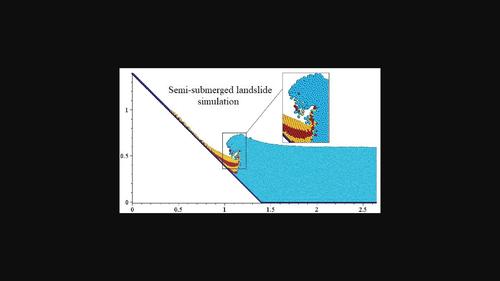
Landslides, which are the sources of most catastrophic natural disasters, can be subaerial (dry), submerged (underwater), or semi‐submerged (transitional). Semi‐submerged or transitional landslides occur when a subaerial landslide enters water and turns to submerged condition. Predicting the behavior of such a highly dynamic multi‐phase granular flow system is challenging, mainly due to the water entry effects, such as wave impact and partial saturation (and resulted cohesion). The mesh‐free particle methods, such as the moving particle semi‐implicit (MPS) method, have proven their capabilities for the simulation of the highly dynamic multiphase systems. This study develops and evaluates a numerical model, based on the MPS particle method in combination with the μ(I) rheological model, to simulate the morphodynamic of the granular mass in semi‐submerged landslides in two and three dimensions. An algorithm is developed to consider partial saturation (and resulting cohesion) during the water entry. Comparing the numerical results with the experimental measurements shows the ability of the proposed model to accurately reproduce the morphological evolution of the granular mass, especially at the moment of water entry.
期刊介绍:
Accounts of Chemical Research presents short, concise and critical articles offering easy-to-read overviews of basic research and applications in all areas of chemistry and biochemistry. These short reviews focus on research from the author’s own laboratory and are designed to teach the reader about a research project. In addition, Accounts of Chemical Research publishes commentaries that give an informed opinion on a current research problem. Special Issues online are devoted to a single topic of unusual activity and significance.
Accounts of Chemical Research replaces the traditional article abstract with an article "Conspectus." These entries synopsize the research affording the reader a closer look at the content and significance of an article. Through this provision of a more detailed description of the article contents, the Conspectus enhances the article's discoverability by search engines and the exposure for the research.




 京公网安备 11010802042870号
京ICP备2023020795号-1
京公网安备 11010802042870号
京ICP备2023020795号-1

 分享
分享
 求助内容:
求助内容: 应助结果提醒方式:
 扫码关注我们
