Amol Dattatray Dhaygude, G. Ameta, I. Khan, P. Singh, R. R. Maaliw, Natrayan Lakshmaiya, Mohammad Shabaz, Muhammad Attique Khan, Hany S. Hussein, H. Alshazly
{"title":"Knowledge‐based deep learning system for classifying Alzheimer's disease for multi‐task learning","authors":"Amol Dattatray Dhaygude, G. Ameta, I. Khan, P. Singh, R. R. Maaliw, Natrayan Lakshmaiya, Mohammad Shabaz, Muhammad Attique Khan, Hany S. Hussein, H. Alshazly","doi":"10.1049/cit2.12291","DOIUrl":null,"url":null,"abstract":"Deep learning has recently become a viable approach for classifying Alzheimer's disease (AD) in medical imaging. However, existing models struggle to efficiently extract features from medical images and may squander additional information resources for illness classification. To address these issues, a deep three‐dimensional convolutional neural network incorporating multi‐task learning and attention mechanisms is proposed. An upgraded primary C3D network is utilised to create rougher low‐level feature maps. It introduces a new convolution block that focuses on the structural aspects of the magnetic resonance imaging image and another block that extracts attention weights unique to certain pixel positions in the feature map and multiplies them with the feature map output. Then, several fully connected layers are used to achieve multi‐task learning, generating three outputs, including the primary classification task. The other two outputs employ backpropagation during training to improve the primary classification job. Experimental findings show that the authors’ proposed method outperforms current approaches for classifying AD, achieving enhanced classification accuracy and other indicators on the Alzheimer's disease Neuroimaging Initiative dataset. The authors demonstrate promise for future disease classification studies.","PeriodicalId":8,"journal":{"name":"ACS Biomaterials Science & Engineering","volume":"20 3","pages":""},"PeriodicalIF":5.5000,"publicationDate":"2024-02-08","publicationTypes":"Journal Article","fieldsOfStudy":null,"isOpenAccess":false,"openAccessPdf":"","citationCount":"0","resultStr":null,"platform":"Semanticscholar","paperid":null,"PeriodicalName":"ACS Biomaterials Science & Engineering","FirstCategoryId":"94","ListUrlMain":"https://doi.org/10.1049/cit2.12291","RegionNum":2,"RegionCategory":"医学","ArticlePicture":[],"TitleCN":null,"AbstractTextCN":null,"PMCID":null,"EPubDate":"","PubModel":"","JCR":"Q2","JCRName":"MATERIALS SCIENCE, BIOMATERIALS","Score":null,"Total":0}
引用次数: 0
Abstract
Deep learning has recently become a viable approach for classifying Alzheimer's disease (AD) in medical imaging. However, existing models struggle to efficiently extract features from medical images and may squander additional information resources for illness classification. To address these issues, a deep three‐dimensional convolutional neural network incorporating multi‐task learning and attention mechanisms is proposed. An upgraded primary C3D network is utilised to create rougher low‐level feature maps. It introduces a new convolution block that focuses on the structural aspects of the magnetic resonance imaging image and another block that extracts attention weights unique to certain pixel positions in the feature map and multiplies them with the feature map output. Then, several fully connected layers are used to achieve multi‐task learning, generating three outputs, including the primary classification task. The other two outputs employ backpropagation during training to improve the primary classification job. Experimental findings show that the authors’ proposed method outperforms current approaches for classifying AD, achieving enhanced classification accuracy and other indicators on the Alzheimer's disease Neuroimaging Initiative dataset. The authors demonstrate promise for future disease classification studies.
最近,深度学习已成为医学影像中阿尔茨海默病(AD)分类的一种可行方法。然而,现有模型难以有效地从医学图像中提取特征,可能会浪费用于疾病分类的额外信息资源。为了解决这些问题,我们提出了一种融合了多任务学习和注意力机制的深度三维卷积神经网络。利用升级后的初级 C3D 网络来创建更粗糙的低级特征图。它引入了一个新的卷积块,重点关注磁共振成像图像的结构方面,另一个卷积块则提取特征图中某些像素位置特有的注意力权重,并将其与特征图输出相乘。然后,使用多个全连接层实现多任务学习,产生三个输出,包括主要分类任务。另外两个输出在训练过程中采用反向传播,以改进主要分类工作。实验结果表明,作者提出的方法优于当前的 AD 分类方法,在阿尔茨海默病神经影像倡议数据集上实现了更高的分类准确率和其他指标。作者展示了未来疾病分类研究的前景。
期刊介绍:
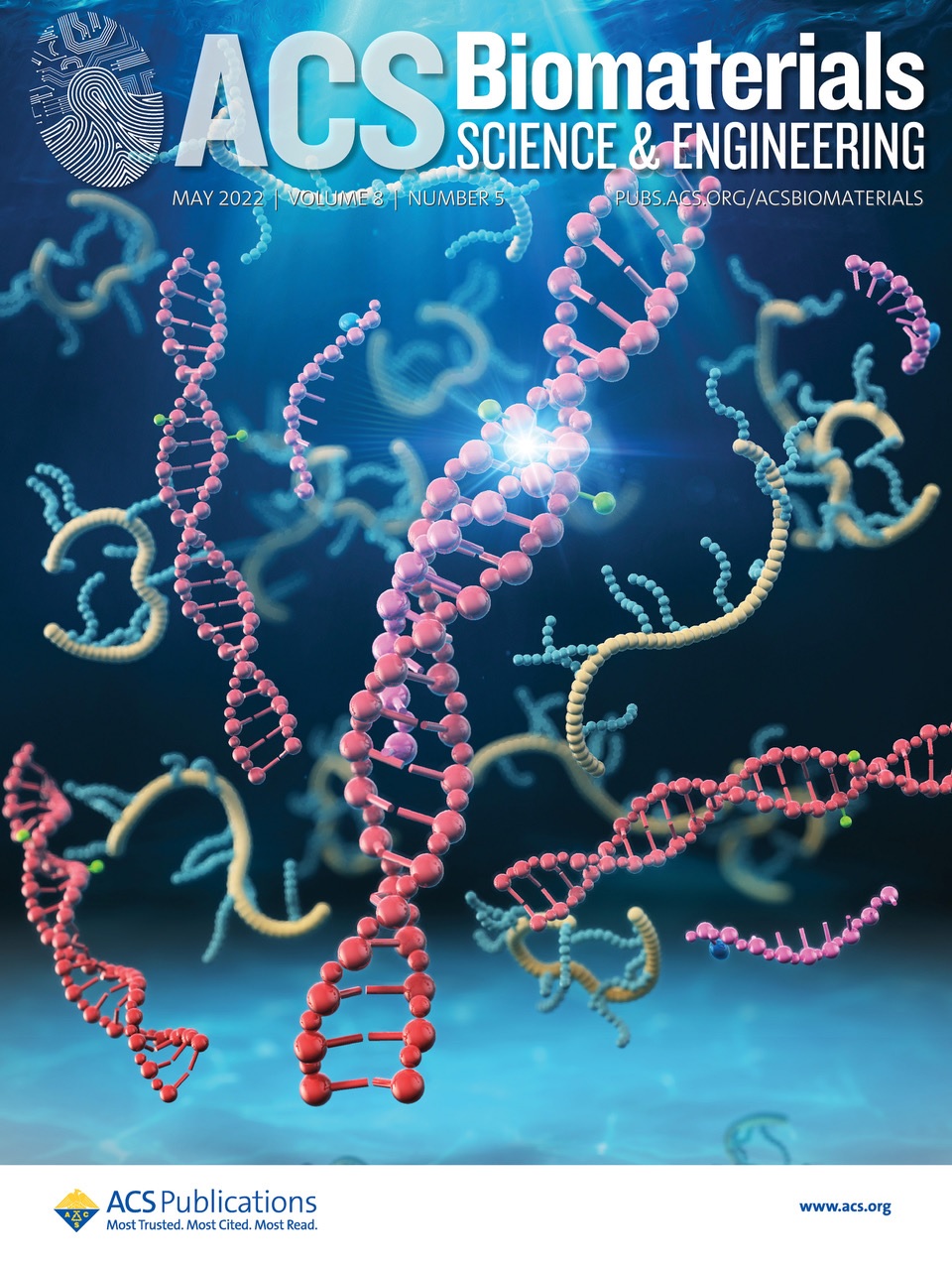
ACS Biomaterials Science & Engineering is the leading journal in the field of biomaterials, serving as an international forum for publishing cutting-edge research and innovative ideas on a broad range of topics:
Applications and Health – implantable tissues and devices, prosthesis, health risks, toxicology
Bio-interactions and Bio-compatibility – material-biology interactions, chemical/morphological/structural communication, mechanobiology, signaling and biological responses, immuno-engineering, calcification, coatings, corrosion and degradation of biomaterials and devices, biophysical regulation of cell functions
Characterization, Synthesis, and Modification – new biomaterials, bioinspired and biomimetic approaches to biomaterials, exploiting structural hierarchy and architectural control, combinatorial strategies for biomaterials discovery, genetic biomaterials design, synthetic biology, new composite systems, bionics, polymer synthesis
Controlled Release and Delivery Systems – biomaterial-based drug and gene delivery, bio-responsive delivery of regulatory molecules, pharmaceutical engineering
Healthcare Advances – clinical translation, regulatory issues, patient safety, emerging trends
Imaging and Diagnostics – imaging agents and probes, theranostics, biosensors, monitoring
Manufacturing and Technology – 3D printing, inks, organ-on-a-chip, bioreactor/perfusion systems, microdevices, BioMEMS, optics and electronics interfaces with biomaterials, systems integration
Modeling and Informatics Tools – scaling methods to guide biomaterial design, predictive algorithms for structure-function, biomechanics, integrating bioinformatics with biomaterials discovery, metabolomics in the context of biomaterials
Tissue Engineering and Regenerative Medicine – basic and applied studies, cell therapies, scaffolds, vascularization, bioartificial organs, transplantation and functionality, cellular agriculture



 京公网安备 11010802042870号
京ICP备2023020795号-1
京公网安备 11010802042870号
京ICP备2023020795号-1

 分享
分享
 求助内容:
求助内容: 应助结果提醒方式:
 扫码关注我们
