{"title":"Talking Past Each Other: Construal Level, Utilitarian Motives, and Entrepreneurial Team Formation","authors":"Steven M. Gray, Travis Howell, Esther Sackett","doi":"10.1287/orsc.2022.16693","DOIUrl":null,"url":null,"abstract":"Entrepreneurs often struggle to add cofounders who are both interpersonally compatible and who possess complementary resources (i.e., hybrid ties). In this paper, we suggest that there are cognitive and motivational differences between lead entrepreneurs and potential cofounders that complicate the formation of hybrid ties. We propose that lead entrepreneurs prioritize resources, whereas potential cofounders prioritize interpersonal compatibility, because of differences in construal level and utilitarian motives during the team formation process. Although these differences can complicate the formation of hybrid ties, we posit that lead entrepreneurs can overcome these differences by communicating in ways that highlight their interpersonal compatibility with potential cofounders. We find support for our theory across three studies with data from (1) the Y Combinator Co-Founder Matching online platform, (2) an online experiment with entrepreneurs, and (3) a networking event at an incubator. Our findings add novel contributions to the entrepreneurial team formation, entrepreneurial networking, and social networks literatures. Funding: This work was supported by the Ewing Marion Kauffman Foundation [2016 Dissertation Fellowship Award]. Supplemental Material: The online appendices are available at https://doi.org/10.1287/orsc.2022.16693 .","PeriodicalId":4,"journal":{"name":"ACS Applied Energy Materials","volume":"153 2","pages":""},"PeriodicalIF":5.5000,"publicationDate":"2024-02-08","publicationTypes":"Journal Article","fieldsOfStudy":null,"isOpenAccess":false,"openAccessPdf":"","citationCount":"0","resultStr":null,"platform":"Semanticscholar","paperid":null,"PeriodicalName":"ACS Applied Energy Materials","FirstCategoryId":"91","ListUrlMain":"https://doi.org/10.1287/orsc.2022.16693","RegionNum":3,"RegionCategory":"材料科学","ArticlePicture":[],"TitleCN":null,"AbstractTextCN":null,"PMCID":null,"EPubDate":"","PubModel":"","JCR":"Q2","JCRName":"CHEMISTRY, PHYSICAL","Score":null,"Total":0}
引用次数: 0
Abstract
Entrepreneurs often struggle to add cofounders who are both interpersonally compatible and who possess complementary resources (i.e., hybrid ties). In this paper, we suggest that there are cognitive and motivational differences between lead entrepreneurs and potential cofounders that complicate the formation of hybrid ties. We propose that lead entrepreneurs prioritize resources, whereas potential cofounders prioritize interpersonal compatibility, because of differences in construal level and utilitarian motives during the team formation process. Although these differences can complicate the formation of hybrid ties, we posit that lead entrepreneurs can overcome these differences by communicating in ways that highlight their interpersonal compatibility with potential cofounders. We find support for our theory across three studies with data from (1) the Y Combinator Co-Founder Matching online platform, (2) an online experiment with entrepreneurs, and (3) a networking event at an incubator. Our findings add novel contributions to the entrepreneurial team formation, entrepreneurial networking, and social networks literatures. Funding: This work was supported by the Ewing Marion Kauffman Foundation [2016 Dissertation Fellowship Award]. Supplemental Material: The online appendices are available at https://doi.org/10.1287/orsc.2022.16693 .
期刊介绍:
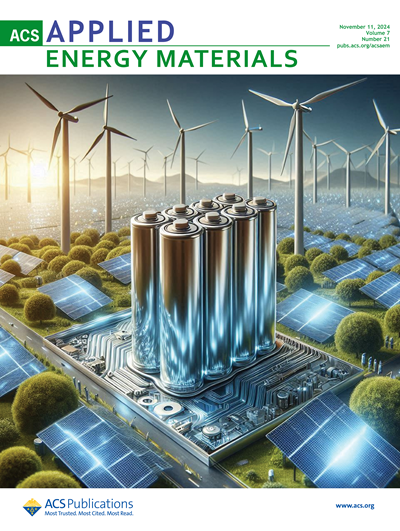
ACS Applied Energy Materials is an interdisciplinary journal publishing original research covering all aspects of materials, engineering, chemistry, physics and biology relevant to energy conversion and storage. The journal is devoted to reports of new and original experimental and theoretical research of an applied nature that integrate knowledge in the areas of materials, engineering, physics, bioscience, and chemistry into important energy applications.



 京公网安备 11010802042870号
京ICP备2023020795号-1
京公网安备 11010802042870号
京ICP备2023020795号-1

 分享
分享
 求助内容:
求助内容: 应助结果提醒方式:
 扫码关注我们
