Anh Le-McClain, Curt Zanelotti, Hector Robert, Federico Casanova
{"title":"Analysis of complex mixtures with benchtop nuclear magnetic resonance: Solvent suppression with T2 and diffusion filters","authors":"Anh Le-McClain, Curt Zanelotti, Hector Robert, Federico Casanova","doi":"10.1002/mrc.5438","DOIUrl":null,"url":null,"abstract":"<p>Benchtop nuclear magnetic resonance (NMR) spectrometers are being employed in a wide variety of applications from undergraduate teaching and research in academia to quality control and process monitoring in industrial settings. Incorporating benchtop NMR in some of these applications presents opportunities for new practical uses of the technology and challenges that truly test the capabilities of compact NMR spectrometers. For instance, the use of protonated solvents in manufacturing or process monitoring requires separating and quantitating the analyte signals of interest from the strong (overwhelming) response from the solvents. Furthermore, due to the lower field strength available with permanent magnet spectrometers, the NMR spectra of complex mixtures can be more difficult to analyze due to partial or complete signal overlap. To address some of these challenges and to extend the range of applications of benchtop NMR, we investigate NMR techniques that enable quantitative analysis of different components in mixtures. These pulse sequences can be used to suppress one or multiple solvent peaks, to filter out signals by spin–spin relaxation time (<i>T</i><sub>2</sub>), or to separate signal components by a molecule's diffusion coefficient (NMR diffusometry). In this paper, we discuss quantitative analysis of excipients in buffers for therapeutic proteins to highlight the usefulness of these NMR pulse sequences in the analysis of complex samples with benchtop NMR spectrometers.</p>","PeriodicalId":18142,"journal":{"name":"Magnetic Resonance in Chemistry","volume":"62 7","pages":"497-504"},"PeriodicalIF":1.4000,"publicationDate":"2024-02-18","publicationTypes":"Journal Article","fieldsOfStudy":null,"isOpenAccess":false,"openAccessPdf":"","citationCount":"0","resultStr":null,"platform":"Semanticscholar","paperid":null,"PeriodicalName":"Magnetic Resonance in Chemistry","FirstCategoryId":"92","ListUrlMain":"https://analyticalsciencejournals.onlinelibrary.wiley.com/doi/10.1002/mrc.5438","RegionNum":3,"RegionCategory":"化学","ArticlePicture":[],"TitleCN":null,"AbstractTextCN":null,"PMCID":null,"EPubDate":"","PubModel":"","JCR":"Q3","JCRName":"CHEMISTRY, MULTIDISCIPLINARY","Score":null,"Total":0}
引用次数: 0
Abstract
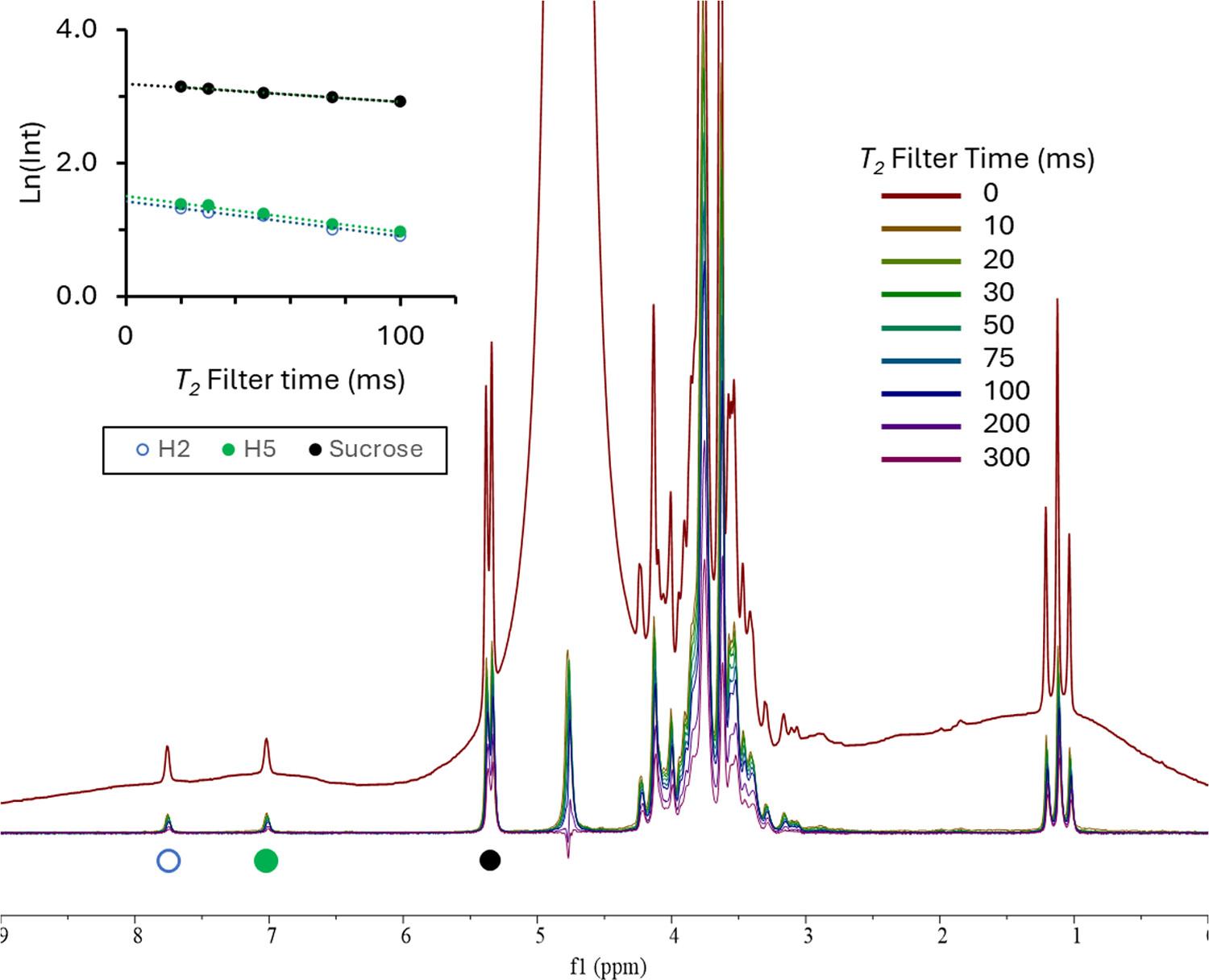
Benchtop nuclear magnetic resonance (NMR) spectrometers are being employed in a wide variety of applications from undergraduate teaching and research in academia to quality control and process monitoring in industrial settings. Incorporating benchtop NMR in some of these applications presents opportunities for new practical uses of the technology and challenges that truly test the capabilities of compact NMR spectrometers. For instance, the use of protonated solvents in manufacturing or process monitoring requires separating and quantitating the analyte signals of interest from the strong (overwhelming) response from the solvents. Furthermore, due to the lower field strength available with permanent magnet spectrometers, the NMR spectra of complex mixtures can be more difficult to analyze due to partial or complete signal overlap. To address some of these challenges and to extend the range of applications of benchtop NMR, we investigate NMR techniques that enable quantitative analysis of different components in mixtures. These pulse sequences can be used to suppress one or multiple solvent peaks, to filter out signals by spin–spin relaxation time (T2), or to separate signal components by a molecule's diffusion coefficient (NMR diffusometry). In this paper, we discuss quantitative analysis of excipients in buffers for therapeutic proteins to highlight the usefulness of these NMR pulse sequences in the analysis of complex samples with benchtop NMR spectrometers.
期刊介绍:
MRC is devoted to the rapid publication of papers which are concerned with the development of magnetic resonance techniques, or in which the application of such techniques plays a pivotal part. Contributions from scientists working in all areas of NMR, ESR and NQR are invited, and papers describing applications in all branches of chemistry, structural biology and materials chemistry are published.
The journal is of particular interest not only to scientists working in academic research, but also those working in commercial organisations who need to keep up-to-date with the latest practical applications of magnetic resonance techniques.





 京公网安备 11010802042870号
京ICP备2023020795号-1
京公网安备 11010802042870号
京ICP备2023020795号-1

 分享
分享
 求助内容:
求助内容: 应助结果提醒方式:
 扫码关注我们
