{"title":"Transcriptomics and Metabolomics Unveil the Neuroprotection Mechanism of AnGong NiuHuang (AGNH) Pill Against Ischaemic Stroke Injury.","authors":"Liangliang Tian, Guangzhao Cao, Xiaotong Zhu, Lihan Wang, Jingyi Hou, Yi Zhang, He Xu, Lixia Wang, Shicong Wang, Chen Zhao, Hongjun Yang, Jingjing Zhang","doi":"10.1007/s12035-024-04016-8","DOIUrl":null,"url":null,"abstract":"<p><p>As a famous prescription in China, AnGong NiuHuang (AGNH) pill exerts good neuroprotection for ischaemic stroke (IS), but its mechanism is still unclear. In this study, the neuroprotection of AGNH was evaluated in the rat IS model which were established with the surgery of middle cerebral artery occlusion (MCAO), and the potential mechanism was elucidated by transcriptomic analysis and metabolomic analysis. AGNH treatment obviously decreased the infarct volume and Zea-Longa 5-point neurological deficit scores, improved the survival percentage of rats, regional cerebral blood flow (rCBF), and rat activity distance and activity time. Transcriptomics showed that AGNH exerted its anti-inflammatory effects by affecting the regulatory network including Tyrobp, Syk, Tlr2, Myd88 and Ccl2 as the core. Integrating transcriptomics and metabolomics identified 8 key metabolites regulated by AGNH, including L-histidine, L-serine, L-alanine, fumaric acid, malic acid, and N-(L-arginino) succinate, 1-pyrroline-4-hydroxy-2-carboxylate and 1-methylhistamine in the rats with IS. Additionally, AGNH obviously reduced Tyrobp, Syk, Tlr2, Myd88 and Ccl2 at both the mRNA and protein levels, decreased IL-1β, KC-GRO, IL-13, TNF-α, cleaved caspase 3 and p65 nucleus translocation, but increased IκBα expression. Network pharmacology analysis showed that quercetin, beta-sitosterol, baicalein, naringenin, acacetin, berberine and palmatine may play an important role in protecting against IS. Taken together, this study reveals that AGNH reduced neuroinflammation and protected against IS by inhibiting Tyrobp/Syk and Tlr2/Myd88, as well as NF-κB signalling pathway and regulating multiple metabolites.</p>","PeriodicalId":18762,"journal":{"name":"Molecular Neurobiology","volume":" ","pages":"7500-7516"},"PeriodicalIF":4.3000,"publicationDate":"2024-10-01","publicationTypes":"Journal Article","fieldsOfStudy":null,"isOpenAccess":false,"openAccessPdf":"","citationCount":"0","resultStr":null,"platform":"Semanticscholar","paperid":null,"PeriodicalName":"Molecular Neurobiology","FirstCategoryId":"3","ListUrlMain":"https://doi.org/10.1007/s12035-024-04016-8","RegionNum":2,"RegionCategory":"医学","ArticlePicture":[],"TitleCN":null,"AbstractTextCN":null,"PMCID":null,"EPubDate":"2024/2/24 0:00:00","PubModel":"Epub","JCR":"Q1","JCRName":"NEUROSCIENCES","Score":null,"Total":0}
引用次数: 0
Abstract
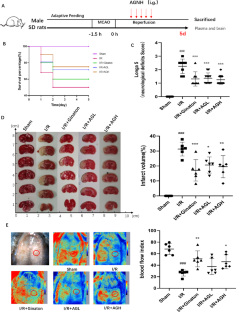
As a famous prescription in China, AnGong NiuHuang (AGNH) pill exerts good neuroprotection for ischaemic stroke (IS), but its mechanism is still unclear. In this study, the neuroprotection of AGNH was evaluated in the rat IS model which were established with the surgery of middle cerebral artery occlusion (MCAO), and the potential mechanism was elucidated by transcriptomic analysis and metabolomic analysis. AGNH treatment obviously decreased the infarct volume and Zea-Longa 5-point neurological deficit scores, improved the survival percentage of rats, regional cerebral blood flow (rCBF), and rat activity distance and activity time. Transcriptomics showed that AGNH exerted its anti-inflammatory effects by affecting the regulatory network including Tyrobp, Syk, Tlr2, Myd88 and Ccl2 as the core. Integrating transcriptomics and metabolomics identified 8 key metabolites regulated by AGNH, including L-histidine, L-serine, L-alanine, fumaric acid, malic acid, and N-(L-arginino) succinate, 1-pyrroline-4-hydroxy-2-carboxylate and 1-methylhistamine in the rats with IS. Additionally, AGNH obviously reduced Tyrobp, Syk, Tlr2, Myd88 and Ccl2 at both the mRNA and protein levels, decreased IL-1β, KC-GRO, IL-13, TNF-α, cleaved caspase 3 and p65 nucleus translocation, but increased IκBα expression. Network pharmacology analysis showed that quercetin, beta-sitosterol, baicalein, naringenin, acacetin, berberine and palmatine may play an important role in protecting against IS. Taken together, this study reveals that AGNH reduced neuroinflammation and protected against IS by inhibiting Tyrobp/Syk and Tlr2/Myd88, as well as NF-κB signalling pathway and regulating multiple metabolites.
期刊介绍:
Molecular Neurobiology is an exciting journal for neuroscientists needing to stay in close touch with progress at the forefront of molecular brain research today. It is an especially important periodical for graduate students and "postdocs," specifically designed to synthesize and critically assess research trends for all neuroscientists hoping to stay active at the cutting edge of this dramatically developing area. This journal has proven to be crucial in departmental libraries, serving as essential reading for every committed neuroscientist who is striving to keep abreast of all rapid developments in a forefront field. Most recent significant advances in experimental and clinical neuroscience have been occurring at the molecular level. Until now, there has been no journal devoted to looking closely at this fragmented literature in a critical, coherent fashion. Each submission is thoroughly analyzed by scientists and clinicians internationally renowned for their special competence in the areas treated.



 京公网安备 11010802042870号
京ICP备2023020795号-1
京公网安备 11010802042870号
京ICP备2023020795号-1

 分享
分享
 求助内容:
求助内容: 应助结果提醒方式:
 扫码关注我们
