{"title":"Progress on Tritium Toxicity and Detoxification Strategies","authors":"Binghui Lu, Xinrui Yang, Jing Liu and Rong Li*, ","doi":"10.1021/acs.chas.3c00091","DOIUrl":null,"url":null,"abstract":"<p >Tritium is a radioactive isotope of hydrogen that emits β-rays. Ingesting large doses of tritium can result in significant internal radiation damage to tissues and organs, causing chromosome damage, genomic instability, and even cancer. Therefore, the efficient promotion of tritium excretion and detoxification has become a crucial concern due to the extensive utilization of tritium. Conventional approaches involve administering diuretics and increased water intake, which can shorten the effective half-excretion period by 4 to 6 days. However, diuretic usage may lead to adverse reactions. In recent years, traditional Chinese medicines, such as Paichuanpian and Chahuangjing, have garnered attention for their potential in tritium elimination, with demonstrated low toxicity in animal experiments. Nevertheless, given the limited number of clinical cases involving internal tritium pollution, uncertainties persist regarding their clinical effects and toxicity levels. Hydrogen-rich water provides a simple, safe, nontoxic solution that has demonstrated promising results in antiradiation therapy and the treatment of various diseases. Experimental evidence suggests that hydrogen-rich water can also enhance excretion and detoxification processes while offering antioxidant benefits in animal models exposed to internal tritium. Therefore, it holds potential as an innovative approach for promoting tritium excretion and detoxification. This paper aims to compare the advantages and disadvantages of different measures and medications to provide insights into the development and enhancement of drugs specifically designed for promoting tritium excretion.</p>","PeriodicalId":73648,"journal":{"name":"Journal of chemical health & safety","volume":"31 2","pages":"144–152"},"PeriodicalIF":3.4000,"publicationDate":"2024-02-23","publicationTypes":"Journal Article","fieldsOfStudy":null,"isOpenAccess":false,"openAccessPdf":"","citationCount":"0","resultStr":null,"platform":"Semanticscholar","paperid":null,"PeriodicalName":"Journal of chemical health & safety","FirstCategoryId":"1085","ListUrlMain":"https://pubs.acs.org/doi/10.1021/acs.chas.3c00091","RegionNum":0,"RegionCategory":null,"ArticlePicture":[],"TitleCN":null,"AbstractTextCN":null,"PMCID":null,"EPubDate":"","PubModel":"","JCR":"","JCRName":"","Score":null,"Total":0}
引用次数: 0
Abstract
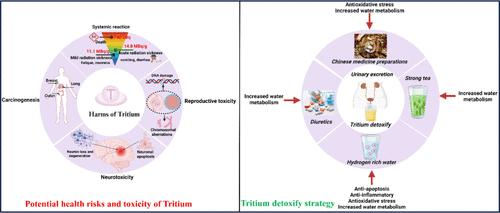
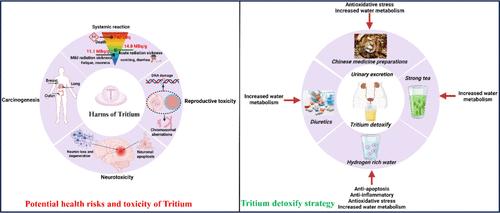
Tritium is a radioactive isotope of hydrogen that emits β-rays. Ingesting large doses of tritium can result in significant internal radiation damage to tissues and organs, causing chromosome damage, genomic instability, and even cancer. Therefore, the efficient promotion of tritium excretion and detoxification has become a crucial concern due to the extensive utilization of tritium. Conventional approaches involve administering diuretics and increased water intake, which can shorten the effective half-excretion period by 4 to 6 days. However, diuretic usage may lead to adverse reactions. In recent years, traditional Chinese medicines, such as Paichuanpian and Chahuangjing, have garnered attention for their potential in tritium elimination, with demonstrated low toxicity in animal experiments. Nevertheless, given the limited number of clinical cases involving internal tritium pollution, uncertainties persist regarding their clinical effects and toxicity levels. Hydrogen-rich water provides a simple, safe, nontoxic solution that has demonstrated promising results in antiradiation therapy and the treatment of various diseases. Experimental evidence suggests that hydrogen-rich water can also enhance excretion and detoxification processes while offering antioxidant benefits in animal models exposed to internal tritium. Therefore, it holds potential as an innovative approach for promoting tritium excretion and detoxification. This paper aims to compare the advantages and disadvantages of different measures and medications to provide insights into the development and enhancement of drugs specifically designed for promoting tritium excretion.



 京公网安备 11010802042870号
京ICP备2023020795号-1
京公网安备 11010802042870号
京ICP备2023020795号-1

 分享
分享

 求助内容:
求助内容: 应助结果提醒方式:
 扫码关注我们
