{"title":"Causal associations between gastroesophageal reflux disease and essential hypertension: A bidirectional Mendelian randomization study.","authors":"Ning Wei, Ming-Hui Liu, Yu-Hu Song","doi":"10.12998/wjcc.v12.i5.880","DOIUrl":null,"url":null,"abstract":"<p><strong>Background: </strong>Clinical studies have reported that patients with gastroesophageal reflux disease (GERD) have a higher prevalence of hypertension.</p><p><strong>Aim: </strong>To performed a bidirectional Mendelian randomization (MR) analysis to investigate the causal link between GERD and essential hypertension.</p><p><strong>Methods: </strong>Eligible single nucleotide polymorphisms (SNPs) were selected, and weighted median, inverse variance weighted (IVW) as well as MR egger (MR-Egger) regression were used to examine the potential causal association between GERD and hypertension. The MR-Pleiotropy RESidual Sum and Outlier analysis was used to detect and attempt to reduce horizontal pleiotropy by removing outliers SNPs. The MR-Egger intercept test, Cochran's <i>Q</i> test and \"leave-one-out\" sensitivity analysis were performed to evaluate the horizontal pleiotropy, heterogeneities, and stability of single instrumental variable.</p><p><strong>Results: </strong>IVW analysis exhibited an increased risk of hypertension (OR = 1.46, 95%CI: 1.33-1.59, <i>P</i> = 2.14E-16) in GERD patients. And the same result was obtained in replication practice (OR = 1.002, 95%CI: 1.0008-1.003, <i>P</i> = 0.000498). Meanwhile, the IVW analysis showed an increased risk of systolic blood pressure (β = 0.78, 95%CI: 0.11-1.44, <i>P</i> = 0.021) and hypertensive heart disease (OR = 1.68, 95%CI: 1.36-2.08, <i>P</i> = 0.0000016) in GERD patients. Moreover, we found an decreased risk of Barrett's esophagus (OR = 0.91, 95%CI: 0.83-0.99, <i>P</i> = 0.043) in essential hypertension patients.</p><p><strong>Conclusion: </strong>We found that GERD would increase the risk of essential hypertension, which provided a novel prevent and therapeutic perspectives of essential hypertension.</p>","PeriodicalId":23912,"journal":{"name":"World Journal of Clinical Cases","volume":"12 5","pages":"880-890"},"PeriodicalIF":1.0000,"publicationDate":"2024-02-16","publicationTypes":"Journal Article","fieldsOfStudy":null,"isOpenAccess":false,"openAccessPdf":"https://www.ncbi.nlm.nih.gov/pmc/articles/PMC10895642/pdf/","citationCount":"0","resultStr":null,"platform":"Semanticscholar","paperid":null,"PeriodicalName":"World Journal of Clinical Cases","FirstCategoryId":"3","ListUrlMain":"https://doi.org/10.12998/wjcc.v12.i5.880","RegionNum":4,"RegionCategory":"医学","ArticlePicture":[],"TitleCN":null,"AbstractTextCN":null,"PMCID":null,"EPubDate":"","PubModel":"","JCR":"Q3","JCRName":"MEDICINE, GENERAL & INTERNAL","Score":null,"Total":0}
引用次数: 0
Abstract
Background: Clinical studies have reported that patients with gastroesophageal reflux disease (GERD) have a higher prevalence of hypertension.
Aim: To performed a bidirectional Mendelian randomization (MR) analysis to investigate the causal link between GERD and essential hypertension.
Methods: Eligible single nucleotide polymorphisms (SNPs) were selected, and weighted median, inverse variance weighted (IVW) as well as MR egger (MR-Egger) regression were used to examine the potential causal association between GERD and hypertension. The MR-Pleiotropy RESidual Sum and Outlier analysis was used to detect and attempt to reduce horizontal pleiotropy by removing outliers SNPs. The MR-Egger intercept test, Cochran's Q test and "leave-one-out" sensitivity analysis were performed to evaluate the horizontal pleiotropy, heterogeneities, and stability of single instrumental variable.
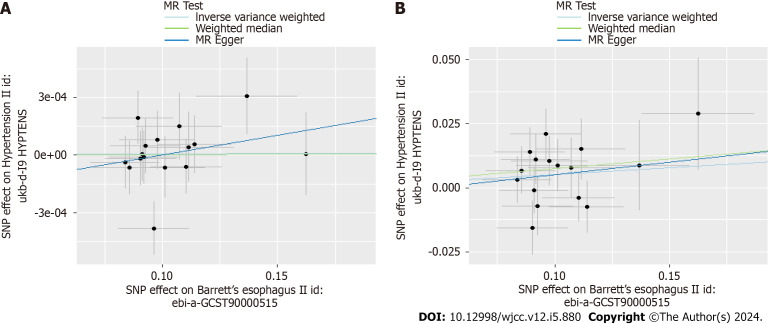
Results: IVW analysis exhibited an increased risk of hypertension (OR = 1.46, 95%CI: 1.33-1.59, P = 2.14E-16) in GERD patients. And the same result was obtained in replication practice (OR = 1.002, 95%CI: 1.0008-1.003, P = 0.000498). Meanwhile, the IVW analysis showed an increased risk of systolic blood pressure (β = 0.78, 95%CI: 0.11-1.44, P = 0.021) and hypertensive heart disease (OR = 1.68, 95%CI: 1.36-2.08, P = 0.0000016) in GERD patients. Moreover, we found an decreased risk of Barrett's esophagus (OR = 0.91, 95%CI: 0.83-0.99, P = 0.043) in essential hypertension patients.
Conclusion: We found that GERD would increase the risk of essential hypertension, which provided a novel prevent and therapeutic perspectives of essential hypertension.
期刊介绍:
The World Journal of Clinical Cases (WJCC) is a high-quality, peer reviewed, open-access journal. The primary task of WJCC is to rapidly publish high-quality original articles, reviews, editorials, and case reports in the field of clinical cases. In order to promote productive academic communication, the peer review process for the WJCC is transparent; to this end, all published manuscripts are accompanied by the anonymized reviewers’ comments as well as the authors’ responses. The primary aims of the WJCC are to improve diagnostic, therapeutic and preventive modalities and the skills of clinicians and to guide clinical practice in clinical cases.





 京公网安备 11010802042870号
京ICP备2023020795号-1
京公网安备 11010802042870号
京ICP备2023020795号-1

 分享
分享
 求助内容:
求助内容: 应助结果提醒方式:
 扫码关注我们
