Clare J Finlay, Michael J Jackson, Ria Fisher, Christoffer Bundgaard, Sarah Rose, Susan Duty
{"title":"Metabotropic Glutamate Receptor 4 (mGlu4) Positive Allosteric Modulators Lack Efficacy in Rat and Marmoset Models of L-DOPA-Induced Dyskinesia.","authors":"Clare J Finlay, Michael J Jackson, Ria Fisher, Christoffer Bundgaard, Sarah Rose, Susan Duty","doi":"10.3233/JPD-230296","DOIUrl":null,"url":null,"abstract":"<p><strong>Background: </strong>Increased activity across corticostriatal glutamatergic synapses may contribute to L-DOPA-induced dyskinesia in Parkinson's disease. Given the weak efficacy and side-effect profile of amantadine, alternative strategies to reduce glutamate transmission are being investigated. Metabotropic glutamate receptor 4 (mGlu4) is a promising target since its activation would reduce glutamate release.</p><p><strong>Objective: </strong>We hypothesized that two mGlu4 positive allosteric modulators, Lu AF21934 ((1 S,2 R)-N1-(3,4-dichlorophenyl)cyclohexane-1,2-dicarboxamide) and ADX88178 (5-Methyl-N-(4-methylpyrimidin-2-yl)-4-(1H-pyrazol-4-yl)thiazol-2-amine), would provide relief in rat and primate models of L-DOPA-induced dyskinesia.</p><p><strong>Methods: </strong>The ability of Lu AF21934 or ADX88178 to reverse pre-established dyskinesia was examined in L-DOPA-primed 6-hydroxydopamine-lesioned rats expressing abnormal involuntary movements (AIMs) or in 1-methyl-4-phenyl,1,2,3,6-tetrahydropyridine (MPTP)-treated common marmosets expressing L-DOPA-induced dyskinesia. Additionally, the ability of Lu AF21934 to prevent the development of de novo L-DOPA-induced AIMs was explored in the 6-hydroxydopamine-lesioned rats.</p><p><strong>Results: </strong>Neither Lu AF21934 (10 or 30 mg/kg p.o.) nor ADX88178 (10 or 30 mg/kg p.o.) reduced pre-established AIMs in 6-hydroxydopamine-lesioned rats. Similarly, in L-DOPA-primed common marmosets, no reduction in established dyskinesia was observed with Lu AF21934 (3 or 10 mg/kg p.o.). Conversely, amantadine significantly reduced (>40%) the expression of dyskinesia in both models. Lu AF21934 also failed to suppress the development of AIMs in 6-hydroxydopamine-lesioned rats.</p><p><strong>Conclusions: </strong>This study found no benefit of mGlu4 positive allosteric modulators in tackling L-DOPA-induced dyskinesia. These findings are concordant with the recent failure of foliglurax in phase II clinical trials supporting the predictive validity of these pre-clinical dyskinesia models, while raising further doubt on the anti-dyskinetic potential of mGlu4 positive allosteric modulators.</p>","PeriodicalId":16660,"journal":{"name":"Journal of Parkinson's disease","volume":" ","pages":"245-259"},"PeriodicalIF":5.0000,"publicationDate":"2024-01-01","publicationTypes":"Journal Article","fieldsOfStudy":null,"isOpenAccess":false,"openAccessPdf":"https://www.ncbi.nlm.nih.gov/pmc/articles/PMC10977372/pdf/","citationCount":"0","resultStr":null,"platform":"Semanticscholar","paperid":null,"PeriodicalName":"Journal of Parkinson's disease","FirstCategoryId":"3","ListUrlMain":"https://doi.org/10.3233/JPD-230296","RegionNum":3,"RegionCategory":"医学","ArticlePicture":[],"TitleCN":null,"AbstractTextCN":null,"PMCID":null,"EPubDate":"","PubModel":"","JCR":"Q2","JCRName":"NEUROSCIENCES","Score":null,"Total":0}
引用次数: 0
Abstract
Background: Increased activity across corticostriatal glutamatergic synapses may contribute to L-DOPA-induced dyskinesia in Parkinson's disease. Given the weak efficacy and side-effect profile of amantadine, alternative strategies to reduce glutamate transmission are being investigated. Metabotropic glutamate receptor 4 (mGlu4) is a promising target since its activation would reduce glutamate release.
Objective: We hypothesized that two mGlu4 positive allosteric modulators, Lu AF21934 ((1 S,2 R)-N1-(3,4-dichlorophenyl)cyclohexane-1,2-dicarboxamide) and ADX88178 (5-Methyl-N-(4-methylpyrimidin-2-yl)-4-(1H-pyrazol-4-yl)thiazol-2-amine), would provide relief in rat and primate models of L-DOPA-induced dyskinesia.
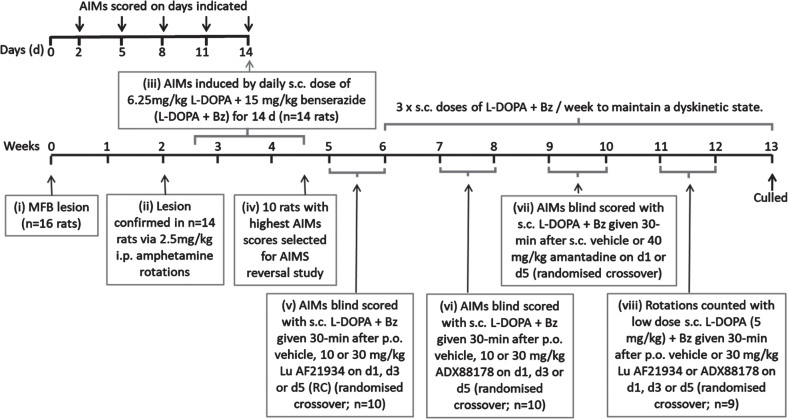
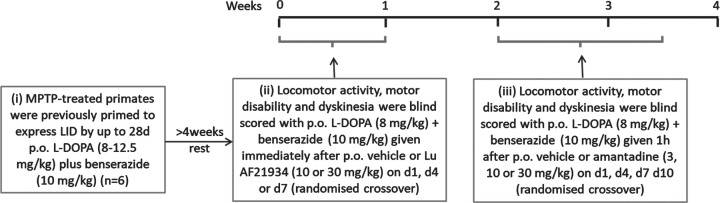
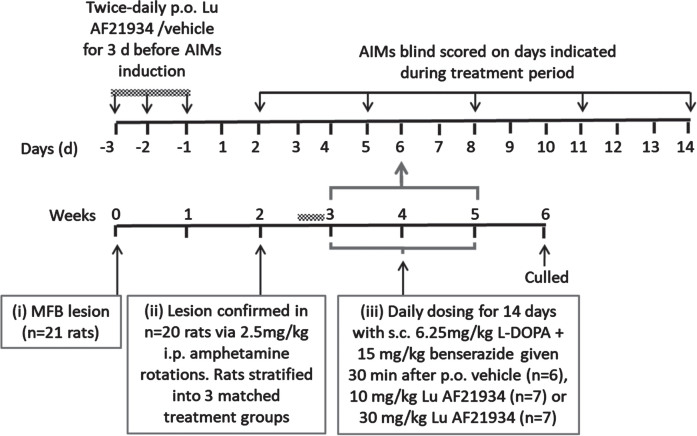
Methods: The ability of Lu AF21934 or ADX88178 to reverse pre-established dyskinesia was examined in L-DOPA-primed 6-hydroxydopamine-lesioned rats expressing abnormal involuntary movements (AIMs) or in 1-methyl-4-phenyl,1,2,3,6-tetrahydropyridine (MPTP)-treated common marmosets expressing L-DOPA-induced dyskinesia. Additionally, the ability of Lu AF21934 to prevent the development of de novo L-DOPA-induced AIMs was explored in the 6-hydroxydopamine-lesioned rats.
Results: Neither Lu AF21934 (10 or 30 mg/kg p.o.) nor ADX88178 (10 or 30 mg/kg p.o.) reduced pre-established AIMs in 6-hydroxydopamine-lesioned rats. Similarly, in L-DOPA-primed common marmosets, no reduction in established dyskinesia was observed with Lu AF21934 (3 or 10 mg/kg p.o.). Conversely, amantadine significantly reduced (>40%) the expression of dyskinesia in both models. Lu AF21934 also failed to suppress the development of AIMs in 6-hydroxydopamine-lesioned rats.
Conclusions: This study found no benefit of mGlu4 positive allosteric modulators in tackling L-DOPA-induced dyskinesia. These findings are concordant with the recent failure of foliglurax in phase II clinical trials supporting the predictive validity of these pre-clinical dyskinesia models, while raising further doubt on the anti-dyskinetic potential of mGlu4 positive allosteric modulators.
期刊介绍:
The Journal of Parkinson''s Disease (JPD) publishes original research in basic science, translational research and clinical medicine in Parkinson’s disease in cooperation with the Journal of Alzheimer''s Disease. It features a first class Editorial Board and provides rigorous peer review and rapid online publication.





 京公网安备 11010802042870号
京ICP备2023020795号-1
京公网安备 11010802042870号
京ICP备2023020795号-1

 分享
分享
 求助内容:
求助内容: 应助结果提醒方式:
 扫码关注我们
