Characterization of Non-Ischemic Dilated Cardiomyopathy in a Native Tanzanian Cohort: MOYO Study.
IF 3.1 3区 医学Q2 CARDIAC & CARDIOVASCULAR SYSTEMSGlobal HeartPub Date : 2024-02-29eCollection Date: 2024-01-01DOI:10.5334/gh.1298
Lulu Said Fundikira, Pilly Chillo, Mohamed Z Alimohamed, Henry Mayala, Engerasiya Kifai, Geofrey M Aloyce, Appolinary Kamuhabwa, Gideon Kwesigabo, Linda W van Laake, Folkert W Asselbergs
{"title":"Characterization of Non-Ischemic Dilated Cardiomyopathy in a Native Tanzanian Cohort: MOYO Study.","authors":"Lulu Said Fundikira, Pilly Chillo, Mohamed Z Alimohamed, Henry Mayala, Engerasiya Kifai, Geofrey M Aloyce, Appolinary Kamuhabwa, Gideon Kwesigabo, Linda W van Laake, Folkert W Asselbergs","doi":"10.5334/gh.1298","DOIUrl":null,"url":null,"abstract":"<p><strong>Background: </strong>Non-ischemic dilated cardiomyopathy (NIDCM) is a common cause of heart failure with progressive tendency. The disease occurs in one in every 2,500 individuals in the developed world, with high morbidity and mortality. However, detailed data on the role of NIDCM in heart failure in Tanzania is lacking.</p><p><strong>Aim: </strong>To characterize NIDCM in a Tanzanian cohort with respect to demographics, clinical profile, imaging findings and management.</p><p><strong>Methods: </strong>Characterization of non-ischemic dilated cardioMyOpathY in a native Tanzanian cOhort (MOYO) is a prospective cohort study of NIDCM patients seen at the Jakaya Kikwete Cardiac Institute. Patients aged ≥18 years with a clinical diagnosis of heart failure, an ejection fraction of ≤45% on echocardiography and no evidence of ischemia were enrolled. Clinical data, echocardiography, electrocardiography (ECG), coronary angiography and stress ECG information were collected from February 2020 to March 2022.</p><p><strong>Results: </strong>Of 402 patients, n = 220 (54.7%) were males with a median (IQR) age of 55.0 (41.0, 66.0) years. Causes of NIDCM were presumably hypertensive n = 218 (54.2%), idiopathic n = 116 (28.9%), PPCM n = 45 (11.2%), alcoholic n = 10 (2.5%) and other causes n = 13 (3.2%). The most common presenting symptoms were dyspnea n = 342 (85.1%), with the majority of patients presenting with New York Heart Association (NYHA) Class III n = 195 (48.5%). The mean (SD) left ventricular ejection fraction (LVEF) was 29.4% (±7.7), and severe systolic dysfunction (LVEF <30%) was common n = 208 (51.7%). Compared with other forms of DCM, idiopathic DCM patients were significantly younger, had more advanced NYHA class (p < 0.001) and presented more often with left bundle branch block on ECG (p = 0.0042). There was suboptimal use of novel guidelines recommended medications ARNI n = 10 (2.5%) and SGLT2 2-inhibitors n = 2 (0.5%).</p><p><strong>Conclusions: </strong>In our Tanzanian cohort, the majority of patients with NIDCM have an identified underlying cause, and they present at late stages of the disease. Patients with idiopathic DCM are younger with more severe disease compared to other forms of NIDCM.</p>","PeriodicalId":56018,"journal":{"name":"Global Heart","volume":"19 1","pages":"26"},"PeriodicalIF":3.1000,"publicationDate":"2024-02-29","publicationTypes":"Journal Article","fieldsOfStudy":null,"isOpenAccess":false,"openAccessPdf":"https://www.ncbi.nlm.nih.gov/pmc/articles/PMC10906337/pdf/","citationCount":"0","resultStr":null,"platform":"Semanticscholar","paperid":null,"PeriodicalName":"Global Heart","FirstCategoryId":"3","ListUrlMain":"https://doi.org/10.5334/gh.1298","RegionNum":3,"RegionCategory":"医学","ArticlePicture":[],"TitleCN":null,"AbstractTextCN":null,"PMCID":null,"EPubDate":"2024/1/1 0:00:00","PubModel":"eCollection","JCR":"Q2","JCRName":"CARDIAC & CARDIOVASCULAR SYSTEMS","Score":null,"Total":0}
引用次数: 0
Abstract
Background: Non-ischemic dilated cardiomyopathy (NIDCM) is a common cause of heart failure with progressive tendency. The disease occurs in one in every 2,500 individuals in the developed world, with high morbidity and mortality. However, detailed data on the role of NIDCM in heart failure in Tanzania is lacking.
Aim: To characterize NIDCM in a Tanzanian cohort with respect to demographics, clinical profile, imaging findings and management.
Methods: Characterization of non-ischemic dilated cardioMyOpathY in a native Tanzanian cOhort (MOYO) is a prospective cohort study of NIDCM patients seen at the Jakaya Kikwete Cardiac Institute. Patients aged ≥18 years with a clinical diagnosis of heart failure, an ejection fraction of ≤45% on echocardiography and no evidence of ischemia were enrolled. Clinical data, echocardiography, electrocardiography (ECG), coronary angiography and stress ECG information were collected from February 2020 to March 2022.
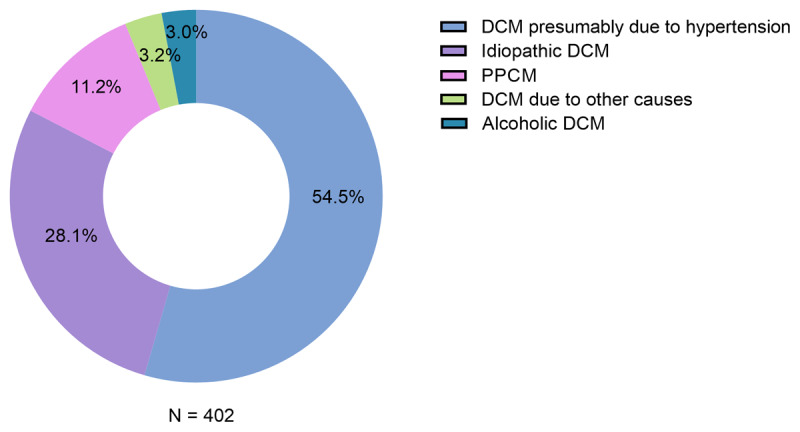
Results: Of 402 patients, n = 220 (54.7%) were males with a median (IQR) age of 55.0 (41.0, 66.0) years. Causes of NIDCM were presumably hypertensive n = 218 (54.2%), idiopathic n = 116 (28.9%), PPCM n = 45 (11.2%), alcoholic n = 10 (2.5%) and other causes n = 13 (3.2%). The most common presenting symptoms were dyspnea n = 342 (85.1%), with the majority of patients presenting with New York Heart Association (NYHA) Class III n = 195 (48.5%). The mean (SD) left ventricular ejection fraction (LVEF) was 29.4% (±7.7), and severe systolic dysfunction (LVEF <30%) was common n = 208 (51.7%). Compared with other forms of DCM, idiopathic DCM patients were significantly younger, had more advanced NYHA class (p < 0.001) and presented more often with left bundle branch block on ECG (p = 0.0042). There was suboptimal use of novel guidelines recommended medications ARNI n = 10 (2.5%) and SGLT2 2-inhibitors n = 2 (0.5%).
Conclusions: In our Tanzanian cohort, the majority of patients with NIDCM have an identified underlying cause, and they present at late stages of the disease. Patients with idiopathic DCM are younger with more severe disease compared to other forms of NIDCM.
Global HeartMedicine-Cardiology and Cardiovascular Medicine
CiteScore
5.70
自引率
5.40%
发文量
77
审稿时长
5 weeks
期刊介绍:
Global Heart offers a forum for dialogue and education on research, developments, trends, solutions and public health programs related to the prevention and control of cardiovascular diseases (CVDs) worldwide, with a special focus on low- and middle-income countries (LMICs). Manuscripts should address not only the extent or epidemiology of the problem, but also describe interventions to effectively control and prevent CVDs and the underlying factors. The emphasis should be on approaches applicable in settings with limited resources.
Economic evaluations of successful interventions are particularly welcome. We will also consider negative findings if important. While reports of hospital or clinic-based treatments are not excluded, particularly if they have broad implications for cost-effective disease control or prevention, we give priority to papers addressing community-based activities. We encourage submissions on cardiovascular surveillance and health policies, professional education, ethical issues and technological innovations related to prevention.
Global Heart is particularly interested in publishing data from updated national or regional demographic health surveys, World Health Organization or Global Burden of Disease data, large clinical disease databases or registries. Systematic reviews or meta-analyses on globally relevant topics are welcome. We will also consider clinical research that has special relevance to LMICs, e.g. using validated instruments to assess health-related quality-of-life in patients from LMICs, innovative diagnostic-therapeutic applications, real-world effectiveness clinical trials, research methods (innovative methodologic papers, with emphasis on low-cost research methods or novel application of methods in low resource settings), and papers pertaining to cardiovascular health promotion and policy (quantitative evaluation of health programs.





 京公网安备 11010802042870号
京ICP备2023020795号-1
京公网安备 11010802042870号
京ICP备2023020795号-1

 分享
分享
 求助内容:
求助内容: 应助结果提醒方式:
 扫码关注我们
