Hui Zhang , Yanfei Zhao , Yusi Wang , Rongxiang Li , Minhao Tang , Wei Zeng , Ying Wang , Xiaoqian Chang , Buxing Han , Zhimin Liu
{"title":"Valorization of polycaprolactone for the production of nylon-6 monomers†","authors":"Hui Zhang , Yanfei Zhao , Yusi Wang , Rongxiang Li , Minhao Tang , Wei Zeng , Ying Wang , Xiaoqian Chang , Buxing Han , Zhimin Liu","doi":"10.1039/d3gc05118h","DOIUrl":null,"url":null,"abstract":"<div><p>Upcycling biodegradable polyester waste into value-added chemicals can not only avoid CO<sub>2</sub> emissions but also achieve sustainable carbon recycling. Herein, we report a one-pot catalytic process to deconstruct polycaprolactone into 6-aminocaproic acid (EACA) and caprolactam (CPL), two monomers of nylon-6, using aqueous ammonia and Ru catalysts. No additional hydrogen is required, and the total yield of EACA and CPL could reach 90.2% using a ternary catalyst, Ru/CeO<sub>2</sub>/RGO, at 140 °C. It is verified that 6-hydroxyhexanoic acid and 6-hydroxyhexanoamide are the initial intermediates resulting from polycaprolactone decomposition, which undergo dehydrogenation, amination and re-hydrogenation to transform into EACA and 6-aminohexanoamide over the Ru catalyst. The hydrolysis of 6-aminohexanoamide produces EACA, and the reverse reaction between dehydration of EACA and hydrolysis of CPL results in their coexistence. The protocol demonstrated here provides a novel route to recycle polycaprolactone to valuable chemicals.</p></div>","PeriodicalId":78,"journal":{"name":"Green Chemistry","volume":"26 6","pages":"Pages 3159-3164"},"PeriodicalIF":9.2000,"publicationDate":"2024-03-18","publicationTypes":"Journal Article","fieldsOfStudy":null,"isOpenAccess":false,"openAccessPdf":"","citationCount":"0","resultStr":null,"platform":"Semanticscholar","paperid":null,"PeriodicalName":"Green Chemistry","FirstCategoryId":"92","ListUrlMain":"https://www.sciencedirect.com/org/science/article/pii/S146392622400236X","RegionNum":1,"RegionCategory":"化学","ArticlePicture":[],"TitleCN":null,"AbstractTextCN":null,"PMCID":null,"EPubDate":"","PubModel":"","JCR":"Q1","JCRName":"CHEMISTRY, MULTIDISCIPLINARY","Score":null,"Total":0}
引用次数: 0
Abstract
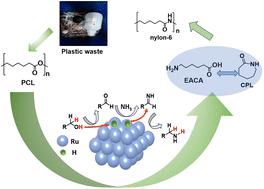
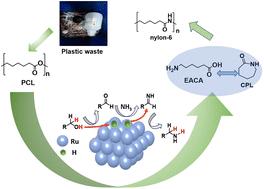
Upcycling biodegradable polyester waste into value-added chemicals can not only avoid CO2 emissions but also achieve sustainable carbon recycling. Herein, we report a one-pot catalytic process to deconstruct polycaprolactone into 6-aminocaproic acid (EACA) and caprolactam (CPL), two monomers of nylon-6, using aqueous ammonia and Ru catalysts. No additional hydrogen is required, and the total yield of EACA and CPL could reach 90.2% using a ternary catalyst, Ru/CeO2/RGO, at 140 °C. It is verified that 6-hydroxyhexanoic acid and 6-hydroxyhexanoamide are the initial intermediates resulting from polycaprolactone decomposition, which undergo dehydrogenation, amination and re-hydrogenation to transform into EACA and 6-aminohexanoamide over the Ru catalyst. The hydrolysis of 6-aminohexanoamide produces EACA, and the reverse reaction between dehydration of EACA and hydrolysis of CPL results in their coexistence. The protocol demonstrated here provides a novel route to recycle polycaprolactone to valuable chemicals.
期刊介绍:
Green Chemistry is a journal that provides a unique forum for the publication of innovative research on the development of alternative green and sustainable technologies. The scope of Green Chemistry is based on the definition proposed by Anastas and Warner (Green Chemistry: Theory and Practice, P T Anastas and J C Warner, Oxford University Press, Oxford, 1998), which defines green chemistry as the utilisation of a set of principles that reduces or eliminates the use or generation of hazardous substances in the design, manufacture and application of chemical products. Green Chemistry aims to reduce the environmental impact of the chemical enterprise by developing a technology base that is inherently non-toxic to living things and the environment. The journal welcomes submissions on all aspects of research relating to this endeavor and publishes original and significant cutting-edge research that is likely to be of wide general appeal. For a work to be published, it must present a significant advance in green chemistry, including a comparison with existing methods and a demonstration of advantages over those methods.