Yan-Lin Ren, Zheng Jiang, Jia-Yi Wang, Qin He, Si-Xu Li, Xiao-Jing Gu, Yang-Ran Qi, Min Zhang, Wen-Jie Yang, Bei Cao, Jing-Yu Li, Yi Wang, Yong-Ping Chen
{"title":"Loss of CHCHD2 Stability Coordinates with C1QBP/CHCHD2/CHCHD10 Complex Impairment to Mediate PD-Linked Mitochondrial Dysfunction.","authors":"Yan-Lin Ren, Zheng Jiang, Jia-Yi Wang, Qin He, Si-Xu Li, Xiao-Jing Gu, Yang-Ran Qi, Min Zhang, Wen-Jie Yang, Bei Cao, Jing-Yu Li, Yi Wang, Yong-Ping Chen","doi":"10.1007/s12035-024-04090-y","DOIUrl":null,"url":null,"abstract":"<p><p>Novel CHCHD2 mutations causing C-terminal truncation and interrupted CHCHD2 protein stability in Parkinson's disease (PD) patients were previously found. However, there is limited understanding of the underlying mechanism and impact of subsequent CHCHD2 loss-of-function on PD pathogenesis. The current study further identified the crucial motif (aa125-133) responsible for diminished CHCHD2 expression and the molecular interplay within the C1QBP/CHCHD2/CHCHD10 complex to regulate mitochondrial functions. Specifically, CHCHD2 deficiency led to decreased neural cell viability and mitochondrial structural and functional impairments, paralleling the upregulation of autophagy under cellular stresses. Meanwhile, as a binding partner of CHCHD2, C1QBP was found to regulate the stability of CHCHD2 and CHCHD10 proteins to maintain the integrity of the C1QBP/CHCHD2/CHCHD10 complex. Moreover, C1QBP-silenced neural cells displayed severe cell death phenotype along with mitochondrial damage that initiated a significant mitophagy process. Taken together, the evidence obtained from our in vitro and in vivo studies emphasized the critical role of CHCHD2 in regulating mitochondria functions via coordination among CHCHD2, CHCHD10, and C1QBP, suggesting the potential mechanism by which CHCHD2 function loss takes part in the progression of neurodegenerative diseases.</p>","PeriodicalId":18762,"journal":{"name":"Molecular Neurobiology","volume":" ","pages":"7968-7988"},"PeriodicalIF":4.3000,"publicationDate":"2024-10-01","publicationTypes":"Journal Article","fieldsOfStudy":null,"isOpenAccess":false,"openAccessPdf":"","citationCount":"0","resultStr":null,"platform":"Semanticscholar","paperid":null,"PeriodicalName":"Molecular Neurobiology","FirstCategoryId":"3","ListUrlMain":"https://doi.org/10.1007/s12035-024-04090-y","RegionNum":2,"RegionCategory":"医学","ArticlePicture":[],"TitleCN":null,"AbstractTextCN":null,"PMCID":null,"EPubDate":"2024/3/7 0:00:00","PubModel":"Epub","JCR":"Q1","JCRName":"NEUROSCIENCES","Score":null,"Total":0}
引用次数: 0
Abstract
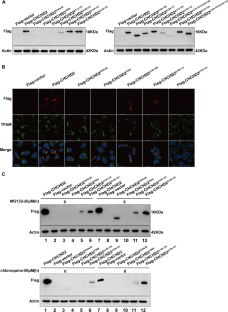
Novel CHCHD2 mutations causing C-terminal truncation and interrupted CHCHD2 protein stability in Parkinson's disease (PD) patients were previously found. However, there is limited understanding of the underlying mechanism and impact of subsequent CHCHD2 loss-of-function on PD pathogenesis. The current study further identified the crucial motif (aa125-133) responsible for diminished CHCHD2 expression and the molecular interplay within the C1QBP/CHCHD2/CHCHD10 complex to regulate mitochondrial functions. Specifically, CHCHD2 deficiency led to decreased neural cell viability and mitochondrial structural and functional impairments, paralleling the upregulation of autophagy under cellular stresses. Meanwhile, as a binding partner of CHCHD2, C1QBP was found to regulate the stability of CHCHD2 and CHCHD10 proteins to maintain the integrity of the C1QBP/CHCHD2/CHCHD10 complex. Moreover, C1QBP-silenced neural cells displayed severe cell death phenotype along with mitochondrial damage that initiated a significant mitophagy process. Taken together, the evidence obtained from our in vitro and in vivo studies emphasized the critical role of CHCHD2 in regulating mitochondria functions via coordination among CHCHD2, CHCHD10, and C1QBP, suggesting the potential mechanism by which CHCHD2 function loss takes part in the progression of neurodegenerative diseases.
期刊介绍:
Molecular Neurobiology is an exciting journal for neuroscientists needing to stay in close touch with progress at the forefront of molecular brain research today. It is an especially important periodical for graduate students and "postdocs," specifically designed to synthesize and critically assess research trends for all neuroscientists hoping to stay active at the cutting edge of this dramatically developing area. This journal has proven to be crucial in departmental libraries, serving as essential reading for every committed neuroscientist who is striving to keep abreast of all rapid developments in a forefront field. Most recent significant advances in experimental and clinical neuroscience have been occurring at the molecular level. Until now, there has been no journal devoted to looking closely at this fragmented literature in a critical, coherent fashion. Each submission is thoroughly analyzed by scientists and clinicians internationally renowned for their special competence in the areas treated.



 京公网安备 11010802042870号
京ICP备2023020795号-1
京公网安备 11010802042870号
京ICP备2023020795号-1

 分享
分享
 求助内容:
求助内容: 应助结果提醒方式:
 扫码关注我们
