{"title":"m6A/m1A/m5C-Associated Methylation Alterations and Immune Profile in MDD.","authors":"Xin Ren, Zhuxiao Feng, Xiaodong Ma, Lijuan Huo, Huiying Zhou, Ayu Bai, Shujie Feng, Ying Zhou, Xuchu Weng, Changhe Fan","doi":"10.1007/s12035-024-04042-6","DOIUrl":null,"url":null,"abstract":"<p><p>Major depressive disorder (MDD) is a prevalent psychiatric condition often accompanied by severe impairments in cognitive and functional capacities. This research was conducted to identify RNA modification-related gene signatures and associated functional pathways in MDD. Differentially expressed RNA modification-related genes in MDD were first identified. And a random forest model was developed and distinct RNA modification patterns were discerned based on signature genes. Then, comprehensive analyses of RNA modification-associated genes in MDD were performed, including functional analyses and immune cell infiltration. The study identified 29 differentially expressed RNA modification-related genes in MDD and two distinct RNA modification patterns. TRMT112, MBD3, NUDT21, and IGF2BP1 of the risk signature were detected. Functional analyses confirmed the involvement of RNA modification in pathways like phosphatidylinositol 3-kinase signaling and nucleotide oligomerization domain (NOD)-like receptor signaling in MDD. NUDT21 displayed a strong positive correlation with type 2 T helper cells, while IGF2BP1 negatively correlated with activated CD8 T cells, central memory CD4 T cells, and natural killer T cells. In summary, further research into the roles of NUDT21 and IGF2BP1 would be valuable for understanding MDD prognosis. The identified RNA modification-related gene signatures and pathways provide insights into MDD molecular etiology and potential diagnostic biomarkers.</p>","PeriodicalId":18762,"journal":{"name":"Molecular Neurobiology","volume":" ","pages":"8000-8025"},"PeriodicalIF":4.3000,"publicationDate":"2024-10-01","publicationTypes":"Journal Article","fieldsOfStudy":null,"isOpenAccess":false,"openAccessPdf":"https://www.ncbi.nlm.nih.gov/pmc/articles/PMC11415454/pdf/","citationCount":"0","resultStr":null,"platform":"Semanticscholar","paperid":null,"PeriodicalName":"Molecular Neurobiology","FirstCategoryId":"3","ListUrlMain":"https://doi.org/10.1007/s12035-024-04042-6","RegionNum":2,"RegionCategory":"医学","ArticlePicture":[],"TitleCN":null,"AbstractTextCN":null,"PMCID":null,"EPubDate":"2024/3/8 0:00:00","PubModel":"Epub","JCR":"Q1","JCRName":"NEUROSCIENCES","Score":null,"Total":0}
引用次数: 0
Abstract
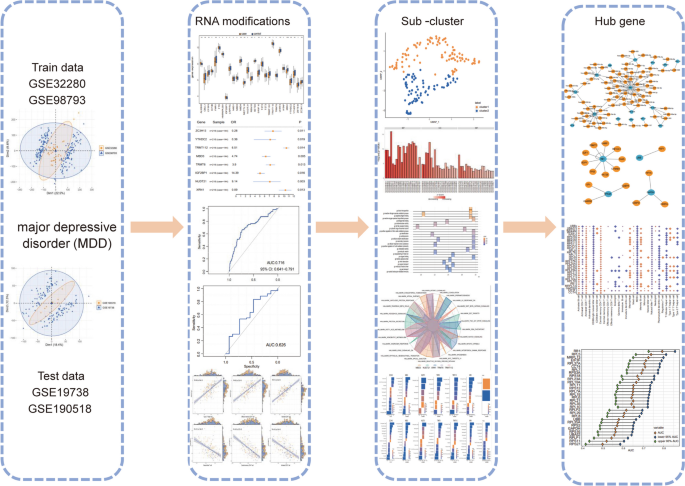
Major depressive disorder (MDD) is a prevalent psychiatric condition often accompanied by severe impairments in cognitive and functional capacities. This research was conducted to identify RNA modification-related gene signatures and associated functional pathways in MDD. Differentially expressed RNA modification-related genes in MDD were first identified. And a random forest model was developed and distinct RNA modification patterns were discerned based on signature genes. Then, comprehensive analyses of RNA modification-associated genes in MDD were performed, including functional analyses and immune cell infiltration. The study identified 29 differentially expressed RNA modification-related genes in MDD and two distinct RNA modification patterns. TRMT112, MBD3, NUDT21, and IGF2BP1 of the risk signature were detected. Functional analyses confirmed the involvement of RNA modification in pathways like phosphatidylinositol 3-kinase signaling and nucleotide oligomerization domain (NOD)-like receptor signaling in MDD. NUDT21 displayed a strong positive correlation with type 2 T helper cells, while IGF2BP1 negatively correlated with activated CD8 T cells, central memory CD4 T cells, and natural killer T cells. In summary, further research into the roles of NUDT21 and IGF2BP1 would be valuable for understanding MDD prognosis. The identified RNA modification-related gene signatures and pathways provide insights into MDD molecular etiology and potential diagnostic biomarkers.
期刊介绍:
Molecular Neurobiology is an exciting journal for neuroscientists needing to stay in close touch with progress at the forefront of molecular brain research today. It is an especially important periodical for graduate students and "postdocs," specifically designed to synthesize and critically assess research trends for all neuroscientists hoping to stay active at the cutting edge of this dramatically developing area. This journal has proven to be crucial in departmental libraries, serving as essential reading for every committed neuroscientist who is striving to keep abreast of all rapid developments in a forefront field. Most recent significant advances in experimental and clinical neuroscience have been occurring at the molecular level. Until now, there has been no journal devoted to looking closely at this fragmented literature in a critical, coherent fashion. Each submission is thoroughly analyzed by scientists and clinicians internationally renowned for their special competence in the areas treated.



 京公网安备 11010802042870号
京ICP备2023020795号-1
京公网安备 11010802042870号
京ICP备2023020795号-1

 分享
分享
 求助内容:
求助内容: 应助结果提醒方式:
 扫码关注我们
