Marie Tremblay-Franco, Cécile Canlet, Audrey Carriere, Jean Nakhle, Anne Galinier, Jean-Charles Portais, Armelle Yart, Cédric Dray, Wan-Hsuan Lu, Justine Bertrand Michel, Sophie Guyonnet, Yves Rolland, Bruno Vellas, Julien Delrieu, Philippe de Souto Barreto, Luc Pénicaud, Louis Casteilla, Isabelle Ader
{"title":"Integrative Multimodal Metabolomics to Early Predict Cognitive Decline Among Amyloid Positive Community-Dwelling Older Adults.","authors":"Marie Tremblay-Franco, Cécile Canlet, Audrey Carriere, Jean Nakhle, Anne Galinier, Jean-Charles Portais, Armelle Yart, Cédric Dray, Wan-Hsuan Lu, Justine Bertrand Michel, Sophie Guyonnet, Yves Rolland, Bruno Vellas, Julien Delrieu, Philippe de Souto Barreto, Luc Pénicaud, Louis Casteilla, Isabelle Ader","doi":"10.1093/gerona/glae077","DOIUrl":null,"url":null,"abstract":"<p><p>Alzheimer's disease is strongly linked to metabolic abnormalities. We aimed to distinguish amyloid-positive people who progressed to cognitive decline from those who remained cognitively intact. We performed untargeted metabolomics of blood samples from amyloid-positive individuals, before any sign of cognitive decline, to distinguish individuals who progressed to cognitive decline from those who remained cognitively intact. A plasma-derived metabolite signature was developed from Supercritical Fluid chromatography coupled with high-resolution mass spectrometry (SFC-HRMS) and nuclear magnetic resonance (NMR) metabolomics. The 2 metabolomics data sets were analyzed by Data Integration Analysis for Biomarker discovery using Latent approaches for Omics studies (DIABLO), to identify a minimum set of metabolites that could describe cognitive decline status. NMR or SFC-HRMS data alone cannot predict cognitive decline. However, among the 320 metabolites identified, a statistical method that integrated the 2 data sets enabled the identification of a minimal signature of 9 metabolites (3-hydroxybutyrate, citrate, succinate, acetone, methionine, glucose, serine, sphingomyelin d18:1/C26:0 and triglyceride C48:3) with a statistically significant ability to predict cognitive decline more than 3 years before decline. This metabolic fingerprint obtained during this exploratory study may help to predict amyloid-positive individuals who will develop cognitive decline. Due to the high prevalence of brain amyloid-positivity in older adults, identifying adults who will have cognitive decline will enable the development of personalized and early interventions.</p>","PeriodicalId":94243,"journal":{"name":"The journals of gerontology. Series A, Biological sciences and medical sciences","volume":" ","pages":""},"PeriodicalIF":0.0000,"publicationDate":"2024-05-01","publicationTypes":"Journal Article","fieldsOfStudy":null,"isOpenAccess":false,"openAccessPdf":"https://www.ncbi.nlm.nih.gov/pmc/articles/PMC11000317/pdf/","citationCount":"0","resultStr":null,"platform":"Semanticscholar","paperid":null,"PeriodicalName":"The journals of gerontology. Series A, Biological sciences and medical sciences","FirstCategoryId":"1085","ListUrlMain":"https://doi.org/10.1093/gerona/glae077","RegionNum":0,"RegionCategory":null,"ArticlePicture":[],"TitleCN":null,"AbstractTextCN":null,"PMCID":null,"EPubDate":"","PubModel":"","JCR":"","JCRName":"","Score":null,"Total":0}
引用次数: 0
Abstract
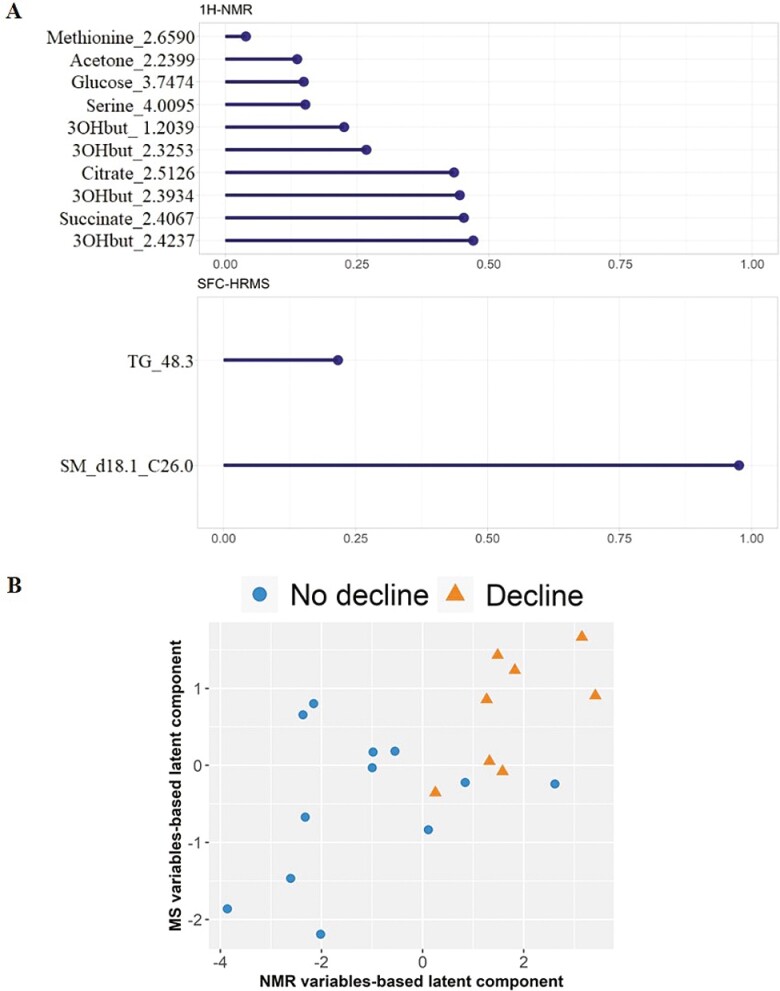
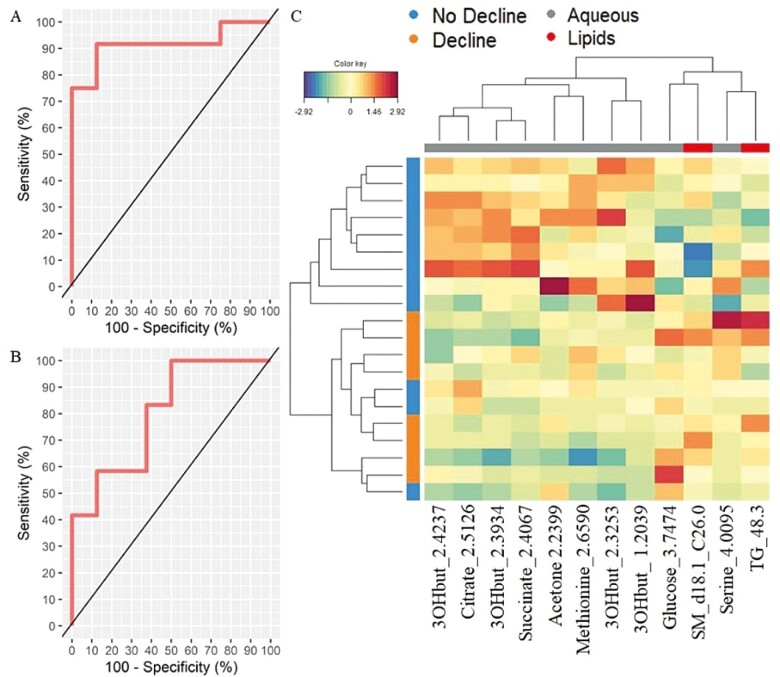
Alzheimer's disease is strongly linked to metabolic abnormalities. We aimed to distinguish amyloid-positive people who progressed to cognitive decline from those who remained cognitively intact. We performed untargeted metabolomics of blood samples from amyloid-positive individuals, before any sign of cognitive decline, to distinguish individuals who progressed to cognitive decline from those who remained cognitively intact. A plasma-derived metabolite signature was developed from Supercritical Fluid chromatography coupled with high-resolution mass spectrometry (SFC-HRMS) and nuclear magnetic resonance (NMR) metabolomics. The 2 metabolomics data sets were analyzed by Data Integration Analysis for Biomarker discovery using Latent approaches for Omics studies (DIABLO), to identify a minimum set of metabolites that could describe cognitive decline status. NMR or SFC-HRMS data alone cannot predict cognitive decline. However, among the 320 metabolites identified, a statistical method that integrated the 2 data sets enabled the identification of a minimal signature of 9 metabolites (3-hydroxybutyrate, citrate, succinate, acetone, methionine, glucose, serine, sphingomyelin d18:1/C26:0 and triglyceride C48:3) with a statistically significant ability to predict cognitive decline more than 3 years before decline. This metabolic fingerprint obtained during this exploratory study may help to predict amyloid-positive individuals who will develop cognitive decline. Due to the high prevalence of brain amyloid-positivity in older adults, identifying adults who will have cognitive decline will enable the development of personalized and early interventions.




 京公网安备 11010802042870号
京ICP备2023020795号-1
京公网安备 11010802042870号
京ICP备2023020795号-1

 分享
分享

 求助内容:
求助内容: 应助结果提醒方式:
 扫码关注我们
