E. V. Shinkar’, I. V. Smolyaninov, N. T. Berberova
{"title":"Metal Complexes with Redox-Active Ligands in the Indirect Electrosynthesis of Organic Sulfur Compounds","authors":"E. V. Shinkar’, I. V. Smolyaninov, N. T. Berberova","doi":"10.1134/S107032842360122X","DOIUrl":null,"url":null,"abstract":"<p>A possibility of using metal complexes with redox-active ligands in organic electrosynthesis is demonstrated on the basis of literature data analysis. Unlike homogeneous catalysis, many examples are known for the application of complexes of this type in electrocatalytic processes characterized by a higher selectivity and milder conditions. Interest in metal complexes with redox-active ligands is due to their use in the heterogeneous electrocatalysis as well. The main attention is given to advantages of the indirect electrosynthesis of organic compounds, in particular, sulfur derivatives, in the presence of mediators or electrocatalysts based on metal complexes with redox-active ligands. Active forms of metal complexes are generated at the electrodes and can initiate the further transformations of inert substrates. A significant decrease in power expenses compared to the direct redox activation of reagents is the main advantage of indirect electrosynthesis. The cyclic processes favoring a permanent regeneration of metal complexes lead to an increase in the yield of target compounds.</p>","PeriodicalId":759,"journal":{"name":"Russian Journal of Coordination Chemistry","volume":"49 2 supplement","pages":"S128 - S158"},"PeriodicalIF":1.1000,"publicationDate":"2024-03-08","publicationTypes":"Journal Article","fieldsOfStudy":null,"isOpenAccess":false,"openAccessPdf":"","citationCount":"0","resultStr":null,"platform":"Semanticscholar","paperid":null,"PeriodicalName":"Russian Journal of Coordination Chemistry","FirstCategoryId":"92","ListUrlMain":"https://link.springer.com/article/10.1134/S107032842360122X","RegionNum":3,"RegionCategory":"化学","ArticlePicture":[],"TitleCN":null,"AbstractTextCN":null,"PMCID":null,"EPubDate":"","PubModel":"","JCR":"Q4","JCRName":"CHEMISTRY, INORGANIC & NUCLEAR","Score":null,"Total":0}
引用次数: 0
Abstract
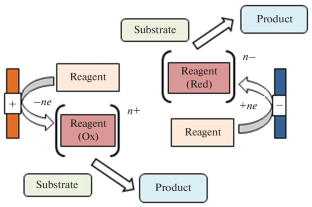
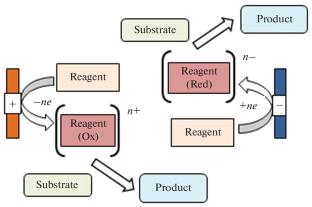
A possibility of using metal complexes with redox-active ligands in organic electrosynthesis is demonstrated on the basis of literature data analysis. Unlike homogeneous catalysis, many examples are known for the application of complexes of this type in electrocatalytic processes characterized by a higher selectivity and milder conditions. Interest in metal complexes with redox-active ligands is due to their use in the heterogeneous electrocatalysis as well. The main attention is given to advantages of the indirect electrosynthesis of organic compounds, in particular, sulfur derivatives, in the presence of mediators or electrocatalysts based on metal complexes with redox-active ligands. Active forms of metal complexes are generated at the electrodes and can initiate the further transformations of inert substrates. A significant decrease in power expenses compared to the direct redox activation of reagents is the main advantage of indirect electrosynthesis. The cyclic processes favoring a permanent regeneration of metal complexes lead to an increase in the yield of target compounds.
期刊介绍:
Russian Journal of Coordination Chemistry is a journal that publishes reviews, original papers, and short communications on all aspects of theoretical and experimental coordination chemistry. Modern coordination chemistry is an interdisciplinary science that makes a bridge between inorganic, organic, physical, analytical, and biological chemistry.



 京公网安备 11010802042870号
京ICP备2023020795号-1
京公网安备 11010802042870号
京ICP备2023020795号-1

 分享
分享
 求助内容:
求助内容: 应助结果提醒方式:
 扫码关注我们
