Rohan K. Henry, Leena Mamilly, Monika Chaudhari, Brett G. Klamer, Melica Nikahd, Amy L. Pyle-Eilola
{"title":"Beyond the bias! Sex distribution in paediatric growth hormone deficiency reexamined","authors":"Rohan K. Henry, Leena Mamilly, Monika Chaudhari, Brett G. Klamer, Melica Nikahd, Amy L. Pyle-Eilola","doi":"10.1111/cen.15047","DOIUrl":null,"url":null,"abstract":"<div>\n \n \n <section>\n \n <h3> Objectives</h3>\n \n <p>Various biases pertaining to stature account for a male sex predominance in growth hormone deficiency (GHD) cases diagnosed by endocrinology clinics. This manuscript will assess the sex distribution when biases are minimised.</p>\n </section>\n \n <section>\n \n <h3> Methods</h3>\n \n <p>Retrospective chart review was conducted on patients diagnosed with GHD between 3 and 16 years of age. The sex distribution of cases was ascertained according to: (1) peak GH (pGH) by groups; based on growth hormone provocative testing, (2) pituitary gland imaging results, and (3) isolated GHD (IGHD) versus multiple pituitary hormone deficiencies (MPHD). The relative frequency of each sex was compared according to these subgroups with significance evaluated at <i>α</i> = .05 level.</p>\n </section>\n \n <section>\n \n <h3> Results</h3>\n \n <p>Of the 5880 clinic referrals for short stature, there were 3709 boys (63%) and 2171 girls (37%). Of these, 20% of boys (<i>n</i> = 745) and 15.3% of girls (<i>n</i> = 332) underwent provocative testing for GHD. Of those tested, 39.2% of boys (<i>n</i> = 292) and 32.2% of girls (<i>n</i> = 107) were diagnosed with GHD, all <i>p</i> < .001. There was a male predominance in GHD cases based on pGH or GHD severity. Though not significant, girls were more likely than boys to have MPHD (<i>p</i> = .056), even across pGH groups (<i>p</i> = .06). Both boys and girls had a similar distribution of imaging abnormalities.</p>\n </section>\n \n <section>\n \n <h3> Conclusion</h3>\n \n <p>Stratifying by sex, we found similar percentages of pituitary imaging abnormalities (including tumours) and the number of pituitary hormone deficiencies in boys and girls as the cause of GHD. For these classifications, we did not find the historically reported male sex predominance.</p>\n </section>\n </div>","PeriodicalId":10346,"journal":{"name":"Clinical Endocrinology","volume":"100 5","pages":"441-446"},"PeriodicalIF":2.4000,"publicationDate":"2024-03-11","publicationTypes":"Journal Article","fieldsOfStudy":null,"isOpenAccess":false,"openAccessPdf":"https://onlinelibrary.wiley.com/doi/epdf/10.1111/cen.15047","citationCount":"0","resultStr":null,"platform":"Semanticscholar","paperid":null,"PeriodicalName":"Clinical Endocrinology","FirstCategoryId":"3","ListUrlMain":"https://onlinelibrary.wiley.com/doi/10.1111/cen.15047","RegionNum":3,"RegionCategory":"医学","ArticlePicture":[],"TitleCN":null,"AbstractTextCN":null,"PMCID":null,"EPubDate":"","PubModel":"","JCR":"Q2","JCRName":"ENDOCRINOLOGY & METABOLISM","Score":null,"Total":0}
引用次数: 0
Abstract
Objectives
Various biases pertaining to stature account for a male sex predominance in growth hormone deficiency (GHD) cases diagnosed by endocrinology clinics. This manuscript will assess the sex distribution when biases are minimised.
Methods
Retrospective chart review was conducted on patients diagnosed with GHD between 3 and 16 years of age. The sex distribution of cases was ascertained according to: (1) peak GH (pGH) by groups; based on growth hormone provocative testing, (2) pituitary gland imaging results, and (3) isolated GHD (IGHD) versus multiple pituitary hormone deficiencies (MPHD). The relative frequency of each sex was compared according to these subgroups with significance evaluated at α = .05 level.
Results
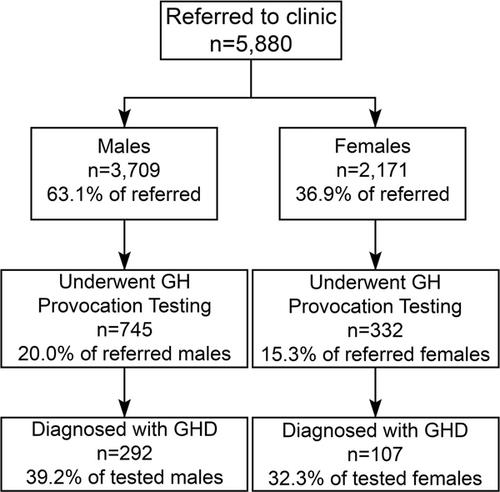
Of the 5880 clinic referrals for short stature, there were 3709 boys (63%) and 2171 girls (37%). Of these, 20% of boys (n = 745) and 15.3% of girls (n = 332) underwent provocative testing for GHD. Of those tested, 39.2% of boys (n = 292) and 32.2% of girls (n = 107) were diagnosed with GHD, all p < .001. There was a male predominance in GHD cases based on pGH or GHD severity. Though not significant, girls were more likely than boys to have MPHD (p = .056), even across pGH groups (p = .06). Both boys and girls had a similar distribution of imaging abnormalities.
Conclusion
Stratifying by sex, we found similar percentages of pituitary imaging abnormalities (including tumours) and the number of pituitary hormone deficiencies in boys and girls as the cause of GHD. For these classifications, we did not find the historically reported male sex predominance.
期刊介绍:
Clinical Endocrinology publishes papers and reviews which focus on the clinical aspects of endocrinology, including the clinical application of molecular endocrinology. It does not publish papers relating directly to diabetes care and clinical management. It features reviews, original papers, commentaries, correspondence and Clinical Questions. Clinical Endocrinology is essential reading not only for those engaged in endocrinological research but also for those involved primarily in clinical practice.



 京公网安备 11010802042870号
京ICP备2023020795号-1
京公网安备 11010802042870号
京ICP备2023020795号-1

 分享
分享
 求助内容:
求助内容: 应助结果提醒方式:
 扫码关注我们
