Etiologic Factors of Temporomandibular Disorders: A Systematic Review of Literature Containing Diagnostic Criteria for Temporomandibular Disorders (DC/TMD) and Research Diagnostic Criteria for Temporomandibular Disorders (RDC/TMD) from 2018 to 2022.
{"title":"Etiologic Factors of Temporomandibular Disorders: A Systematic Review of Literature Containing Diagnostic Criteria for Temporomandibular Disorders (DC/TMD) and Research Diagnostic Criteria for Temporomandibular Disorders (RDC/TMD) from 2018 to 2022.","authors":"Joanna Warzocha, Joanna Gadomska-Krasny, Joanna Mrowiec","doi":"10.3390/healthcare12050575","DOIUrl":null,"url":null,"abstract":"<p><p>This study aims to conduct a systematic analysis of literature published between 1 January 2018 and 1 September 2022, exploring factors influencing the progression or development of temporomandibular disorders (TMD), diagnosed using the Diagnostic Criteria for Temporomandibular Disorders (DC/TMD) or Research Diagnostic Criteria for Temporomandibular Disorders (RDC/TMD). Three electronic databases were reviewed to identify papers that examined TMD factors using DC/TMD or RDC/TMD. Inclusion criteria encompassed original research published in English between 1 January 2018 and 1 October 2022, online, and complete DC/TMD or RDC/TMD studies on human participants aged 18 or older. Two authors independently assessed the risk of bias using The Joanna Briggs Institute (JBI) Analytical cross-sectional studies' Critical Appraisal Tool. Of 1478 articles, 11 were included. The studies revealed strong associations between TMD and factors such as female, poor sleep quality, depression, oral parafunction, anxiety, somatization, and anatomical features. However, variables such as education, living conditions, socioeconomic status, marital status, chronic pain, and stress did not exhibit statistically significant correlations. Based on the obtained data, it can be concluded that the causes of TMD are largely related to psychological factors, which supports the biopsychosocial theory of the disorder.</p>","PeriodicalId":12977,"journal":{"name":"Healthcare","volume":"12 5","pages":""},"PeriodicalIF":2.7000,"publicationDate":"2024-02-29","publicationTypes":"Journal Article","fieldsOfStudy":null,"isOpenAccess":false,"openAccessPdf":"https://www.ncbi.nlm.nih.gov/pmc/articles/PMC10931313/pdf/","citationCount":"0","resultStr":null,"platform":"Semanticscholar","paperid":null,"PeriodicalName":"Healthcare","FirstCategoryId":"3","ListUrlMain":"https://doi.org/10.3390/healthcare12050575","RegionNum":4,"RegionCategory":"医学","ArticlePicture":[],"TitleCN":null,"AbstractTextCN":null,"PMCID":null,"EPubDate":"","PubModel":"","JCR":"Q2","JCRName":"HEALTH CARE SCIENCES & SERVICES","Score":null,"Total":0}
引用次数: 0
Abstract
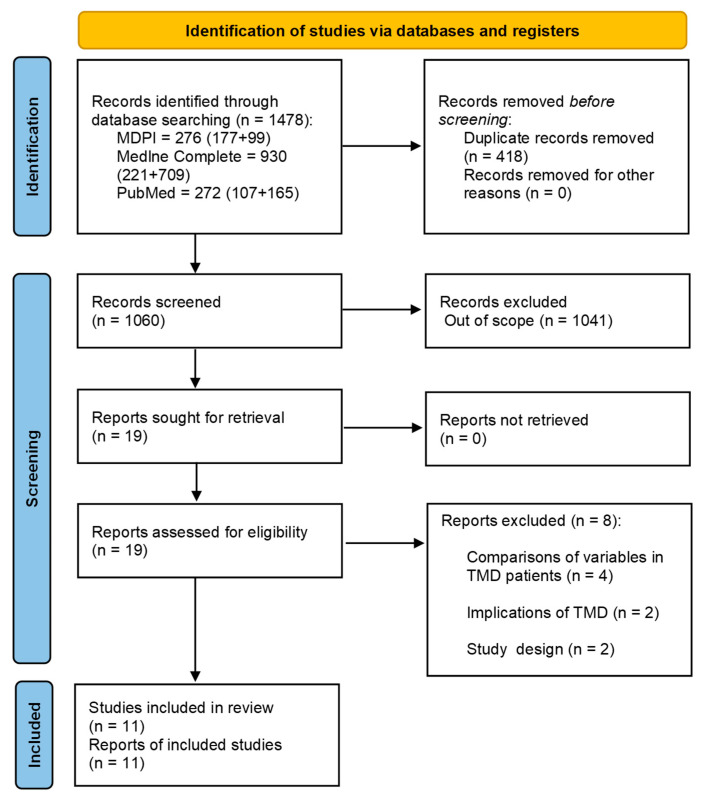
This study aims to conduct a systematic analysis of literature published between 1 January 2018 and 1 September 2022, exploring factors influencing the progression or development of temporomandibular disorders (TMD), diagnosed using the Diagnostic Criteria for Temporomandibular Disorders (DC/TMD) or Research Diagnostic Criteria for Temporomandibular Disorders (RDC/TMD). Three electronic databases were reviewed to identify papers that examined TMD factors using DC/TMD or RDC/TMD. Inclusion criteria encompassed original research published in English between 1 January 2018 and 1 October 2022, online, and complete DC/TMD or RDC/TMD studies on human participants aged 18 or older. Two authors independently assessed the risk of bias using The Joanna Briggs Institute (JBI) Analytical cross-sectional studies' Critical Appraisal Tool. Of 1478 articles, 11 were included. The studies revealed strong associations between TMD and factors such as female, poor sleep quality, depression, oral parafunction, anxiety, somatization, and anatomical features. However, variables such as education, living conditions, socioeconomic status, marital status, chronic pain, and stress did not exhibit statistically significant correlations. Based on the obtained data, it can be concluded that the causes of TMD are largely related to psychological factors, which supports the biopsychosocial theory of the disorder.
期刊介绍:
Healthcare (ISSN 2227-9032) is an international, peer-reviewed, open access journal (free for readers), which publishes original theoretical and empirical work in the interdisciplinary area of all aspects of medicine and health care research. Healthcare publishes Original Research Articles, Reviews, Case Reports, Research Notes and Short Communications. We encourage researchers to publish their experimental and theoretical results in as much detail as possible. For theoretical papers, full details of proofs must be provided so that the results can be checked; for experimental papers, full experimental details must be provided so that the results can be reproduced. Additionally, electronic files or software regarding the full details of the calculations, experimental procedure, etc., can be deposited along with the publication as “Supplementary Material”.



 京公网安备 11010802042870号
京ICP备2023020795号-1
京公网安备 11010802042870号
京ICP备2023020795号-1

 分享
分享
 求助内容:
求助内容: 应助结果提醒方式:
 扫码关注我们
