Pernille Jul Clemmensen, Nis Brix, Jörg Schullehner, Gunnar Toft, Sandra Søgaard Tøttenborg, Karin Sørig Hougaard, Anne Ahrendt Bjerregaard, Thorhallur Ingi Halldorsson, Sjurdur Frodi Olsen, Birgitte Hansen, Leslie Thomas Stayner, Torben Sigsgaard, Henrik Kolstad, Jens Peter Ellekilde Bonde, Cecilia Høst Ramlau-Hansen
{"title":"Maternal use of nitrosatable drugs during pregnancy and adult male reproductive health: A population-based cohort study","authors":"Pernille Jul Clemmensen, Nis Brix, Jörg Schullehner, Gunnar Toft, Sandra Søgaard Tøttenborg, Karin Sørig Hougaard, Anne Ahrendt Bjerregaard, Thorhallur Ingi Halldorsson, Sjurdur Frodi Olsen, Birgitte Hansen, Leslie Thomas Stayner, Torben Sigsgaard, Henrik Kolstad, Jens Peter Ellekilde Bonde, Cecilia Høst Ramlau-Hansen","doi":"10.1111/andr.13625","DOIUrl":null,"url":null,"abstract":"<div>\n \n \n <section>\n \n <h3> Background</h3>\n \n <p>Prenatal exposures to xenobiotics during the <i>masculinization programming window</i> are suggested to impact male fecundity later in life. Frequently used nitrosatable drugs, such as penicillins and beta2-agonists, contain amines or amides that may form teratogenic compounds in reaction with nitrite.</p>\n </section>\n \n <section>\n \n <h3> Objectives</h3>\n \n <p>We explored whether maternal nitrosatable drug use during gestation was associated with biomarkers of male fecundity in adulthood; moreover, the potential modifiable effect of nitrate and vitamin intake was investigated.</p>\n </section>\n \n <section>\n \n <h3> Method</h3>\n \n <p>We performed a cohort study in the Fetal Programming of Semen Quality cohort that includes semen characteristics, reproductive hormone concentrations, and measures of testis size on 1058 young adult sons in the Danish National Birth Cohort. Information on maternal use of nitrosatable drugs was obtained from questionnaires and interviews around gestational weeks 11 and 16. A multivariable negative binomial regression model was used to obtain relative differences in biomarkers of male fecundity for those whose mothers used nitrosatable drugs compared to those without such maternal use. In sub-analyses, the exposure was categorized according to nitrosatable drug type: secondary amine, tertiary amine, or amide. We investigated dose dependency by examining the number of weeks with intake and explored potential effect modification by low versus high maternal nitrate and vitamin intake from diet and nitrate concentration in drinking water. We added selection weights and imputed values of missing covariates to limit the risk of selection bias.</p>\n </section>\n \n <section>\n \n <h3> Results</h3>\n \n <p>In total, 19.6% of the study population were born of mothers with an intake of nitrosatable drugs at least once during early pregnancy. Relative differences in biomarkers related to male fecundity between exposed and unexposed participants were negligible. Imputation of missing covariates did not fundamentally alter the results. Furthermore, no sensitive subpopulations were detected.</p>\n </section>\n \n <section>\n \n <h3> Conclusions</h3>\n \n <p>The results suggest that maternal use of nitrosatable drugs does not have a harmful influence on the male fecundity of the offspring.</p>\n </section>\n </div>","PeriodicalId":7898,"journal":{"name":"Andrology","volume":"12 8","pages":"1740-1750"},"PeriodicalIF":3.4000,"publicationDate":"2024-03-15","publicationTypes":"Journal Article","fieldsOfStudy":null,"isOpenAccess":false,"openAccessPdf":"https://onlinelibrary.wiley.com/doi/epdf/10.1111/andr.13625","citationCount":"0","resultStr":null,"platform":"Semanticscholar","paperid":null,"PeriodicalName":"Andrology","FirstCategoryId":"3","ListUrlMain":"https://onlinelibrary.wiley.com/doi/10.1111/andr.13625","RegionNum":2,"RegionCategory":"医学","ArticlePicture":[],"TitleCN":null,"AbstractTextCN":null,"PMCID":null,"EPubDate":"","PubModel":"","JCR":"Q1","JCRName":"ANDROLOGY","Score":null,"Total":0}
引用次数: 0
Abstract
Background
Prenatal exposures to xenobiotics during the masculinization programming window are suggested to impact male fecundity later in life. Frequently used nitrosatable drugs, such as penicillins and beta2-agonists, contain amines or amides that may form teratogenic compounds in reaction with nitrite.
Objectives
We explored whether maternal nitrosatable drug use during gestation was associated with biomarkers of male fecundity in adulthood; moreover, the potential modifiable effect of nitrate and vitamin intake was investigated.
Method
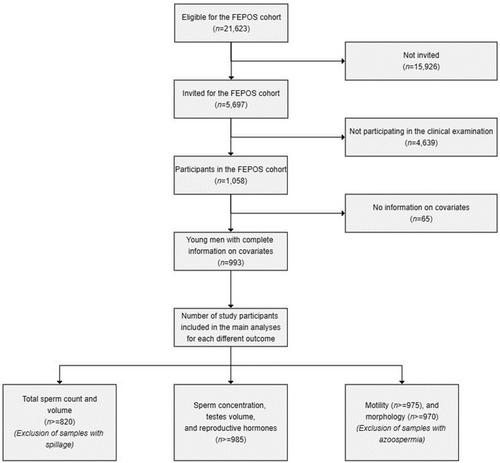
We performed a cohort study in the Fetal Programming of Semen Quality cohort that includes semen characteristics, reproductive hormone concentrations, and measures of testis size on 1058 young adult sons in the Danish National Birth Cohort. Information on maternal use of nitrosatable drugs was obtained from questionnaires and interviews around gestational weeks 11 and 16. A multivariable negative binomial regression model was used to obtain relative differences in biomarkers of male fecundity for those whose mothers used nitrosatable drugs compared to those without such maternal use. In sub-analyses, the exposure was categorized according to nitrosatable drug type: secondary amine, tertiary amine, or amide. We investigated dose dependency by examining the number of weeks with intake and explored potential effect modification by low versus high maternal nitrate and vitamin intake from diet and nitrate concentration in drinking water. We added selection weights and imputed values of missing covariates to limit the risk of selection bias.
Results
In total, 19.6% of the study population were born of mothers with an intake of nitrosatable drugs at least once during early pregnancy. Relative differences in biomarkers related to male fecundity between exposed and unexposed participants were negligible. Imputation of missing covariates did not fundamentally alter the results. Furthermore, no sensitive subpopulations were detected.
Conclusions
The results suggest that maternal use of nitrosatable drugs does not have a harmful influence on the male fecundity of the offspring.
期刊介绍:
Andrology is the study of the male reproductive system and other male gender related health issues. Andrology deals with basic and clinical aspects of the male reproductive system (gonads, endocrine and accessory organs) in all species, including the diagnosis and treatment of medical problems associated with sexual development, infertility, sexual dysfunction, sex hormone action and other urological problems. In medicine, Andrology as a specialty is a recent development, as it had previously been considered a subspecialty of urology or endocrinology




 京公网安备 11010802042870号
京ICP备2023020795号-1
京公网安备 11010802042870号
京ICP备2023020795号-1

 分享
分享
 求助内容:
求助内容: 应助结果提醒方式:
 扫码关注我们
