Pongamol Prevents Neurotoxicity via the Activation of MAPKs/Nrf2 Signaling Pathway in H2O2-Induced Neuronal PC12 Cells and Prolongs the Lifespan of Caenorhabditis elegans.
Shaojun Wu, Jie Miao, Susu Zhu, Xinyuan Wu, Jindan Shi, Jichao Zhou, Yi Xing, Kun Hu, Jie Ren, Hao Yang
{"title":"Pongamol Prevents Neurotoxicity via the Activation of MAPKs/Nrf2 Signaling Pathway in H<sub>2</sub>O<sub>2</sub>-Induced Neuronal PC12 Cells and Prolongs the Lifespan of Caenorhabditis elegans.","authors":"Shaojun Wu, Jie Miao, Susu Zhu, Xinyuan Wu, Jindan Shi, Jichao Zhou, Yi Xing, Kun Hu, Jie Ren, Hao Yang","doi":"10.1007/s12035-024-04110-x","DOIUrl":null,"url":null,"abstract":"<p><p>Despite tremendous advances in modern medicine, effective prevention or therapeutic strategies for age-related neurodegenerative diseases such as Alzheimer's disease (AD) remain limited. Growing evidence now suggests that oxidative stress and apoptosis are increasingly associated with AD as promising therapeutic targets. Pongamol, a flavonoid, is the main constituent of pongamia pinnata and possesses a variety of pharmacological activities such as antioxidant, anti-aging and anti-inflammatory. In the present study, we investigated the antioxidant effects and mechanisms of pongamol in H<sub>2</sub>O<sub>2</sub>-induced PC12 cells and Caenorhabditis elegans (C. elegans). Our findings revealed that pongamol reduced cellular damage and apoptosis in H<sub>2</sub>O<sub>2</sub>-induced PC12 cells. Furthermore, pongamol reduced levels of apoptosis-related proteins Bax, Cyto C, Cleaved Caspase-3, and Cleaved PARP1, and increased the level of anti-apoptotic protein Bcl-2. Pongamol also effectively attenuated the level of oxidative stress markers such as glutathione (GSH) and reactive oxygen species (ROS) in H<sub>2</sub>O<sub>2</sub>-induced PC12 cells. Additionally, pongamol possessed antioxidant activity in H<sub>2</sub>O<sub>2</sub>-induced PC12 cells through the MAPKs/Nrf2 signaling pathway. Furthermore, pongamol exerted neuroprotective and anti-aging effects in C. elegans. All together, these results suggested that pongamol has a potential neuroprotective effect through the modulation of MAPKs/Nrf2 signaling pathway.</p>","PeriodicalId":18762,"journal":{"name":"Molecular Neurobiology","volume":" ","pages":"8219-8233"},"PeriodicalIF":4.3000,"publicationDate":"2024-10-01","publicationTypes":"Journal Article","fieldsOfStudy":null,"isOpenAccess":false,"openAccessPdf":"","citationCount":"0","resultStr":null,"platform":"Semanticscholar","paperid":null,"PeriodicalName":"Molecular Neurobiology","FirstCategoryId":"3","ListUrlMain":"https://doi.org/10.1007/s12035-024-04110-x","RegionNum":2,"RegionCategory":"医学","ArticlePicture":[],"TitleCN":null,"AbstractTextCN":null,"PMCID":null,"EPubDate":"2024/3/14 0:00:00","PubModel":"Epub","JCR":"Q1","JCRName":"NEUROSCIENCES","Score":null,"Total":0}
引用次数: 0
Abstract
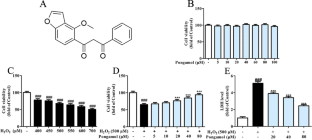
Despite tremendous advances in modern medicine, effective prevention or therapeutic strategies for age-related neurodegenerative diseases such as Alzheimer's disease (AD) remain limited. Growing evidence now suggests that oxidative stress and apoptosis are increasingly associated with AD as promising therapeutic targets. Pongamol, a flavonoid, is the main constituent of pongamia pinnata and possesses a variety of pharmacological activities such as antioxidant, anti-aging and anti-inflammatory. In the present study, we investigated the antioxidant effects and mechanisms of pongamol in H2O2-induced PC12 cells and Caenorhabditis elegans (C. elegans). Our findings revealed that pongamol reduced cellular damage and apoptosis in H2O2-induced PC12 cells. Furthermore, pongamol reduced levels of apoptosis-related proteins Bax, Cyto C, Cleaved Caspase-3, and Cleaved PARP1, and increased the level of anti-apoptotic protein Bcl-2. Pongamol also effectively attenuated the level of oxidative stress markers such as glutathione (GSH) and reactive oxygen species (ROS) in H2O2-induced PC12 cells. Additionally, pongamol possessed antioxidant activity in H2O2-induced PC12 cells through the MAPKs/Nrf2 signaling pathway. Furthermore, pongamol exerted neuroprotective and anti-aging effects in C. elegans. All together, these results suggested that pongamol has a potential neuroprotective effect through the modulation of MAPKs/Nrf2 signaling pathway.
期刊介绍:
Molecular Neurobiology is an exciting journal for neuroscientists needing to stay in close touch with progress at the forefront of molecular brain research today. It is an especially important periodical for graduate students and "postdocs," specifically designed to synthesize and critically assess research trends for all neuroscientists hoping to stay active at the cutting edge of this dramatically developing area. This journal has proven to be crucial in departmental libraries, serving as essential reading for every committed neuroscientist who is striving to keep abreast of all rapid developments in a forefront field. Most recent significant advances in experimental and clinical neuroscience have been occurring at the molecular level. Until now, there has been no journal devoted to looking closely at this fragmented literature in a critical, coherent fashion. Each submission is thoroughly analyzed by scientists and clinicians internationally renowned for their special competence in the areas treated.



 京公网安备 11010802042870号
京ICP备2023020795号-1
京公网安备 11010802042870号
京ICP备2023020795号-1

 分享
分享
 求助内容:
求助内容: 应助结果提醒方式:
 扫码关注我们
