Faizan Fazal, Maham L Adil, Talha Ijaz, Shahrukh Ahmad Khan, Ahmed Imran Butt, Areesha Abid, Muhammad N Bashir, Saima Ambreen, Taha Z Chaudhry, Bilal H Malik
{"title":"Improving the Quality and Completeness of Discharge Summaries at a Tertiary Care Hospital in Pakistan: A Quality Improvement Project.","authors":"Faizan Fazal, Maham L Adil, Talha Ijaz, Shahrukh Ahmad Khan, Ahmed Imran Butt, Areesha Abid, Muhammad N Bashir, Saima Ambreen, Taha Z Chaudhry, Bilal H Malik","doi":"10.7759/cureus.56134","DOIUrl":null,"url":null,"abstract":"<p><p>Introduction Discharge summaries (DS) allow continued patient care after being discharged from the hospital. Only a few quality improvement projects (QIPs) focused on assessing and improving the quality and completeness of DS at tertiary care hospitals have been undertaken in Pakistan. This QIP aimed to evaluate and enhance the quality and completeness of DS at a tertiary care hospital in Pakistan to facilitate seamless healthcare transitions. Methods A QIP was conducted in the medical unit of a tertiary care hospital in Rawalpindi, Pakistan. The DS were assessed using the e-discharge summary self-assessment checklist devised by the Royal College of Physicians (RCP). This QIP was done by the plan, do, study, act (PDSA) cycle. The PDSA cycle comprised two audit cycles and an intervention in between them. The first audit cycle (AC) was conducted on 150 DS. Its duration was from March 2023 to June 2023. An educational workshop was conducted before the re-audit cycle (RAC) to address deficiencies and reinforce the implementation of the guidelines provided by the RCP. The RAC was conducted from June 2023 to August 2023. 100 DS were studied and analyzed to assess for improvement in the completeness of DS. Frequencies and percentages were calculated in each audit cycle. The Chi-squared test was applied to compare the statistical difference between the results of both audit cycles. Results A total of 150 DS were analyzed in the first AC and 100 DS in the RAC. The results of the first AC show that the details of any allergies were recorded only in 3% of the DS; this percentage significantly improved to 51% after the RAC (p-value <0.05). Relevant past medical history was included in 52% and 88% of the DS during the first AC and RAC, respectively (p-value <0.05). Secondary diagnoses were written in 54% and 71% of the DS during the first AC and RAC, respectively (p-value <0.05). Details of relevant investigations were included in 60% and 88% of the DS during the first AC and RAC, respectively (p-value <0.05). The post-discharge management plan was written in 90% and 98% of the DS during the first AC and RAC, respectively (p-value <0.05). The follow-up plan was written clearly in 65% and 93% of the DS during the first AC and RAC, respectively (p-value <0.05). Conclusion The DS was found to be incomplete after analyzing the results of the first AC. The details related to allergies, medications, operations, and procedures were found to be missing in the majority of the cases. No mention of the patient's concerns or expectations was made in the DS. The results of the RAC showed improvement in the level of completeness of DS. The majority of the weak points observed after the first AC seemed to have improved after the RAC, which shows that intervention proved to be quite effective in improving the completeness and quality of DS. The RAC showed significant improvement in the completeness of the details relating to investigations, allergies, past medical history, secondary diagnoses, and the post-discharge follow-up plan. QIP must be routinely carried out to assess and improve the completeness and quality of DS at hospitals.</p>","PeriodicalId":93960,"journal":{"name":"Cureus","volume":"16 3","pages":"e56134"},"PeriodicalIF":1.3000,"publicationDate":"2024-03-14","publicationTypes":"Journal Article","fieldsOfStudy":null,"isOpenAccess":false,"openAccessPdf":"https://www.ncbi.nlm.nih.gov/pmc/articles/PMC10938087/pdf/","citationCount":"0","resultStr":null,"platform":"Semanticscholar","paperid":null,"PeriodicalName":"Cureus","FirstCategoryId":"1085","ListUrlMain":"https://doi.org/10.7759/cureus.56134","RegionNum":0,"RegionCategory":null,"ArticlePicture":[],"TitleCN":null,"AbstractTextCN":null,"PMCID":null,"EPubDate":"2024/3/1 0:00:00","PubModel":"eCollection","JCR":"Q3","JCRName":"MEDICINE, GENERAL & INTERNAL","Score":null,"Total":0}
引用次数: 0
Abstract
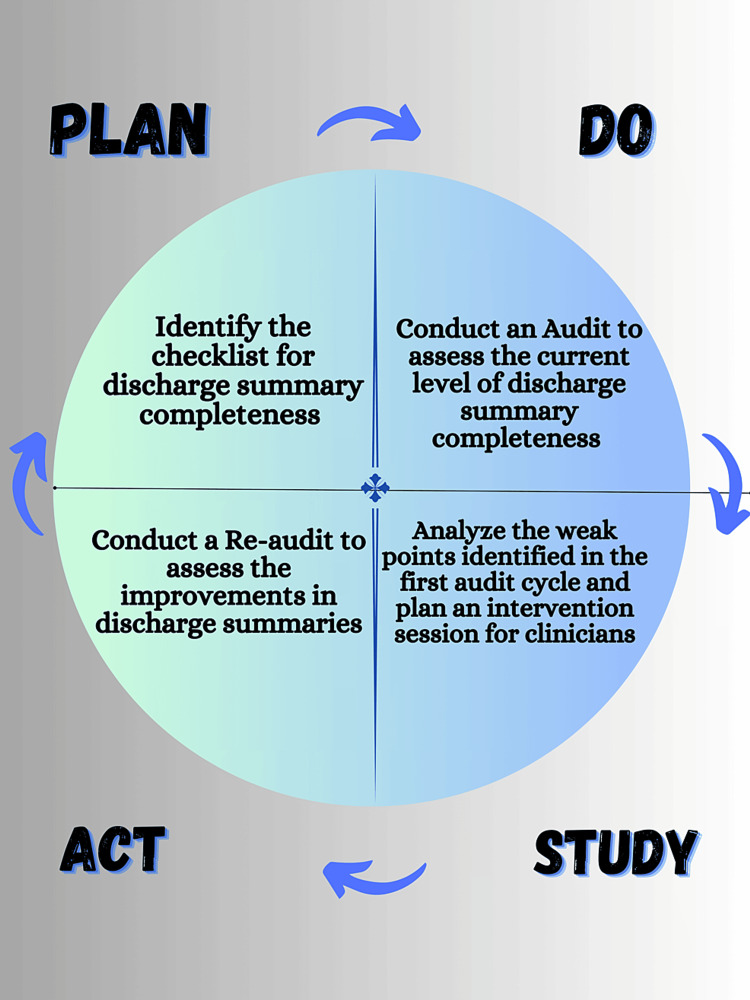
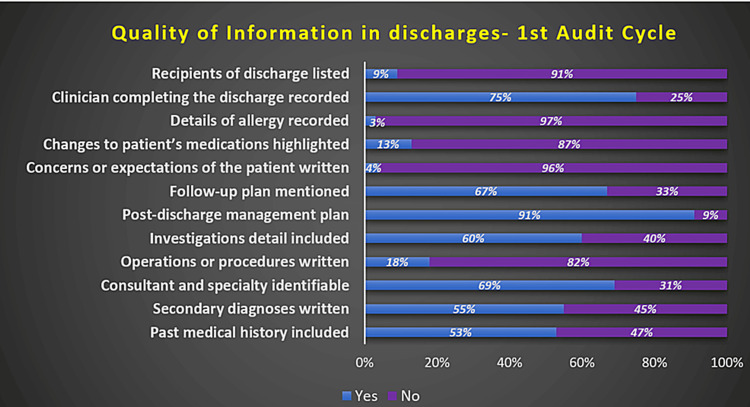
Introduction Discharge summaries (DS) allow continued patient care after being discharged from the hospital. Only a few quality improvement projects (QIPs) focused on assessing and improving the quality and completeness of DS at tertiary care hospitals have been undertaken in Pakistan. This QIP aimed to evaluate and enhance the quality and completeness of DS at a tertiary care hospital in Pakistan to facilitate seamless healthcare transitions. Methods A QIP was conducted in the medical unit of a tertiary care hospital in Rawalpindi, Pakistan. The DS were assessed using the e-discharge summary self-assessment checklist devised by the Royal College of Physicians (RCP). This QIP was done by the plan, do, study, act (PDSA) cycle. The PDSA cycle comprised two audit cycles and an intervention in between them. The first audit cycle (AC) was conducted on 150 DS. Its duration was from March 2023 to June 2023. An educational workshop was conducted before the re-audit cycle (RAC) to address deficiencies and reinforce the implementation of the guidelines provided by the RCP. The RAC was conducted from June 2023 to August 2023. 100 DS were studied and analyzed to assess for improvement in the completeness of DS. Frequencies and percentages were calculated in each audit cycle. The Chi-squared test was applied to compare the statistical difference between the results of both audit cycles. Results A total of 150 DS were analyzed in the first AC and 100 DS in the RAC. The results of the first AC show that the details of any allergies were recorded only in 3% of the DS; this percentage significantly improved to 51% after the RAC (p-value <0.05). Relevant past medical history was included in 52% and 88% of the DS during the first AC and RAC, respectively (p-value <0.05). Secondary diagnoses were written in 54% and 71% of the DS during the first AC and RAC, respectively (p-value <0.05). Details of relevant investigations were included in 60% and 88% of the DS during the first AC and RAC, respectively (p-value <0.05). The post-discharge management plan was written in 90% and 98% of the DS during the first AC and RAC, respectively (p-value <0.05). The follow-up plan was written clearly in 65% and 93% of the DS during the first AC and RAC, respectively (p-value <0.05). Conclusion The DS was found to be incomplete after analyzing the results of the first AC. The details related to allergies, medications, operations, and procedures were found to be missing in the majority of the cases. No mention of the patient's concerns or expectations was made in the DS. The results of the RAC showed improvement in the level of completeness of DS. The majority of the weak points observed after the first AC seemed to have improved after the RAC, which shows that intervention proved to be quite effective in improving the completeness and quality of DS. The RAC showed significant improvement in the completeness of the details relating to investigations, allergies, past medical history, secondary diagnoses, and the post-discharge follow-up plan. QIP must be routinely carried out to assess and improve the completeness and quality of DS at hospitals.




 京公网安备 11010802042870号
京ICP备2023020795号-1
京公网安备 11010802042870号
京ICP备2023020795号-1

 分享
分享

 求助内容:
求助内容: 应助结果提醒方式:
 扫码关注我们
