Zeping Wang, Chengyu Li, Gongao Peng, Dr. Run Shi, Prof. Lu Shang, Prof. Tierui Zhang
{"title":"Highly Selective Acetylene-to-Ethylene Electroreduction Over Cd-Decorated Cu Catalyst with Efficiently Inhibited Carbon-Carbon Coupling","authors":"Zeping Wang, Chengyu Li, Gongao Peng, Dr. Run Shi, Prof. Lu Shang, Prof. Tierui Zhang","doi":"10.1002/anie.202400122","DOIUrl":null,"url":null,"abstract":"<p>Electrochemical acetylene reduction (EAR) employing Cu catalysts represents an environmentally friendly and cost-effective method for ethylene production and purification. However, Cu-based catalysts encounter product selectivity issues stemming from carbon-carbon coupling and other side reactions. We explored the use of secondary metals to modify Cu-based catalysts and identified Cd decoration as particular effective. Cd decoration demonstrated a high ethylene Faradaic efficiency (FE) of 98.38 % with well-inhibited carbon-carbon coupling reactions (0.06 % for butadiene FE at −0.5 V versus reversible hydrogen electrode) in a 5 vol % acetylene gas feed. Notably, ethylene selectivity of 99.99 % was achieved in the crude ethylene feed during prolonged stability tests. Theoretical calculations revealed that Cd metal accelerates the water dissociation on neighboring Cu surfaces allowing more H* to participate in the acetylene semi-hydrogenation, while increasing the energy barrier for carbon-carbon coupling, thereby contributing to a high ethylene semi-hydrogenation efficiency and significant inhibition of carbon-carbon coupling. This study provides a paradigm for a deeper understanding of secondary metals in regulating the product selectivity of EAR electrocatalysts.</p>","PeriodicalId":125,"journal":{"name":"Angewandte Chemie International Edition","volume":"63 19","pages":""},"PeriodicalIF":16.9000,"publicationDate":"2024-03-17","publicationTypes":"Journal Article","fieldsOfStudy":null,"isOpenAccess":false,"openAccessPdf":"","citationCount":"0","resultStr":null,"platform":"Semanticscholar","paperid":null,"PeriodicalName":"Angewandte Chemie International Edition","FirstCategoryId":"92","ListUrlMain":"https://onlinelibrary.wiley.com/doi/10.1002/anie.202400122","RegionNum":1,"RegionCategory":"化学","ArticlePicture":[],"TitleCN":null,"AbstractTextCN":null,"PMCID":null,"EPubDate":"","PubModel":"","JCR":"Q1","JCRName":"CHEMISTRY, MULTIDISCIPLINARY","Score":null,"Total":0}
引用次数: 0
Abstract
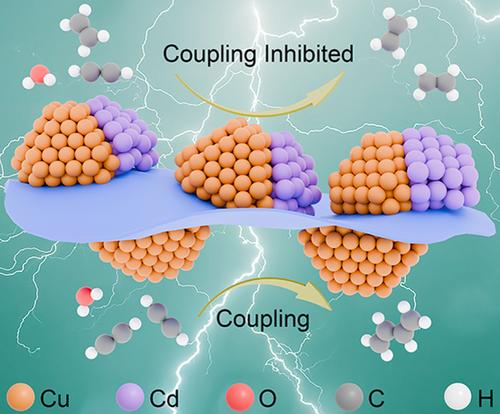
Electrochemical acetylene reduction (EAR) employing Cu catalysts represents an environmentally friendly and cost-effective method for ethylene production and purification. However, Cu-based catalysts encounter product selectivity issues stemming from carbon-carbon coupling and other side reactions. We explored the use of secondary metals to modify Cu-based catalysts and identified Cd decoration as particular effective. Cd decoration demonstrated a high ethylene Faradaic efficiency (FE) of 98.38 % with well-inhibited carbon-carbon coupling reactions (0.06 % for butadiene FE at −0.5 V versus reversible hydrogen electrode) in a 5 vol % acetylene gas feed. Notably, ethylene selectivity of 99.99 % was achieved in the crude ethylene feed during prolonged stability tests. Theoretical calculations revealed that Cd metal accelerates the water dissociation on neighboring Cu surfaces allowing more H* to participate in the acetylene semi-hydrogenation, while increasing the energy barrier for carbon-carbon coupling, thereby contributing to a high ethylene semi-hydrogenation efficiency and significant inhibition of carbon-carbon coupling. This study provides a paradigm for a deeper understanding of secondary metals in regulating the product selectivity of EAR electrocatalysts.
期刊介绍:
Angewandte Chemie, a journal of the German Chemical Society (GDCh), maintains a leading position among scholarly journals in general chemistry with an impressive Impact Factor of 16.6 (2022 Journal Citation Reports, Clarivate, 2023). Published weekly in a reader-friendly format, it features new articles almost every day. Established in 1887, Angewandte Chemie is a prominent chemistry journal, offering a dynamic blend of Review-type articles, Highlights, Communications, and Research Articles on a weekly basis, making it unique in the field.



 京公网安备 11010802042870号
京ICP备2023020795号-1
京公网安备 11010802042870号
京ICP备2023020795号-1

 分享
分享
 求助内容:
求助内容: 应助结果提醒方式:
 扫码关注我们
