Monique M. Ridosh, William Adams, Allison D. Payne, Taylor L. Hilderbrand, Fabiola Magaña, Kathleen J. Sawin, Grayson N. Holmbeck
{"title":"Contextual predictors of self-management and independence trajectories in adolescents and young adults with spina bifida","authors":"Monique M. Ridosh, William Adams, Allison D. Payne, Taylor L. Hilderbrand, Fabiola Magaña, Kathleen J. Sawin, Grayson N. Holmbeck","doi":"10.1111/dmcn.15900","DOIUrl":null,"url":null,"abstract":"<div>\n \n \n <section>\n \n <h3> Aim</h3>\n \n <p>To examine socioeconomic, condition-related, and neuropsychological predictors of self-management trajectories in adolescents and young adults with spina bifida.</p>\n </section>\n \n <section>\n \n <h3> Method</h3>\n \n <p>In this longitudinal study, participants completed the Adolescent/Young Adult Self-Management and Independence Scale interview. Socioeconomic status (SES), shunt status, lesion level, and executive functioning were assessed. Growth in self-management was estimated using linear mixed-effects models.</p>\n </section>\n \n <section>\n \n <h3> Results</h3>\n \n <p>Participants (<i>n</i> = 99) were aged 18 to 27 years. Approximately half (52.5%) were female and White; 15.2% were Black; and 32.3% Hispanic or Latino. Although none of the predictors were associated with growth in self-management from ages 18 to 27 years (<i>p</i> > 0.05), several factors were associated with the intercept at age 18 years for total self-management. Higher SES at baseline predicted a higher total self-management score at age 18 years (<i>b</i> = 0.03, standard error [SE] = 0.01; <i>p</i> < 0.001). On average, participants at age 18 years with a shunt scored lower than those without a shunt (<i>b</i> = −0.90, SE = 0.32; <i>p =</i> 0.01); those with a thoracic lesion scored lower than those with lower lesion levels (lumbar: <i>b</i> = −1.22, SE = 0.34; sacral: <i>b</i> = −1.20, SE = 0.36; <i>p</i> = 0.001 for both). Better parent-reported and teacher-reported executive functions predicted higher total self-management (metacognitive: <i>b</i> = −0.03, SE = 0.01; behavioral regulation: <i>b</i> = −0.04, SE = 0.01; <i>p</i> < 0.05 for both).</p>\n </section>\n \n <section>\n \n <h3> Interpretation</h3>\n \n <p>On average, all participants improved in self-management over time. Additionally, baseline superiority in self-management for adolescents and young adults without a shunt, less severe lesions, better executive functions, and higher SES persisted over time.</p>\n </section>\n \n <section>\n \n <h3> What this paper adds</h3>\n \n <div>\n \n <ul>\n \n <li>Higher socioeconomic status at baseline predicted higher self-management scores at age 18 years.</li>\n \n <li>Participants with a shunt scored lower than those without a shunt.</li>\n \n <li>Participants with a thoracic lesion scored lower than those with other, less severe lesions.</li>\n \n <li>Better parent-reported and teacher-reported executive functions predicted higher self-management scores at age 18 years.</li>\n \n <li>Growth in self-management was not moderated by socioeconomic, condition-related, or neuropsychological variables.</li>\n </ul>\n </div>\n </section>\n </div>","PeriodicalId":50587,"journal":{"name":"Developmental Medicine and Child Neurology","volume":"66 10","pages":"1329-1339"},"PeriodicalIF":4.3000,"publicationDate":"2024-03-17","publicationTypes":"Journal Article","fieldsOfStudy":null,"isOpenAccess":false,"openAccessPdf":"https://onlinelibrary.wiley.com/doi/epdf/10.1111/dmcn.15900","citationCount":"0","resultStr":null,"platform":"Semanticscholar","paperid":null,"PeriodicalName":"Developmental Medicine and Child Neurology","FirstCategoryId":"3","ListUrlMain":"https://onlinelibrary.wiley.com/doi/10.1111/dmcn.15900","RegionNum":2,"RegionCategory":"医学","ArticlePicture":[],"TitleCN":null,"AbstractTextCN":null,"PMCID":null,"EPubDate":"","PubModel":"","JCR":"Q1","JCRName":"CLINICAL NEUROLOGY","Score":null,"Total":0}
引用次数: 0
Abstract
Aim
To examine socioeconomic, condition-related, and neuropsychological predictors of self-management trajectories in adolescents and young adults with spina bifida.
Method
In this longitudinal study, participants completed the Adolescent/Young Adult Self-Management and Independence Scale interview. Socioeconomic status (SES), shunt status, lesion level, and executive functioning were assessed. Growth in self-management was estimated using linear mixed-effects models.
Results
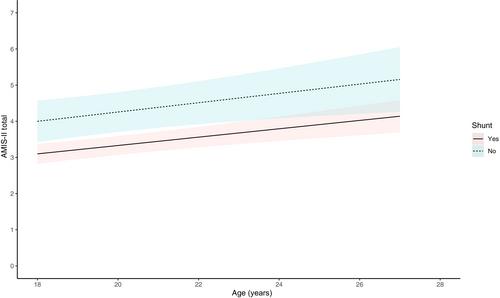
Participants (n = 99) were aged 18 to 27 years. Approximately half (52.5%) were female and White; 15.2% were Black; and 32.3% Hispanic or Latino. Although none of the predictors were associated with growth in self-management from ages 18 to 27 years (p > 0.05), several factors were associated with the intercept at age 18 years for total self-management. Higher SES at baseline predicted a higher total self-management score at age 18 years (b = 0.03, standard error [SE] = 0.01; p < 0.001). On average, participants at age 18 years with a shunt scored lower than those without a shunt (b = −0.90, SE = 0.32; p = 0.01); those with a thoracic lesion scored lower than those with lower lesion levels (lumbar: b = −1.22, SE = 0.34; sacral: b = −1.20, SE = 0.36; p = 0.001 for both). Better parent-reported and teacher-reported executive functions predicted higher total self-management (metacognitive: b = −0.03, SE = 0.01; behavioral regulation: b = −0.04, SE = 0.01; p < 0.05 for both).
Interpretation
On average, all participants improved in self-management over time. Additionally, baseline superiority in self-management for adolescents and young adults without a shunt, less severe lesions, better executive functions, and higher SES persisted over time.
What this paper adds
Higher socioeconomic status at baseline predicted higher self-management scores at age 18 years.
Participants with a shunt scored lower than those without a shunt.
Participants with a thoracic lesion scored lower than those with other, less severe lesions.
Better parent-reported and teacher-reported executive functions predicted higher self-management scores at age 18 years.
Growth in self-management was not moderated by socioeconomic, condition-related, or neuropsychological variables.
期刊介绍:
Wiley-Blackwell is pleased to publish Developmental Medicine & Child Neurology (DMCN), a Mac Keith Press publication and official journal of the American Academy for Cerebral Palsy and Developmental Medicine (AACPDM) and the British Paediatric Neurology Association (BPNA).
For over 50 years, DMCN has defined the field of paediatric neurology and neurodisability and is one of the world’s leading journals in the whole field of paediatrics. DMCN disseminates a range of information worldwide to improve the lives of disabled children and their families. The high quality of published articles is maintained by expert review, including independent statistical assessment, before acceptance.



 京公网安备 11010802042870号
京ICP备2023020795号-1
京公网安备 11010802042870号
京ICP备2023020795号-1

 分享
分享
 求助内容:
求助内容: 应助结果提醒方式:
 扫码关注我们
