Ida Klitzing Storgaard, Elisabeth Kjær Jensen, Søren Bøgevig, Torben Balchen, Anders Holten Springborg, Mike Allan Royal, Kirsten Møller, Mads Utke Werner, Trine Meldgaard Lund
{"title":"Population pharmacokinetic–pharmacodynamic model of subcutaneous bupivacaine in a novel extended-release microparticle formulation","authors":"Ida Klitzing Storgaard, Elisabeth Kjær Jensen, Søren Bøgevig, Torben Balchen, Anders Holten Springborg, Mike Allan Royal, Kirsten Møller, Mads Utke Werner, Trine Meldgaard Lund","doi":"10.1111/bcpt.14004","DOIUrl":null,"url":null,"abstract":"<p>The objective of this study was to develop a population pharmacokinetic–pharmacodynamic model of subcutaneously administered bupivacaine in a novel extended-release microparticle formulation for postoperative pain management. Bupivacaine was administered subcutaneously in the lower leg to 28 healthy male subjects in doses from 150 to 600 mg in a phase 1 randomized, placebo-controlled, double-blind, dose-ascending study with two different microparticle formulations, LIQ865A and LIQ865B. Warmth detection threshold was used as a surrogate pharmacodynamic endpoint. Population pharmacokinetic–pharmacodynamic models were fitted to plasma concentration-effect-time data using non-linear mixed-effects modelling. The pharmacokinetics were best described by a two-compartment model with biphasic absorption as two parallel absorption processes: a fast, zero-order process and a slower, first-order process with two transit compartments. The slow absorption process was found to be dose-dependent and rate-limiting for elimination at higher doses. Apparent bupivacaine clearance and the transit rate constant describing the slow absorption process both appeared to decrease with increasing doses following a power function with a shared covariate effect. The pharmacokinetic–pharmacodynamic relationship between plasma concentrations and effect was best described by a linear function. This model gives new insight into the pharmacokinetics and pharmacodynamics of microparticle formulations of bupivacaine and the biphasic absorption seen for several local anaesthetics.</p>","PeriodicalId":8733,"journal":{"name":"Basic & Clinical Pharmacology & Toxicology","volume":"134 5","pages":"676-685"},"PeriodicalIF":3.3000,"publicationDate":"2024-03-20","publicationTypes":"Journal Article","fieldsOfStudy":null,"isOpenAccess":false,"openAccessPdf":"https://onlinelibrary.wiley.com/doi/epdf/10.1111/bcpt.14004","citationCount":"0","resultStr":null,"platform":"Semanticscholar","paperid":null,"PeriodicalName":"Basic & Clinical Pharmacology & Toxicology","FirstCategoryId":"3","ListUrlMain":"https://onlinelibrary.wiley.com/doi/10.1111/bcpt.14004","RegionNum":4,"RegionCategory":"医学","ArticlePicture":[],"TitleCN":null,"AbstractTextCN":null,"PMCID":null,"EPubDate":"","PubModel":"","JCR":"Q2","JCRName":"PHARMACOLOGY & PHARMACY","Score":null,"Total":0}
引用次数: 0
Abstract
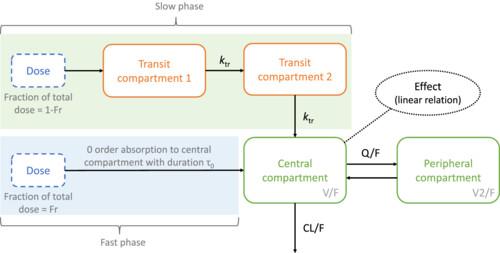
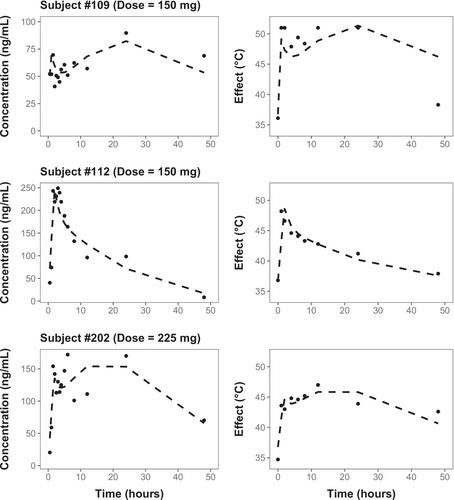
The objective of this study was to develop a population pharmacokinetic–pharmacodynamic model of subcutaneously administered bupivacaine in a novel extended-release microparticle formulation for postoperative pain management. Bupivacaine was administered subcutaneously in the lower leg to 28 healthy male subjects in doses from 150 to 600 mg in a phase 1 randomized, placebo-controlled, double-blind, dose-ascending study with two different microparticle formulations, LIQ865A and LIQ865B. Warmth detection threshold was used as a surrogate pharmacodynamic endpoint. Population pharmacokinetic–pharmacodynamic models were fitted to plasma concentration-effect-time data using non-linear mixed-effects modelling. The pharmacokinetics were best described by a two-compartment model with biphasic absorption as two parallel absorption processes: a fast, zero-order process and a slower, first-order process with two transit compartments. The slow absorption process was found to be dose-dependent and rate-limiting for elimination at higher doses. Apparent bupivacaine clearance and the transit rate constant describing the slow absorption process both appeared to decrease with increasing doses following a power function with a shared covariate effect. The pharmacokinetic–pharmacodynamic relationship between plasma concentrations and effect was best described by a linear function. This model gives new insight into the pharmacokinetics and pharmacodynamics of microparticle formulations of bupivacaine and the biphasic absorption seen for several local anaesthetics.
期刊介绍:
Basic & Clinical Pharmacology and Toxicology is an independent journal, publishing original scientific research in all fields of toxicology, basic and clinical pharmacology. This includes experimental animal pharmacology and toxicology and molecular (-genetic), biochemical and cellular pharmacology and toxicology. It also includes all aspects of clinical pharmacology: pharmacokinetics, pharmacodynamics, therapeutic drug monitoring, drug/drug interactions, pharmacogenetics/-genomics, pharmacoepidemiology, pharmacovigilance, pharmacoeconomics, randomized controlled clinical trials and rational pharmacotherapy. For all compounds used in the studies, the chemical constitution and composition should be known, also for natural compounds.



 京公网安备 11010802042870号
京ICP备2023020795号-1
京公网安备 11010802042870号
京ICP备2023020795号-1

 分享
分享
 求助内容:
求助内容: 应助结果提醒方式:
 扫码关注我们
