{"title":"A Hybrid-Salt Strategy for Modulating the Li+ Solvation Sheathes and Constructing Robust SEI in Non-Flammable Electrolyte Lithium Metal Batteries","authors":"Kai Lan, Xinan Zhang, Xinxin Yang, Qing Hou, Ruming Yuan, Mingseng Zheng, Jingmin Fan, Xinping Qiu, Quanfeng Dong","doi":"10.1002/cssc.202400210","DOIUrl":null,"url":null,"abstract":"<p>The electrode interface determines the performance of an electrochemical energy storage system. Using traditional electrolyte organic additives and high-concentration electrolyte emerging recently are two generally strategies for improving the electrode interface. Here, a hybrid-salt electrolyte strategy is proposed for constructing the stable electrode interface. Through the solubilization effect of phosphate ester on LiNO<sub>3</sub>, a hybrid-salts-based non-flammable phosphate ester electrolyte system (HSPE) with LiPF<sub>6</sub> and LiNO<sub>3</sub> as Li salts has been developed. By the strong interaction between NO<sub>3</sub><sup>−</sup> and Li<sup>+</sup>, the Li<sup>+</sup> solvation sheath and solvent behaviors have been modulated, thus the undesirable effects of phosphate ester are eliminated and a robust SEI is formed. Experimental results and theoretical calculations illustrate that NO<sub>3</sub><sup>−</sup> as a kind of strongly coordinating anion can reduce the number of TEP molecules and lower the reduction reactivity of TEP. The reconfigured Li<sup>+</sup> solvation structure allows the formation of an inorganic-rich SEI on the electrode surface. As a result, in the designed HSPE, the average coulombic efficiency of lithium plating/stripping is increased to 99.12 %. This work explored a new approach to construct the electrode interface and addressing the poor interface performance issue of phosphate esters.</p>","PeriodicalId":149,"journal":{"name":"ChemSusChem","volume":"17 17","pages":""},"PeriodicalIF":6.6000,"publicationDate":"2024-03-21","publicationTypes":"Journal Article","fieldsOfStudy":null,"isOpenAccess":false,"openAccessPdf":"","citationCount":"0","resultStr":null,"platform":"Semanticscholar","paperid":null,"PeriodicalName":"ChemSusChem","FirstCategoryId":"92","ListUrlMain":"https://chemistry-europe.onlinelibrary.wiley.com/doi/10.1002/cssc.202400210","RegionNum":2,"RegionCategory":"化学","ArticlePicture":[],"TitleCN":null,"AbstractTextCN":null,"PMCID":null,"EPubDate":"","PubModel":"","JCR":"Q1","JCRName":"CHEMISTRY, MULTIDISCIPLINARY","Score":null,"Total":0}
引用次数: 0
Abstract
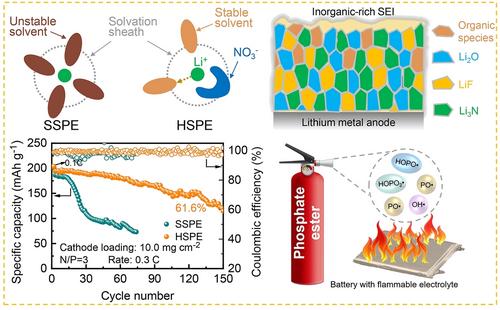
The electrode interface determines the performance of an electrochemical energy storage system. Using traditional electrolyte organic additives and high-concentration electrolyte emerging recently are two generally strategies for improving the electrode interface. Here, a hybrid-salt electrolyte strategy is proposed for constructing the stable electrode interface. Through the solubilization effect of phosphate ester on LiNO3, a hybrid-salts-based non-flammable phosphate ester electrolyte system (HSPE) with LiPF6 and LiNO3 as Li salts has been developed. By the strong interaction between NO3− and Li+, the Li+ solvation sheath and solvent behaviors have been modulated, thus the undesirable effects of phosphate ester are eliminated and a robust SEI is formed. Experimental results and theoretical calculations illustrate that NO3− as a kind of strongly coordinating anion can reduce the number of TEP molecules and lower the reduction reactivity of TEP. The reconfigured Li+ solvation structure allows the formation of an inorganic-rich SEI on the electrode surface. As a result, in the designed HSPE, the average coulombic efficiency of lithium plating/stripping is increased to 99.12 %. This work explored a new approach to construct the electrode interface and addressing the poor interface performance issue of phosphate esters.
期刊介绍:
ChemSusChem
Impact Factor (2016): 7.226
Scope:
Interdisciplinary journal
Focuses on research at the interface of chemistry and sustainability
Features the best research on sustainability and energy
Areas Covered:
Chemistry
Materials Science
Chemical Engineering
Biotechnology




 京公网安备 11010802042870号
京ICP备2023020795号-1
京公网安备 11010802042870号
京ICP备2023020795号-1

 分享
分享
 求助内容:
求助内容: 应助结果提醒方式:
 扫码关注我们
