Thermal modeling of an office environment with variable volume air condition system using zonal method for control system applications

IF 4 4区 工程技术 Q3 ENERGY & FUELS Energy Efficiency Pub Date : 2024-03-21 DOI:10.1007/s12053-024-10196-y
Mahdi Rastegar-Moghadam, Yadollah Farzaneh, Seyed Mohammad Yasoubi
{"title":"Thermal modeling of an office environment with variable volume air condition system using zonal method for control system applications","authors":"Mahdi Rastegar-Moghadam,&nbsp;Yadollah Farzaneh,&nbsp;Seyed Mohammad Yasoubi","doi":"10.1007/s12053-024-10196-y","DOIUrl":null,"url":null,"abstract":"<div><p>Appropriate thermal modeling is the first step in controlling thermal comfort and reducing energy consumption. In this article, the thermal modeling of an office room with a variable air volume (VAV) system is considered. Various thermal modeling methods are reviewed, and finally, the zonal method is selected. The main advantage of the selected method is its simple formulation but still accurate results. Furthermore, the output equations are in the state-space forms which are suitable for control applications. The thermal model is obtained by considering the airflow patterns in the office room. One of the key features of the obtained model is its applicability to winter as well as summer conditions. DesignBuilder software is also used to validate the thermal model. Results indicate the accuracy of the obtained thermal model in all weather conditions.</p></div>","PeriodicalId":537,"journal":{"name":"Energy Efficiency","volume":"17 4","pages":""},"PeriodicalIF":4.0000,"publicationDate":"2024-03-21","publicationTypes":"Journal Article","fieldsOfStudy":null,"isOpenAccess":false,"openAccessPdf":"","citationCount":"0","resultStr":null,"platform":"Semanticscholar","paperid":null,"PeriodicalName":"Energy Efficiency","FirstCategoryId":"5","ListUrlMain":"https://link.springer.com/article/10.1007/s12053-024-10196-y","RegionNum":4,"RegionCategory":"工程技术","ArticlePicture":[],"TitleCN":null,"AbstractTextCN":null,"PMCID":null,"EPubDate":"","PubModel":"","JCR":"Q3","JCRName":"ENERGY & FUELS","Score":null,"Total":0}
引用次数: 0

Abstract

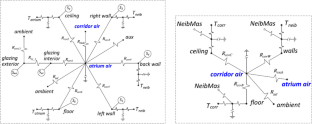
Appropriate thermal modeling is the first step in controlling thermal comfort and reducing energy consumption. In this article, the thermal modeling of an office room with a variable air volume (VAV) system is considered. Various thermal modeling methods are reviewed, and finally, the zonal method is selected. The main advantage of the selected method is its simple formulation but still accurate results. Furthermore, the output equations are in the state-space forms which are suitable for control applications. The thermal model is obtained by considering the airflow patterns in the office room. One of the key features of the obtained model is its applicability to winter as well as summer conditions. DesignBuilder software is also used to validate the thermal model. Results indicate the accuracy of the obtained thermal model in all weather conditions.
Abstract Image

Abstract Image

查看原文
分享 分享
微信好友 朋友圈 QQ好友 复制链接
本刊更多论文
采用分区法对带有变风量空调系统的办公环境进行热建模,以便于控制系统应用
适当的热建模是控制热舒适度和降低能耗的第一步。本文考虑了采用变风量(VAV)系统的办公房间的热建模问题。对各种热建模方法进行了综述,最后选择了分区法。所选方法的主要优点是表述简单,但结果仍然精确。此外,输出方程为状态空间形式,适合控制应用。热模型是通过考虑办公室内的气流模式获得的。所获模型的主要特点之一是适用于冬季和夏季条件。DesignBuilder 软件也用于验证热模型。结果表明,所获得的热模型在所有天气条件下都非常准确。
本文章由计算机程序翻译,如有差异,请以英文原文为准。
求助全文
约1分钟内获得全文 去求助
来源期刊
Energy Efficiency
Energy Efficiency ENERGY & FUELS-ENERGY & FUELS
CiteScore
5.80
自引率
6.50%
发文量
59
审稿时长
>12 weeks
期刊介绍: The journal Energy Efficiency covers wide-ranging aspects of energy efficiency in the residential, tertiary, industrial and transport sectors. Coverage includes a number of different topics and disciplines including energy efficiency policies at local, regional, national and international levels; long term impact of energy efficiency; technologies to improve energy efficiency; consumer behavior and the dynamics of consumption; socio-economic impacts of energy efficiency measures; energy efficiency as a virtual utility; transportation issues; building issues; energy management systems and energy services; energy planning and risk assessment; energy efficiency in developing countries and economies in transition; non-energy benefits of energy efficiency and opportunities for policy integration; energy education and training, and emerging technologies. See Aims and Scope for more details.
期刊最新文献
Creating green shared value: How energy-efficient technologies are transferred across borders through clean development mechanism and international cooperation Bridging the energy efficiency gaps: Lessons from the Swedish PFE programmes Effectiveness of emission reduction policies and the role of corporate governance Projections in hindsight for the building sector: understanding drivers for future policymaking Connectivity, diversity, and proximity: analysing information networks of professional actors for the diffusion of energy innovations
×
引用
GB/T 7714-2015
复制
MLA
复制
APA
复制
导出至
BibTeX EndNote RefMan NoteFirst NoteExpress
×
×
提示
您的信息不完整,为了账户安全,请先补充。
现在去补充
×
提示
您因"违规操作"
具体请查看互助需知
我知道了
×
提示
现在去查看 取消
×
提示
确定
0
微信
客服QQ
Book学术公众号 扫码关注我们
反馈
×
意见反馈
请填写您的意见或建议
请填写您的手机或邮箱
已复制链接
已复制链接
快去分享给好友吧!
我知道了
×
扫码分享
扫码分享
Book学术官方微信
Book学术文献互助
Book学术文献互助群
群 号:604180095
Book学术
文献互助 智能选刊 最新文献 互助须知 联系我们:info@booksci.cn
Book学术提供免费学术资源搜索服务,方便国内外学者检索中英文文献。致力于提供最便捷和优质的服务体验。
Copyright © 2023 Book学术 All rights reserved.
ghs 京公网安备 11010802042870号 京ICP备2023020795号-1