Michael Inskip, Carolina Almendrales Rangel, Chidiamara Maria Njoku, Fiona Barnett, Isabel Shih, Leonie O'Neill, Maria A Fiatarone Singh, Trinidad Valenzuela
{"title":"The Frailty Reduction via Implementation of Exercise, Nutrition, and Deprescribing (FRIEND) Trial: Study Protocol and Recruitment Results.","authors":"Michael Inskip, Carolina Almendrales Rangel, Chidiamara Maria Njoku, Fiona Barnett, Isabel Shih, Leonie O'Neill, Maria A Fiatarone Singh, Trinidad Valenzuela","doi":"10.3390/mps7020026","DOIUrl":null,"url":null,"abstract":"<p><strong>Introduction: </strong>Virtually all adults in aged care facilities are frail, a condition which contributes to falls, cognitive decline, hospitalisation, and mortality. Polypharmacy, malnutrition, sedentariness, and sarcopenia are risk factors amenable to intervention. The Asia-Pacific Frailty Management Guidelines recommend anabolic exercise and the optimisation of medications and nutrition. However, no study has evaluated this best practice intervention triad in aged care.</p><p><strong>Methods: </strong>The Frailty Reduction via the Implementation of Exercise, Nutrition, and Deprescribing (FRIEND) Trial (ANZCTR No.ACTRN12622000926730p) is a staged 6-month translational trial evaluating resident outcomes, staff/caregiver knowledge, and institutional implementation in a Townsville aged care facility. Residents received high-intensity resistance exercise and balance training and medication and nutrition optimisation co-implemented by investigators (exercise physiologist, geriatrician, pharmacist, and nutritionist) and facility staff. Staff and caregivers completed comprehensive education modules and training. We report the trial protocol and recruitment results.</p><p><strong>Results: </strong>29 residents (21 female, age: 88.6 ± 6.3 years) were recruited. At baseline, the residents were frail (frailty scale nursing home (FRAIL-NH); 6.3 ± 2.4/14), cognitively impaired (Montreal Cognitive Assessment; 13.8 ± 6.8/30), functionally impaired (Short Physical Performance Battery; 4.9 ± 3.1/12, 6 min walk distance; 222.2 ± 104.4 m), and were prescribed numerous medications (15.5 ± 5.9). Two residents died and one withdrew before the intervention's commencement. Thirty family members and 19 staff (carers, allied health assistants, nurse managers, registered nurses, lifestyle-leisure officers, kitchen/hospitality staff, and senior leadership) were recruited to receive frailty education modules.</p><p><strong>Conclusions: </strong>The FRIEND trial is currently being implemented with results expected in mid-2024. This is the first trial to evaluate the implementation of the best practice frailty guidelines including anabolic exercise and medication/nutritional optimisation in residential aged care.</p>","PeriodicalId":18715,"journal":{"name":"Methods and Protocols","volume":"7 2","pages":""},"PeriodicalIF":2.0000,"publicationDate":"2024-03-22","publicationTypes":"Journal Article","fieldsOfStudy":null,"isOpenAccess":false,"openAccessPdf":"https://www.ncbi.nlm.nih.gov/pmc/articles/PMC10961770/pdf/","citationCount":"0","resultStr":null,"platform":"Semanticscholar","paperid":null,"PeriodicalName":"Methods and Protocols","FirstCategoryId":"1085","ListUrlMain":"https://doi.org/10.3390/mps7020026","RegionNum":0,"RegionCategory":null,"ArticlePicture":[],"TitleCN":null,"AbstractTextCN":null,"PMCID":null,"EPubDate":"","PubModel":"","JCR":"Q3","JCRName":"BIOCHEMICAL RESEARCH METHODS","Score":null,"Total":0}
引用次数: 0
Abstract
Introduction: Virtually all adults in aged care facilities are frail, a condition which contributes to falls, cognitive decline, hospitalisation, and mortality. Polypharmacy, malnutrition, sedentariness, and sarcopenia are risk factors amenable to intervention. The Asia-Pacific Frailty Management Guidelines recommend anabolic exercise and the optimisation of medications and nutrition. However, no study has evaluated this best practice intervention triad in aged care.
Methods: The Frailty Reduction via the Implementation of Exercise, Nutrition, and Deprescribing (FRIEND) Trial (ANZCTR No.ACTRN12622000926730p) is a staged 6-month translational trial evaluating resident outcomes, staff/caregiver knowledge, and institutional implementation in a Townsville aged care facility. Residents received high-intensity resistance exercise and balance training and medication and nutrition optimisation co-implemented by investigators (exercise physiologist, geriatrician, pharmacist, and nutritionist) and facility staff. Staff and caregivers completed comprehensive education modules and training. We report the trial protocol and recruitment results.
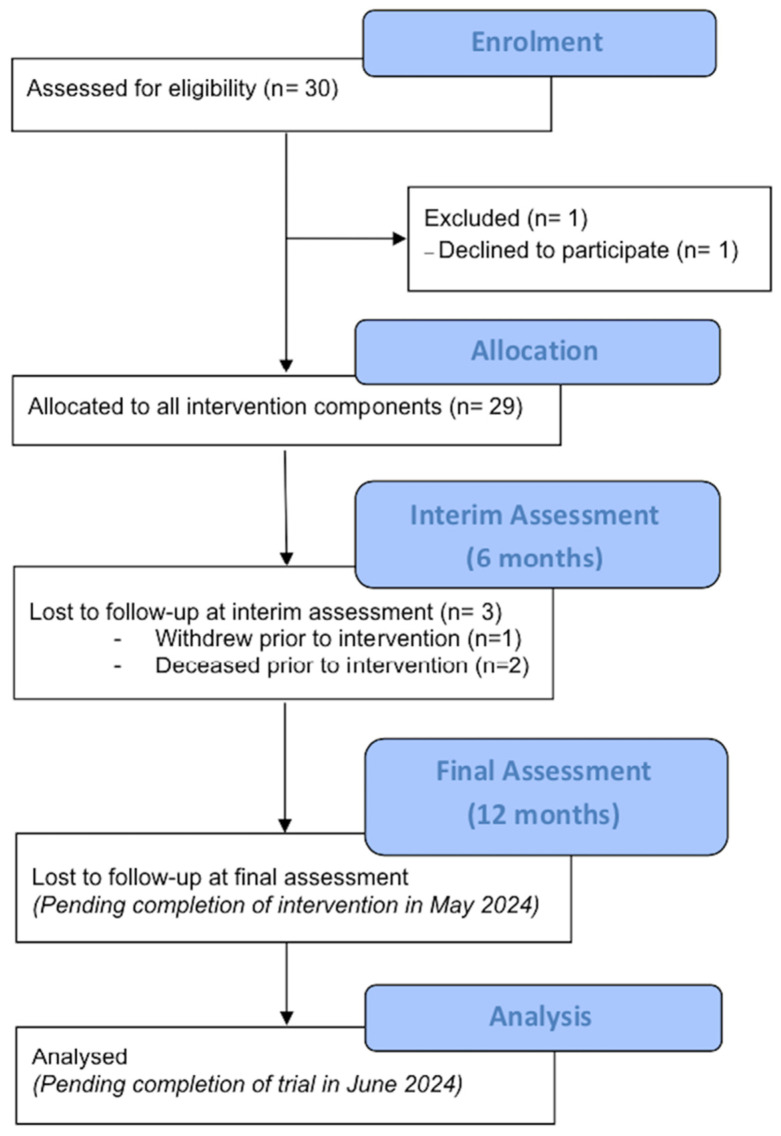
Results: 29 residents (21 female, age: 88.6 ± 6.3 years) were recruited. At baseline, the residents were frail (frailty scale nursing home (FRAIL-NH); 6.3 ± 2.4/14), cognitively impaired (Montreal Cognitive Assessment; 13.8 ± 6.8/30), functionally impaired (Short Physical Performance Battery; 4.9 ± 3.1/12, 6 min walk distance; 222.2 ± 104.4 m), and were prescribed numerous medications (15.5 ± 5.9). Two residents died and one withdrew before the intervention's commencement. Thirty family members and 19 staff (carers, allied health assistants, nurse managers, registered nurses, lifestyle-leisure officers, kitchen/hospitality staff, and senior leadership) were recruited to receive frailty education modules.
Conclusions: The FRIEND trial is currently being implemented with results expected in mid-2024. This is the first trial to evaluate the implementation of the best practice frailty guidelines including anabolic exercise and medication/nutritional optimisation in residential aged care.





 京公网安备 11010802042870号
京ICP备2023020795号-1
京公网安备 11010802042870号
京ICP备2023020795号-1

 分享
分享
 求助内容:
求助内容: 应助结果提醒方式:
 扫码关注我们
