C. L. V. Sivakumar, Varda Mone, Rakhmanov Abdumukhtor
{"title":"Addressing privacy concerns with wearable health monitoring technology","authors":"C. L. V. Sivakumar, Varda Mone, Rakhmanov Abdumukhtor","doi":"10.1002/widm.1535","DOIUrl":null,"url":null,"abstract":"The growing popularity of wearable health devices like fitness trackers and smartwatches enables continuous personal health monitoring but also raises significant privacy concerns due to the real-time collection of sensitive data. Many users are unaware of vulnerabilities that could lead to unauthorized access or discrimination if health information is revealed without consent. However, even informed users may willingly share data despite understanding privacy risks. The recent implementation of the General Data Protection Regulation (GDPR) in the EU and states taking initiatives to regulate privacy shows growing regulatory efforts to address these threats. This paper evaluates the key privacy threats posed specifically by consumer wearable devices. It provides a focused analysis of how health data could be exploited or shared without users' knowledge and the security flaws that enable such risks. Potential solutions including improving protections, empowering user control, enhancing transparency, and strengthening regulations are examined. However, it is argued that effective change requires balancing privacy risks with health benefits while also considering human decision-making behaviors. The paper concludes by proposing a multifaceted approach to enable informed choices about wearable health data.","PeriodicalId":501013,"journal":{"name":"WIREs Data Mining and Knowledge Discovery","volume":"150 1","pages":""},"PeriodicalIF":0.0000,"publicationDate":"2024-03-23","publicationTypes":"Journal Article","fieldsOfStudy":null,"isOpenAccess":false,"openAccessPdf":"","citationCount":"0","resultStr":null,"platform":"Semanticscholar","paperid":null,"PeriodicalName":"WIREs Data Mining and Knowledge Discovery","FirstCategoryId":"1085","ListUrlMain":"https://doi.org/10.1002/widm.1535","RegionNum":0,"RegionCategory":null,"ArticlePicture":[],"TitleCN":null,"AbstractTextCN":null,"PMCID":null,"EPubDate":"","PubModel":"","JCR":"","JCRName":"","Score":null,"Total":0}
引用次数: 0
Abstract
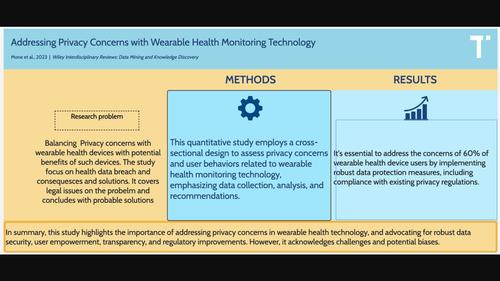
The growing popularity of wearable health devices like fitness trackers and smartwatches enables continuous personal health monitoring but also raises significant privacy concerns due to the real-time collection of sensitive data. Many users are unaware of vulnerabilities that could lead to unauthorized access or discrimination if health information is revealed without consent. However, even informed users may willingly share data despite understanding privacy risks. The recent implementation of the General Data Protection Regulation (GDPR) in the EU and states taking initiatives to regulate privacy shows growing regulatory efforts to address these threats. This paper evaluates the key privacy threats posed specifically by consumer wearable devices. It provides a focused analysis of how health data could be exploited or shared without users' knowledge and the security flaws that enable such risks. Potential solutions including improving protections, empowering user control, enhancing transparency, and strengthening regulations are examined. However, it is argued that effective change requires balancing privacy risks with health benefits while also considering human decision-making behaviors. The paper concludes by proposing a multifaceted approach to enable informed choices about wearable health data.



 京公网安备 11010802042870号
京ICP备2023020795号-1
京公网安备 11010802042870号
京ICP备2023020795号-1

 分享
分享

 求助内容:
求助内容: 应助结果提醒方式:
 扫码关注我们
