Sowmya S. Sundaram, Sairam Gurajada, Deepak Padmanabhan, Savitha Sam Abraham, Marco Fisichella
{"title":"Does a language model “understand” high school math? A survey of deep learning based word problem solvers","authors":"Sowmya S. Sundaram, Sairam Gurajada, Deepak Padmanabhan, Savitha Sam Abraham, Marco Fisichella","doi":"10.1002/widm.1534","DOIUrl":null,"url":null,"abstract":"From the latter half of the last decade, there has been a growing interest in developing algorithms for automatically solving mathematical word problems (MWP). It is a challenging and unique task that demands blending surface level text pattern recognition with mathematical reasoning. In spite of extensive research, we still have a lot to explore for building robust representations of elementary math word problems and effective solutions for the general task. In this paper, we critically examine the various models that have been developed for solving word problems, their pros and cons and the challenges ahead. In the last 2 years, a lot of deep learning models have recorded competing results on benchmark datasets, making a critical and conceptual analysis of literature highly useful at this juncture. We take a step back and analyze why, in spite of this abundance in scholarly interest, the predominantly used experiment and dataset designs continue to be a stumbling block. From the vantage point of having analyzed the literature closely, we also endeavor to provide a road-map for future math word problem research.","PeriodicalId":501013,"journal":{"name":"WIREs Data Mining and Knowledge Discovery","volume":"17 1","pages":""},"PeriodicalIF":0.0000,"publicationDate":"2024-03-24","publicationTypes":"Journal Article","fieldsOfStudy":null,"isOpenAccess":false,"openAccessPdf":"","citationCount":"0","resultStr":null,"platform":"Semanticscholar","paperid":null,"PeriodicalName":"WIREs Data Mining and Knowledge Discovery","FirstCategoryId":"1085","ListUrlMain":"https://doi.org/10.1002/widm.1534","RegionNum":0,"RegionCategory":null,"ArticlePicture":[],"TitleCN":null,"AbstractTextCN":null,"PMCID":null,"EPubDate":"","PubModel":"","JCR":"","JCRName":"","Score":null,"Total":0}
引用次数: 0
Abstract
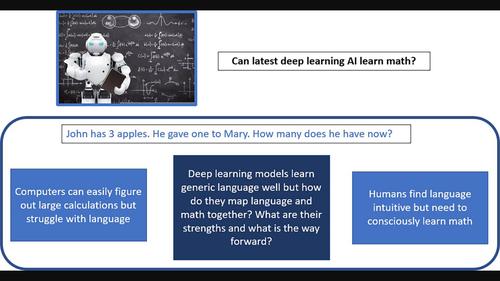
From the latter half of the last decade, there has been a growing interest in developing algorithms for automatically solving mathematical word problems (MWP). It is a challenging and unique task that demands blending surface level text pattern recognition with mathematical reasoning. In spite of extensive research, we still have a lot to explore for building robust representations of elementary math word problems and effective solutions for the general task. In this paper, we critically examine the various models that have been developed for solving word problems, their pros and cons and the challenges ahead. In the last 2 years, a lot of deep learning models have recorded competing results on benchmark datasets, making a critical and conceptual analysis of literature highly useful at this juncture. We take a step back and analyze why, in spite of this abundance in scholarly interest, the predominantly used experiment and dataset designs continue to be a stumbling block. From the vantage point of having analyzed the literature closely, we also endeavor to provide a road-map for future math word problem research.



 京公网安备 11010802042870号
京ICP备2023020795号-1
京公网安备 11010802042870号
京ICP备2023020795号-1

 分享
分享

 求助内容:
求助内容: 应助结果提醒方式:
 扫码关注我们
