Brendan A. Rich, Zohaib Jessani, Colleen M. Cummings, Nina S. Starin, Mary K. Alvord
{"title":"Targeting Self-Regulation to Reduce Internalizing Problems in Children: The Predictive Effect of Resilience","authors":"Brendan A. Rich, Zohaib Jessani, Colleen M. Cummings, Nina S. Starin, Mary K. Alvord","doi":"10.1007/s42844-024-00132-5","DOIUrl":null,"url":null,"abstract":"<div><p>The Resilience Builder Program® (RBP) is a cognitive-behavioral based group therapy for children with psychosocial deficits. Previous studies in children with varied diagnoses (attention deficit/hyperactivity disorder, anxiety disorders, and autism spectrum disorders) have provided evidence for its effectiveness in emotion regulation, positive emotions, social skills, and resilience. However, little is known about the mechanisms through which specific therapeutic components of the RBP may reduce internalizing problems in children. The current study examined pre- to post-therapy change in self-regulation, resilience, and internalizing problems, and investigated the therapeutic pathways of the RBP for reducing children’s internalizing problems by accounting for resilience improvement. Children (<i>N</i> = 244) between 7 to 15 years old with diverse diagnoses and heterogeneous symptoms who completed the RBP were assessed with parent-report measures of executive functioning, emotion regulation, resilience, and internalizing problems prior to and following the RBP. Results found that improvement in self-regulation and resilience predicted significant reductions in internalizing problems in children following the RBP. In addition, the change in resilience was found to be a significant predictor of the relationship between the change in self-regulation and internalizing problems. These findings clarify the therapeutic mechanisms of RBP, and more broadly speak to the value of targeting self-regulation and resilience as a means of reducing internalizing problems in youth receiving psychotherapeutic interventions.</p></div>","PeriodicalId":72113,"journal":{"name":"Adversity and resilience science","volume":"5 3","pages":"321 - 332"},"PeriodicalIF":2.9000,"publicationDate":"2024-03-13","publicationTypes":"Journal Article","fieldsOfStudy":null,"isOpenAccess":false,"openAccessPdf":"","citationCount":"0","resultStr":null,"platform":"Semanticscholar","paperid":null,"PeriodicalName":"Adversity and resilience science","FirstCategoryId":"1085","ListUrlMain":"https://link.springer.com/article/10.1007/s42844-024-00132-5","RegionNum":0,"RegionCategory":null,"ArticlePicture":[],"TitleCN":null,"AbstractTextCN":null,"PMCID":null,"EPubDate":"","PubModel":"","JCR":"","JCRName":"","Score":null,"Total":0}
引用次数: 0
Abstract
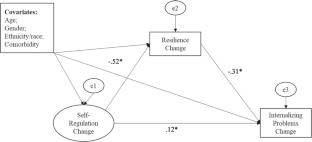
The Resilience Builder Program® (RBP) is a cognitive-behavioral based group therapy for children with psychosocial deficits. Previous studies in children with varied diagnoses (attention deficit/hyperactivity disorder, anxiety disorders, and autism spectrum disorders) have provided evidence for its effectiveness in emotion regulation, positive emotions, social skills, and resilience. However, little is known about the mechanisms through which specific therapeutic components of the RBP may reduce internalizing problems in children. The current study examined pre- to post-therapy change in self-regulation, resilience, and internalizing problems, and investigated the therapeutic pathways of the RBP for reducing children’s internalizing problems by accounting for resilience improvement. Children (N = 244) between 7 to 15 years old with diverse diagnoses and heterogeneous symptoms who completed the RBP were assessed with parent-report measures of executive functioning, emotion regulation, resilience, and internalizing problems prior to and following the RBP. Results found that improvement in self-regulation and resilience predicted significant reductions in internalizing problems in children following the RBP. In addition, the change in resilience was found to be a significant predictor of the relationship between the change in self-regulation and internalizing problems. These findings clarify the therapeutic mechanisms of RBP, and more broadly speak to the value of targeting self-regulation and resilience as a means of reducing internalizing problems in youth receiving psychotherapeutic interventions.




 京公网安备 11010802042870号
京ICP备2023020795号-1
京公网安备 11010802042870号
京ICP备2023020795号-1

 分享
分享

 求助内容:
求助内容: 应助结果提醒方式:
 扫码关注我们
