Soheil Saghafi, Timothy Rumbell, Viatcheslav Gurev, James Kozloski, Francesco Tamagnini, Kyle C A Wedgwood, Casey O Diekman
{"title":"Inferring Parameters of Pyramidal Neuron Excitability in Mouse Models of Alzheimer's Disease Using Biophysical Modeling and Deep Learning.","authors":"Soheil Saghafi, Timothy Rumbell, Viatcheslav Gurev, James Kozloski, Francesco Tamagnini, Kyle C A Wedgwood, Casey O Diekman","doi":"10.1007/s11538-024-01273-5","DOIUrl":null,"url":null,"abstract":"<p><p>Alzheimer's disease (AD) is believed to occur when abnormal amounts of the proteins amyloid beta and tau aggregate in the brain, resulting in a progressive loss of neuronal function. Hippocampal neurons in transgenic mice with amyloidopathy or tauopathy exhibit altered intrinsic excitability properties. We used deep hybrid modeling (DeepHM), a recently developed parameter inference technique that combines deep learning with biophysical modeling, to map experimental data recorded from hippocampal CA1 neurons in transgenic AD mice and age-matched wildtype littermate controls to the parameter space of a conductance-based CA1 model. Although mechanistic modeling and machine learning methods are by themselves powerful tools for approximating biological systems and making accurate predictions from data, when used in isolation these approaches suffer from distinct shortcomings: model and parameter uncertainty limit mechanistic modeling, whereas machine learning methods disregard the underlying biophysical mechanisms. DeepHM addresses these shortcomings by using conditional generative adversarial networks to provide an inverse mapping of data to mechanistic models that identifies the distributions of mechanistic modeling parameters coherent to the data. Here, we demonstrated that DeepHM accurately infers parameter distributions of the conductance-based model on several test cases using synthetic data generated with complex underlying parameter structures. We then used DeepHM to estimate parameter distributions corresponding to the experimental data and infer which ion channels are altered in the Alzheimer's mouse models compared to their wildtype controls at 12 and 24 months. We found that the conductances most disrupted by tauopathy, amyloidopathy, and aging are delayed rectifier potassium, transient sodium, and hyperpolarization-activated potassium, respectively.</p>","PeriodicalId":9372,"journal":{"name":"Bulletin of Mathematical Biology","volume":"86 5","pages":"46"},"PeriodicalIF":2.3000,"publicationDate":"2024-03-25","publicationTypes":"Journal Article","fieldsOfStudy":null,"isOpenAccess":false,"openAccessPdf":"https://www.ncbi.nlm.nih.gov/pmc/articles/PMC10963524/pdf/","citationCount":"0","resultStr":null,"platform":"Semanticscholar","paperid":null,"PeriodicalName":"Bulletin of Mathematical Biology","FirstCategoryId":"100","ListUrlMain":"https://doi.org/10.1007/s11538-024-01273-5","RegionNum":4,"RegionCategory":"数学","ArticlePicture":[],"TitleCN":null,"AbstractTextCN":null,"PMCID":null,"EPubDate":"","PubModel":"","JCR":"Q2","JCRName":"BIOLOGY","Score":null,"Total":0}
引用次数: 0
Abstract
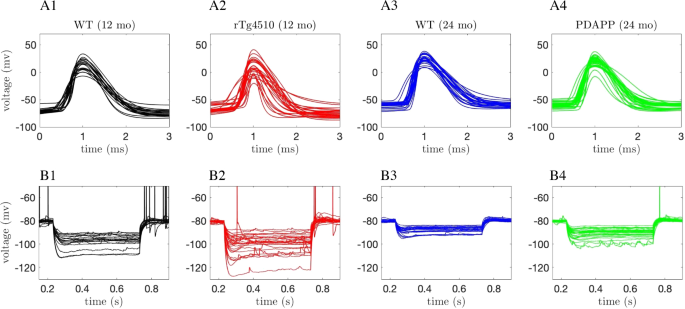
Alzheimer's disease (AD) is believed to occur when abnormal amounts of the proteins amyloid beta and tau aggregate in the brain, resulting in a progressive loss of neuronal function. Hippocampal neurons in transgenic mice with amyloidopathy or tauopathy exhibit altered intrinsic excitability properties. We used deep hybrid modeling (DeepHM), a recently developed parameter inference technique that combines deep learning with biophysical modeling, to map experimental data recorded from hippocampal CA1 neurons in transgenic AD mice and age-matched wildtype littermate controls to the parameter space of a conductance-based CA1 model. Although mechanistic modeling and machine learning methods are by themselves powerful tools for approximating biological systems and making accurate predictions from data, when used in isolation these approaches suffer from distinct shortcomings: model and parameter uncertainty limit mechanistic modeling, whereas machine learning methods disregard the underlying biophysical mechanisms. DeepHM addresses these shortcomings by using conditional generative adversarial networks to provide an inverse mapping of data to mechanistic models that identifies the distributions of mechanistic modeling parameters coherent to the data. Here, we demonstrated that DeepHM accurately infers parameter distributions of the conductance-based model on several test cases using synthetic data generated with complex underlying parameter structures. We then used DeepHM to estimate parameter distributions corresponding to the experimental data and infer which ion channels are altered in the Alzheimer's mouse models compared to their wildtype controls at 12 and 24 months. We found that the conductances most disrupted by tauopathy, amyloidopathy, and aging are delayed rectifier potassium, transient sodium, and hyperpolarization-activated potassium, respectively.
期刊介绍:
The Bulletin of Mathematical Biology, the official journal of the Society for Mathematical Biology, disseminates original research findings and other information relevant to the interface of biology and the mathematical sciences. Contributions should have relevance to both fields. In order to accommodate the broad scope of new developments, the journal accepts a variety of contributions, including:
Original research articles focused on new biological insights gained with the help of tools from the mathematical sciences or new mathematical tools and methods with demonstrated applicability to biological investigations
Research in mathematical biology education
Reviews
Commentaries
Perspectives, and contributions that discuss issues important to the profession
All contributions are peer-reviewed.




 京公网安备 11010802042870号
京ICP备2023020795号-1
京公网安备 11010802042870号
京ICP备2023020795号-1

 分享
分享
 求助内容:
求助内容: 应助结果提醒方式:
 扫码关注我们
