{"title":"DeepLabCut-based daily behavioural and posture analysis in a cricket.","authors":"Shota Hayakawa, Kosuke Kataoka, Masanobu Yamamoto, Toru Asahi, Takeshi Suzuki","doi":"10.1242/bio.060237","DOIUrl":null,"url":null,"abstract":"<p><p>Circadian rhythms are indispensable intrinsic programs that regulate the daily rhythmicity of physiological processes, such as feeding and sleep. The cricket has been employed as a model organism for understanding the neural mechanisms underlying circadian rhythms in insects. However, previous studies measuring rhythm-controlled behaviours only analysed locomotive activity using seesaw-type and infrared sensor-based actometers. Meanwhile, advances in deep learning techniques have made it possible to analyse animal behaviour and posture using software that is devoid of human bias and does not require physical tagging of individual animals. Here, we present a system that can simultaneously quantify multiple behaviours in individual crickets - such as locomotor activity, feeding, and sleep-like states - in the long-term, using DeepLabCut, a supervised machine learning-based software for body keypoints labelling. Our system successfully labelled the six body parts of a single cricket with a high level of confidence and produced reliable data showing the diurnal rhythms of multiple behaviours. Our system also enabled the estimation of sleep-like states by focusing on posture, instead of immobility time, which is a conventional parameter. We anticipate that this system will provide an opportunity for simultaneous and automatic prediction of cricket behaviour and posture, facilitating the study of circadian rhythms.</p>","PeriodicalId":9216,"journal":{"name":"Biology Open","volume":" ","pages":""},"PeriodicalIF":1.7000,"publicationDate":"2024-04-15","publicationTypes":"Journal Article","fieldsOfStudy":null,"isOpenAccess":false,"openAccessPdf":"https://www.ncbi.nlm.nih.gov/pmc/articles/PMC11070783/pdf/","citationCount":"0","resultStr":null,"platform":"Semanticscholar","paperid":null,"PeriodicalName":"Biology Open","FirstCategoryId":"99","ListUrlMain":"https://doi.org/10.1242/bio.060237","RegionNum":4,"RegionCategory":"生物学","ArticlePicture":[],"TitleCN":null,"AbstractTextCN":null,"PMCID":null,"EPubDate":"2024/4/23 0:00:00","PubModel":"Epub","JCR":"Q3","JCRName":"BIOLOGY","Score":null,"Total":0}
引用次数: 0
Abstract
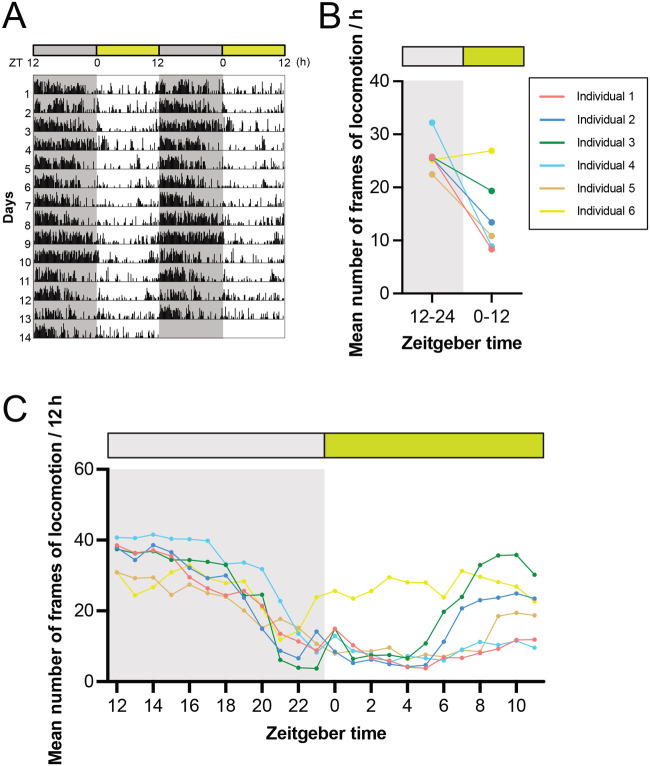
Circadian rhythms are indispensable intrinsic programs that regulate the daily rhythmicity of physiological processes, such as feeding and sleep. The cricket has been employed as a model organism for understanding the neural mechanisms underlying circadian rhythms in insects. However, previous studies measuring rhythm-controlled behaviours only analysed locomotive activity using seesaw-type and infrared sensor-based actometers. Meanwhile, advances in deep learning techniques have made it possible to analyse animal behaviour and posture using software that is devoid of human bias and does not require physical tagging of individual animals. Here, we present a system that can simultaneously quantify multiple behaviours in individual crickets - such as locomotor activity, feeding, and sleep-like states - in the long-term, using DeepLabCut, a supervised machine learning-based software for body keypoints labelling. Our system successfully labelled the six body parts of a single cricket with a high level of confidence and produced reliable data showing the diurnal rhythms of multiple behaviours. Our system also enabled the estimation of sleep-like states by focusing on posture, instead of immobility time, which is a conventional parameter. We anticipate that this system will provide an opportunity for simultaneous and automatic prediction of cricket behaviour and posture, facilitating the study of circadian rhythms.
期刊介绍:
Biology Open (BiO) is an online Open Access journal that publishes peer-reviewed original research across all aspects of the biological sciences. BiO aims to provide rapid publication for scientifically sound observations and valid conclusions, without a requirement for perceived impact.





 京公网安备 11010802042870号
京ICP备2023020795号-1
京公网安备 11010802042870号
京ICP备2023020795号-1

 分享
分享
 求助内容:
求助内容: 应助结果提醒方式:
 扫码关注我们
