Cezar Silvino Gomes, Diogo de Jesus Soares Freire, Hadassa de Souza Ramos Pontes Moura, Adriano Otávio Maldaner, Francisco Ayrton Senna Domingos Pinheiro, George Leandro Ramos Ferreira, Matheus Leopoldo de Oliveira Miranda, Leandro De Santis Ferreira, Felipe Gonçalves Murga, Fernando Fabriz Sodré, Cícero Flávio Soares Aragão
{"title":"Wastewater surveillance to assess cocaine and methylenedioxymethamphetamine use trends during a major music festival in Brazil","authors":"Cezar Silvino Gomes, Diogo de Jesus Soares Freire, Hadassa de Souza Ramos Pontes Moura, Adriano Otávio Maldaner, Francisco Ayrton Senna Domingos Pinheiro, George Leandro Ramos Ferreira, Matheus Leopoldo de Oliveira Miranda, Leandro De Santis Ferreira, Felipe Gonçalves Murga, Fernando Fabriz Sodré, Cícero Flávio Soares Aragão","doi":"10.1002/dta.3682","DOIUrl":null,"url":null,"abstract":"<p>This study employed the wastewater-based epidemiology (WBE) strategy to investigate cocaine (COC) and ecstasy (MDMA) usage during Carnatal festival in Rio Grande do Norte, Brazil. Wastewater samples were collected over the four festival days (December 12–15, 2019), as well as during corresponding days before and after the event. The samples underwent filtration, acidification, solid-phase extraction (SPE) for pre-concentration, and analysis using ultra-high-performance liquid chromatography–tandem mass spectrometry (UHPLC–MS/MS) with calibration using deuterated internal standards. The measured concentration ranges in the wastewater samples were as follows: benzoylecgonine (BE, a metabolite of COC use) ranged from 760 ± 30 to 8914 ± 252 ng/L, COC (non-metabolized or directly discharged) ranged from 1182 ± 25 to 6,760 ± 95 ng/L, cocaethylene (COE, a metabolite of alcohol-COC use) ranged from 21 ± 10 to 161 ± 10 ng/L, and MDMA (ecstasy) ranged from 18 ± 5 to 613 ± 15 ng/L. Daily wastewater loads were estimated as 0.81 ± 0.03 to 11.69 ± 0.33 g/day for BE, 1.42 ± 0.03 to 8.06 ± 0.11 g/day for COC, 0.02 ± 0.01 to 0.21 ± 0.01 g/day for COE, and 0.02 ± 0.01 to 0.80 ± 0.02 g/day for MDMA. Notably, COE and MDMA were only detected above the quantification limit during the festival days. The data enable estimating that COC consumption doubled during the event days. The COC/BE ratio indicated likely drug disposals on the event's last day and the subsequent week. The study's findings shed light on illicit substance consumption, assisting in public health programs and combating drug trafficking efforts.</p>","PeriodicalId":160,"journal":{"name":"Drug Testing and Analysis","volume":"17 1","pages":"88-100"},"PeriodicalIF":2.7000,"publicationDate":"2024-03-28","publicationTypes":"Journal Article","fieldsOfStudy":null,"isOpenAccess":false,"openAccessPdf":"","citationCount":"0","resultStr":null,"platform":"Semanticscholar","paperid":null,"PeriodicalName":"Drug Testing and Analysis","FirstCategoryId":"3","ListUrlMain":"https://analyticalsciencejournals.onlinelibrary.wiley.com/doi/10.1002/dta.3682","RegionNum":3,"RegionCategory":"医学","ArticlePicture":[],"TitleCN":null,"AbstractTextCN":null,"PMCID":null,"EPubDate":"","PubModel":"","JCR":"Q2","JCRName":"BIOCHEMICAL RESEARCH METHODS","Score":null,"Total":0}
引用次数: 0
Abstract
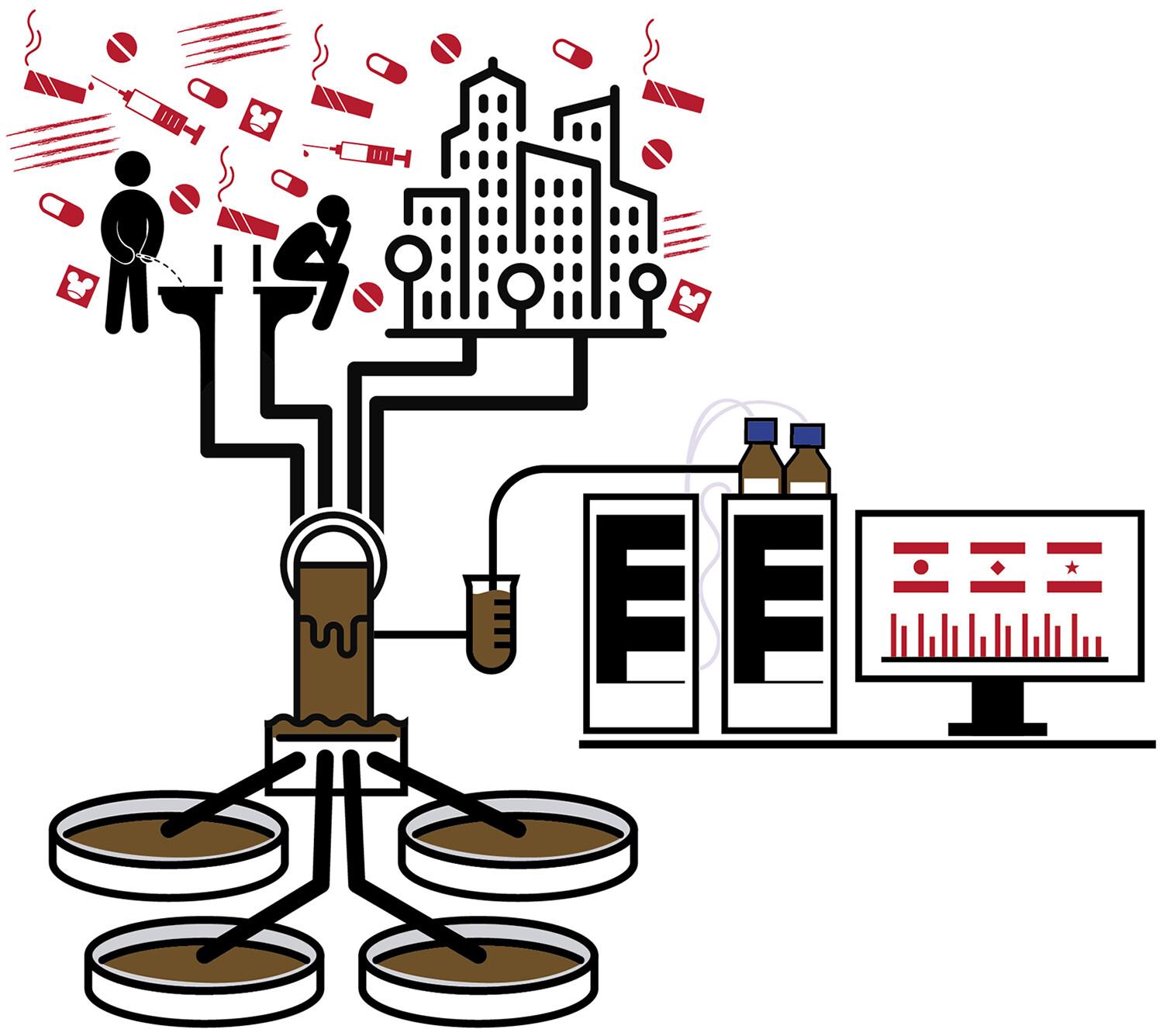
This study employed the wastewater-based epidemiology (WBE) strategy to investigate cocaine (COC) and ecstasy (MDMA) usage during Carnatal festival in Rio Grande do Norte, Brazil. Wastewater samples were collected over the four festival days (December 12–15, 2019), as well as during corresponding days before and after the event. The samples underwent filtration, acidification, solid-phase extraction (SPE) for pre-concentration, and analysis using ultra-high-performance liquid chromatography–tandem mass spectrometry (UHPLC–MS/MS) with calibration using deuterated internal standards. The measured concentration ranges in the wastewater samples were as follows: benzoylecgonine (BE, a metabolite of COC use) ranged from 760 ± 30 to 8914 ± 252 ng/L, COC (non-metabolized or directly discharged) ranged from 1182 ± 25 to 6,760 ± 95 ng/L, cocaethylene (COE, a metabolite of alcohol-COC use) ranged from 21 ± 10 to 161 ± 10 ng/L, and MDMA (ecstasy) ranged from 18 ± 5 to 613 ± 15 ng/L. Daily wastewater loads were estimated as 0.81 ± 0.03 to 11.69 ± 0.33 g/day for BE, 1.42 ± 0.03 to 8.06 ± 0.11 g/day for COC, 0.02 ± 0.01 to 0.21 ± 0.01 g/day for COE, and 0.02 ± 0.01 to 0.80 ± 0.02 g/day for MDMA. Notably, COE and MDMA were only detected above the quantification limit during the festival days. The data enable estimating that COC consumption doubled during the event days. The COC/BE ratio indicated likely drug disposals on the event's last day and the subsequent week. The study's findings shed light on illicit substance consumption, assisting in public health programs and combating drug trafficking efforts.
期刊介绍:
As the incidence of drugs escalates in 21st century living, their detection and analysis have become increasingly important. Sport, the workplace, crime investigation, homeland security, the pharmaceutical industry and the environment are just some of the high profile arenas in which analytical testing has provided an important investigative tool for uncovering the presence of extraneous substances.
In addition to the usual publishing fare of primary research articles, case reports and letters, Drug Testing and Analysis offers a unique combination of; ‘How to’ material such as ‘Tutorials’ and ‘Reviews’, Speculative pieces (‘Commentaries’ and ‘Perspectives'', providing a broader scientific and social context to the aspects of analytical testing), ‘Annual banned substance reviews’ (delivering a critical evaluation of the methods used in the characterization of established and newly outlawed compounds).
Rather than focus on the application of a single technique, Drug Testing and Analysis employs a unique multidisciplinary approach to the field of controversial compound determination. Papers discussing chromatography, mass spectrometry, immunological approaches, 1D/2D gel electrophoresis, to name just a few select methods, are welcomed where their application is related to any of the six key topics listed below.







 京公网安备 11010802042870号
京ICP备2023020795号-1
京公网安备 11010802042870号
京ICP备2023020795号-1

 分享
分享
 求助内容:
求助内容: 应助结果提醒方式:
 扫码关注我们
