Grace McIlvain, Emily M Magoon, Rebecca G Clements, Alexis Merritt, Lucy V Hiscox, Hillary Schwarb, Curtis L Johnson
{"title":"Acute effects of high-intensity exercise on brain mechanical properties and cognitive function.","authors":"Grace McIlvain, Emily M Magoon, Rebecca G Clements, Alexis Merritt, Lucy V Hiscox, Hillary Schwarb, Curtis L Johnson","doi":"10.1007/s11682-024-00873-y","DOIUrl":null,"url":null,"abstract":"<p><p>Previous studies have shown that engagement in even a single session of exercise can improve cognitive performance in the short term. However, the underlying physiological mechanisms contributing to this effect are still being studied. Recently, with improvements to advanced quantitative neuroimaging techniques, brain tissue mechanical properties can be sensitively and noninvasively measured with magnetic resonance elastography (MRE) and regional brain mechanical properties have been shown to reflect individual cognitive performance. Here we assess brain mechanical properties before and immediately after engagement in a high-intensity interval training (HIIT) regimen, as well as one-hour post-exercise. We find that immediately after exercise, subjects in the HIIT group had an average global brain stiffness decrease of 4.2% (p < 0.001), and an average brain damping ratio increase of 3.1% (p = 0.002). In contrast, control participants who did not engage in exercise showed no significant change over time in either stiffness or damping ratio. Changes in brain mechanical properties with exercise appeared to be regionally dependent, with the hippocampus decreasing in stiffness by 10.4%. We also found that one-hour after exercise, brain mechanical properties returned to initial baseline values. The magnitude of changes to brain mechanical properties also correlated with improvements in reaction time on executive control tasks (Eriksen Flanker and Stroop) with exercise. Understanding the neural changes that arise in response to exercise may inform potential mechanisms behind improvements to cognitive performance with acute exercise.</p>","PeriodicalId":9192,"journal":{"name":"Brain Imaging and Behavior","volume":" ","pages":"863-874"},"PeriodicalIF":2.4000,"publicationDate":"2024-08-01","publicationTypes":"Journal Article","fieldsOfStudy":null,"isOpenAccess":false,"openAccessPdf":"https://www.ncbi.nlm.nih.gov/pmc/articles/PMC11364612/pdf/","citationCount":"0","resultStr":null,"platform":"Semanticscholar","paperid":null,"PeriodicalName":"Brain Imaging and Behavior","FirstCategoryId":"3","ListUrlMain":"https://doi.org/10.1007/s11682-024-00873-y","RegionNum":3,"RegionCategory":"医学","ArticlePicture":[],"TitleCN":null,"AbstractTextCN":null,"PMCID":null,"EPubDate":"2024/3/28 0:00:00","PubModel":"Epub","JCR":"Q2","JCRName":"NEUROIMAGING","Score":null,"Total":0}
引用次数: 0
Abstract
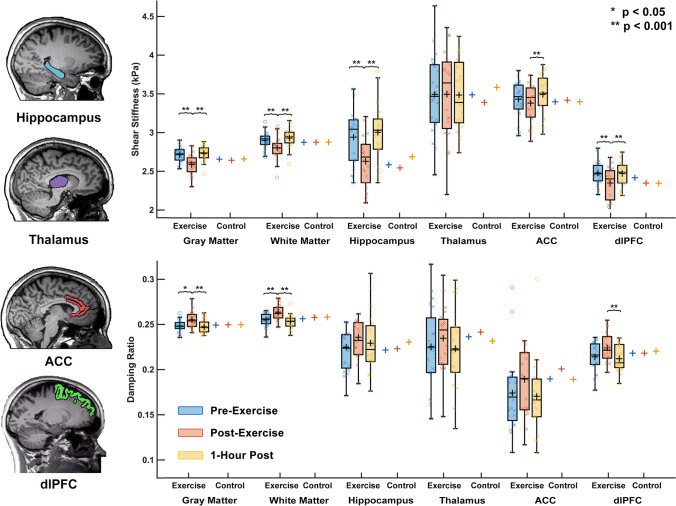
Previous studies have shown that engagement in even a single session of exercise can improve cognitive performance in the short term. However, the underlying physiological mechanisms contributing to this effect are still being studied. Recently, with improvements to advanced quantitative neuroimaging techniques, brain tissue mechanical properties can be sensitively and noninvasively measured with magnetic resonance elastography (MRE) and regional brain mechanical properties have been shown to reflect individual cognitive performance. Here we assess brain mechanical properties before and immediately after engagement in a high-intensity interval training (HIIT) regimen, as well as one-hour post-exercise. We find that immediately after exercise, subjects in the HIIT group had an average global brain stiffness decrease of 4.2% (p < 0.001), and an average brain damping ratio increase of 3.1% (p = 0.002). In contrast, control participants who did not engage in exercise showed no significant change over time in either stiffness or damping ratio. Changes in brain mechanical properties with exercise appeared to be regionally dependent, with the hippocampus decreasing in stiffness by 10.4%. We also found that one-hour after exercise, brain mechanical properties returned to initial baseline values. The magnitude of changes to brain mechanical properties also correlated with improvements in reaction time on executive control tasks (Eriksen Flanker and Stroop) with exercise. Understanding the neural changes that arise in response to exercise may inform potential mechanisms behind improvements to cognitive performance with acute exercise.
期刊介绍:
Brain Imaging and Behavior is a bi-monthly, peer-reviewed journal, that publishes clinically relevant research using neuroimaging approaches to enhance our understanding of disorders of higher brain function. The journal is targeted at clinicians and researchers in fields concerned with human brain-behavior relationships, such as neuropsychology, psychiatry, neurology, neurosurgery, rehabilitation, and cognitive neuroscience.





 京公网安备 11010802042870号
京ICP备2023020795号-1
京公网安备 11010802042870号
京ICP备2023020795号-1

 分享
分享
 求助内容:
求助内容: 应助结果提醒方式:
 扫码关注我们
